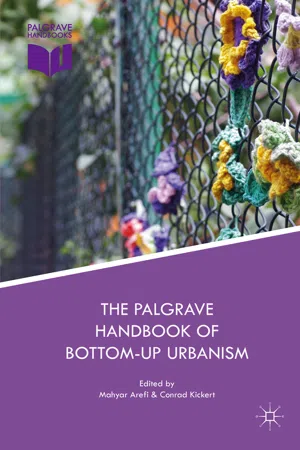
Who shapes our cities? In an age of increasing urban pluralism, globalization and immigration, decreasing public budgets, and an ongoing crisis of authority among designers and planners, the urban environment is shaped by a number of non-traditional stakeholders. The book surveys the kaleidoscope of views on the agency of urbanism, providing an overview of the various scholarly debates and territories that pertain to bottom-up efforts such as everyday urbanism, DIY urbanism, guerilla urbanism, tactical urbanism, and lean urbanism. Uniquely, this books seeks connections between the various movements by curating a range of views on the past, present, and future of bottom-up urbanism. The contributors also connect the recent trend of bottom-up efforts in the West with urban informality in the Global South, drawing parallels and finding contrast between social and institutional structures across the globe. The book appeals to urbanists in the widest sense of the word: those who shape, study, and improve our urban spaces.
eBook - ePub
The Palgrave Handbook of Bottom-Up Urbanism
- English
- ePUB (mobile friendly)
- Available on iOS & Android
eBook - ePub
The Palgrave Handbook of Bottom-Up Urbanism
About this book
Information
© The Author(s) 2019
Mahyar Arefi and Conrad Kickert (eds.)The Palgrave Handbook of Bottom-Up Urbanismhttps://doi.org/10.1007/978-3-319-90131-2_11. Introduction
Conrad Kickert1 and Mahyar Arefi2
(1)
School of Planning, University of Cincinnati, Cincinnati, OH, USA
(2)
Department of Planning and Landscape Architecture, University of Texas at Arlington, Arlington, USA
Conrad Kickert (Corresponding author)
Mahyar Arefi
This book delves into a question that has become increasingly prevalent over the past decade: Who shapes our cities? For over a century the answer to this question included a range of usual suspects, dependent on the global context. In the Modern era of the Global North, cities were usually shaped by governments, giving way over the decades to powerful private interests. The inflexibility of this order has prompted some of the most influential urban theorists of the twentieth century such as Jane Jacobs, Jan Gehl, and William Whyte to reappreciate individual agency in the Modern city, and Kevin Lynch to argue for a more democratic urban environment in which citizens can achieve a better ‘fit’ for their needs (Gehl 1987; Jacobs 1961; Lynch 1984; Whyte 1988). In the Global South cities have been shaped by a far more complex interplay of governmental and non-governmental organizations, politicians, and citizens. Conversely to the perhaps overly ordered environment of Western cities, informal cities in developing countries have often struggled to maintain a physical, social, and economic infrastructure for their populations, prompting concern among global organizations such as the United Nations and the World Health Organization. The status quo between Northern rigidity and Southern informality has increasingly been uprooted from the bottom up, shaking up global distinctions. This book explores the various new ways in which our urban environment is transformed by new stakeholders, challenging the public–private hegemony in Western countries, while bolstering a new urban order in the Global South.
This book expressly bridges current bottom-up theories and their implementations across the globe. First, it compares the main schools of thought on bottom-up and informal urbanism by introducing a dialogue between key thinkers in the field of urban planning, architecture, sociology, and anthropology. Rather than picking sides in the increasingly crowded landscape of urbanisms, this book surveys their differences and similarities. Furthermore, it compares and contrasts the bottom-up initiatives that fulfill the unmet desire for spontaneity and serendipity in the orderly city with the order and ordering of informality in the overwhelmed city. The new agency of bottom-up urbanism can complement and describe the urban condition across the globe. By connecting the intellectual positions of bottom-up urbanism and the geographical positions of informality, the book provides an unprecedentedly detailed and comprehensive perspective on agency in the contemporary global city.
New Urbanists and New Urbanisms?
The question of agency in cities is as old as their order itself. Commonly accepted as a manifestation of power, the ordering of urban environments has consistently reflected the relations between rulers and citizens. While famous for the order of the gridded castra, Romans were unable to keep their capital city from devolving into a notoriously overcrowded and unsanitary hotbed for dissent. When London burned down in the seventeenth century, institutional structures could not prevent citizens rebuilding to largely the same structure, despite visionary plans and legislative support. Efforts to structure the city were only successful in small doses, from Paris’ Place Royale to London’s Covent Garden, or on more or less virgin land, such as Rome’s restructuring under Pope Sixtus V and Amsterdam’s new canal districts in its Golden Age. An inner-urban leap in the scale of urban order involved new and largely undemocratic power structures, prompting Hausmann’s restructuring of Paris under Napoleon Bonaparte, and the construction of the Viennese Ringstrasse under Joseph II—arguably the onset of urban modernity (Abrahamse 2011; Berman 1980; Morris 1972; Mumford 1961). This shift prompted the first pushback among urban observers and scholars, such as Charles Baudelaire who described the lingering inequality behind Paris’ new spatial order (1869), or Camillo Sitte’s reappreciation of the bottom-up ‘artistic’ order of medieval squares as opposed to Vienna’s new technocratic urban order (Sitte 1889). Sitte was one of the first urban observers to discover the “organized complexity” behind the emergence, evolution, and functioning of the urban environment as a self-organizing process, anticipating the human and urban ecologies of Geddes (1915), Park and Burgess (1925), the urban manifestos of Jacobs (1961, 1969), the pattern language of Alexander et al. (1977), and Contextualists like Rowe and Koetter (1984: 128–129; Shane 2004).1 Meanwhile, the Structuralist movement that started in Europe in the 1960s acknowledged the different dynamics between individual, collective and institutional agency (e.g. Habraken and Teicher 2000). As Chapter 2 by Jeffrey Hou in this volume explains, bottom-up urbanism can almost read as a counter-narrative of our conventional history of Western urban development.
Urban agency has taken a decidedly different shape outside of Europe. In the fever of North American urbanization, the speculative forces that shaped the city commonly considered any spatial ordering beyond the perceived neutrality of the grid as a burden to progress. American urban planning has surprising roots as a bottom-up effort of urban beautification, originating in local art and civic societies, only later taking root as the Progressive start to professional city planning and urban reform (Peterson 1976; Talen 2015). While the urban grid arguably originates in prehistoric India and China, top-down urban order often has colonial underpinnings in the Global South, from the sixteenth-century Laws of the Indies imposed on many Central and South American cities (Morris 1972: 302–306), to Lutyen’s New Delhi (Hall 2002: 198–206; Ridley 1998), and Geddes’ designs for many other Indian cities (Tyrwhitt 1947). Even in the post-colonial era, many countries continued to look toward the West for urban order, with Le Corbusier, Gropius, and Wright inspiring or building projects in South America and the Middle East, followed by Doxiades and a slew of internationally active architecture–engineering conglomerates. Today, the renderings for new African, Middle Eastern, and Asian middle-class developments are frighteningly difficult to distinguish, as the Generic City is emerging across the globe (Koolhaas and Mau 1995; Murray 2017). Resistance has grown against these top-down or “top-up” visions of urban order, as explained in Chapter 17 by Nezar AlSayyad and Sujin Eom. By and large, these external orders have had relatively little impact on the overwhelmed cities in the Global South, as the majority of urban growth still happens outside formally designed global enclaves in the form of rapidly expanding informal settlements. Rather than responding to local or national authorities, most cities in Latin America, Africa, and Asia are shaped by a growing influx of individual agents responding to global forces of migration and opportunity (Burdett and Sudjic 2007). In the Global South, the formally designed and planned city is the counter-narrative against a domination of informal urban development.
Urban informality has become an increasingly salient topic in contemporary scholarly and professional debates on the city due to the fact that these counter-narratives have grown in importance. The division between formal development in the Global North and informal development in the Global South has started to blur. An increasing number of scholars—such as Margaret Crawford...
Table of contents
- Cover
- Front Matter
- 1. Introduction
- Part I. Agency Versus Authority
- Part II. Informalizing the Formal
- Part III. Formalizing the Informal
- Part IV. Theory Versus Practice
- Back Matter
Trusted by 375,005 students
Access to over 1.5 million titles for a fair monthly price.
Study more efficiently using our study tools.
Frequently asked questions
Yes, you can cancel anytime from the Subscription tab in your account settings on the Perlego website. Your subscription will stay active until the end of your current billing period. Learn how to cancel your subscription
No, books cannot be downloaded as external files, such as PDFs, for use outside of Perlego. However, you can download books within the Perlego app for offline reading on mobile or tablet. Learn how to download books offline
Perlego offers two plans: Essential and Complete
- Essential is ideal for learners and professionals who enjoy exploring a wide range of subjects. Access the Essential Library with 800,000+ trusted titles and best-sellers across business, personal growth, and the humanities. Includes unlimited reading time and Standard Read Aloud voice.
- Complete: Perfect for advanced learners and researchers needing full, unrestricted access. Unlock 1.5M+ books across hundreds of subjects, including academic and specialized titles. The Complete Plan also includes advanced features like Premium Read Aloud and Research Assistant.
We are an online textbook subscription service, where you can get access to an entire online library for less than the price of a single book per month. With over 1.5 million books across 990+ topics, we’ve got you covered! Learn about our mission
Look out for the read-aloud symbol on your next book to see if you can listen to it. The read-aloud tool reads text aloud for you, highlighting the text as it is being read. You can pause it, speed it up and slow it down. Learn more about Read Aloud
Yes! You can use the Perlego app on both iOS and Android devices to read anytime, anywhere — even offline. Perfect for commutes or when you’re on the go.
Please note we cannot support devices running on iOS 13 and Android 7 or earlier. Learn more about using the app
Please note we cannot support devices running on iOS 13 and Android 7 or earlier. Learn more about using the app
Yes, you can access The Palgrave Handbook of Bottom-Up Urbanism by Mahyar Arefi, Conrad Kickert, Mahyar Arefi,Conrad Kickert in PDF and/or ePUB format, as well as other popular books in Social Sciences & Urban Planning & Landscaping. We have over 1.5 million books available in our catalogue for you to explore.