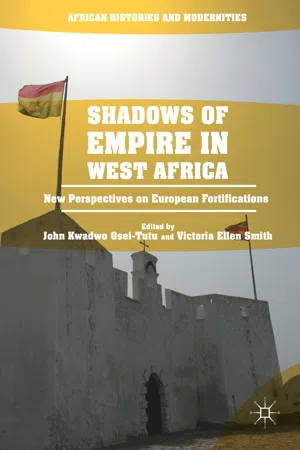
These essays reexamine European forts in West Africa as hubs where different peoples interacted, negotiated and transformed each other socially, politically, culturally, and economically. This collection brings together scholars of history, archaeology, cultural studies, and others to present a nuanced image of fortifications, showing that over time the functions and impacts of the buildings changed as the motives, missions, allegiances, and power dynamics in the region also changed. Focusing on the fortifications of Ghana, the authors discuss how these structures may be interpreted as connecting Ghanaian and West African histories to a multitude of global histories. They also enable greater understanding of the fortifications' contemporary use as heritage sites, where the Afro-European experience is narrated through guided tours and museums.
John Kwadwo Osei-Tutu and Victoria Ellen Smith (eds.)Shadows of Empire in West AfricaAfrican Histories and Modernitieshttps://doi.org/10.1007/978-3-319-39282-0_1
Begin Abstract
1. Introduction: Interpreting West Africa’s Forts and Castles
John Kwadwo Osei-Tutu1 and Victoria Ellen Smith2
(1)
Department of Historical Studies, Norwegian University of Science and Technology, Trondheim, Norway
(2)
Department of History, University of Ghana, Legon, Ghana
John Kwadwo Osei-Tutu (Corresponding author)
Victoria Ellen Smith
End Abstract
Fortresses are a universal phenomenon: they dominated the landscapes and societies of civilisations and empires such as Mesopotamia, Assyria, Egypt, China, Greece; Rome, and became ubiquitous features of European spaces from the Middle Ages.1 As old as they may be, some of these buildings have endured the tides of time and the vagaries of the weather, becoming the inheritances of contemporary societies that often had nothing to do with their construction. Paul Erdmann Isert, a German surgeon and naturalist who worked for the Danish establishment at Christiansborg Castle on the Gold Coast (now Ghana) in the 1780s, observed that a fortress is not like a mushroom that springs up and withers overnight.2 The enduring architectural relics of European activity and interactions with the societies in West Africa support Isert’s truism. From 1445 to the 1870s, trading companies of core European nations introduced congeries of European-type fortification systems to West Africa, where these buildings became essential geo-strategic tools of inter-European commercial competition, components in the intricate networks of the Atlantic Basin trade and instruments of enslavement and colonisation.
As pioneers of the European-African trade, the Portuguese were the first to build fortified trading stations or factories (feitoria) in Africa. They built their first fort on Mauritania’s Arguin Island in 1445 and followed up with a string of forts at important trading points along the West African coastline, including the infamous São Jorge da Mina—now known as Ghana’s Elmina Castle—in 1482.3 Over a period of four centuries, fortified trading stations grew in number and purpose as the respective chartered companies of Holland, Sweden, Denmark-Norway, Brandenburg and England (later, the UK) embarked on coastal fortification projects comprising a string of castle-like structures, sparsely defended lodges and small secondary forts that served as company outposts.4
Questions remain regarding how many fortified and non-fortified structures the competing European companies erected in West Africa. Figures based on the physical evidence in the form of structural remnants do not give a complete picture of the numbers built over the years, as they do not account for those that have disappeared entirely: plundered for building materials, eaten up by the Atlantic Ocean or simply left to crumble and turn into dust. Through long and painstaking research into the archives of the various trading companies, some scholars have, however, provided estimates of their numbers. A. W. Lawrence lists forty-three extant principal fortified trading stations in West Africa from Arguin Island to Ouidah, with the majority—thirty-two, to be precise—located in Ghana.5 Other sources list between forty-eight and sixty fortified edifices in Ghana alone, comprising large structures—commonly designated as castles—medium-sized forts and trading lodges (see Fig. 1.1).6 The apparent quantitative discrepancies in the literature are somewhat bridgeable through further research; and an increased scholarly and popular interest is now bringing more knowledge to light.
Currently, what is clear from attempts to quantify fortresses in West Africa is that the Gold Coast had the largest concentration of European fortresses in the non-European world. Ghana’s 500-kilometre-long coastline was so densely built upon in certain areas that many of the fortresses are in close proximity and rivalling trading companies stood side by side.7 This concentration of European fortified trading posts underscores the important historical position of the Gold Coast as a site of intense activity within the Atlantic economic and social systems from the fifteenth to the nineteenth centuries.
As the largest stone structures on the West African coast, the fortresses functioned as claims of authority, defensive installations, trading markets, warehouses, accommodation and administrative centres.8 Their primary military purpose was to safeguard the commercial monopolies of resident European trading companies within negotiated geographical spheres under the jurisdictions of friendly African potentates. The designs, positioning, weaponry and garrisoning accentuated their defensive roles in the context of the European overseas competition. Though each of the buildings was unique in design, all of them shared the same basic features. Their individual uniqueness comes out through differences ranging in design from rectangular and triangular to concentric and star shaped.9 Overwhelmingly, they were littoral and placed strategically on rocky promontories with the Atlantic forming a natural exterior protection to one side. The landward façades were oriented towards the neighbouring settlements of established African territories, with the reach of European guns and cannons dictating the parameters of defence. Some, like Arguin Fort and Gorée Fort, were built on islands and were relatively secure from inland attacks. Fewer still were located on inland waterways, like the Portuguese Fort Duma erected on the bank of Ghana’s Ankobra River in 1623.
The fortresses varied in structure, but generally they featured curtain walls; massive battlements made of imported material and indigenous raw materials such as limestone and granite; watchtowers; central courtyards; and gun slits (referred to as ‘peep holes’ by tour guides) through which the garrison soldiers could shoot at enemies approaching from sea or land. Some, like Elmina Castle, had adjoining moats and were reachable by drawbridges. Certainly, these replicas of medieval and early modern European fortifications must have looked discordantly humongous within West Africa’s contemporary fifteenth and sixteenth century vernacular architectural settings. Depending on the size and strength of their battlements, some were capable of carrying canons ranging from four pounders to twenty-four pounders and of withstanding the ricochet of firing such weaponry. The smaller poundage were generally trained inland to ward off African enemies who were probably seen as a lesser threat, whilst the larger poundage were poised to intimidate and potentially destroy the approaching ships of belligerent European competitors. Today, remnants of the forts and castles appear to be losing a centuries-long war of attrition meted out by an unwavering ‘enemy’: the forces of nature, particularly the mighty waves of the Atlantic Ocean, which bombard mud and stone foundations with their unceasing saltwater artillery. It will require massive inflows of expensive technology and masonry to save the remnants; otherwise, in the next 50 years, only a handful will remain.10
Some scholars have suggested that there were European states that embarked on the practice of building fortifications overseas partly to dominate territories.11 However, our research indicates that claims of fortresses functioning as bases for territorial domination before the late nineteenth century are tenuous, if not impossible to substantiate. More realistically, during the period of commerce, the positioning of these fortified trading warehouses enabled the representatives of European nations to achieve exclusive political, defensive and commercial alliances with African sovereigns from whom they leased the land on which they built. As a result, Europeans—such as the British, Dutch and Danish on the Gold Coast (now Ghana) —established a permanent presence in West Africa. Over the years, some European traders and company agents also gained political influence in African affairs as a result of their mediatory role in local disputes (either by invitation or intimidation), which led to some Europeans defining the territories in which they were located as protectorates. It was not until the late nineteenth century—when the British became the dominant power on the Gold Coast and adopted Christiansborg Castle as headquarters for the newly formed Gold Coast Colony and as residence for its Governor—that history tells of Europeans translating their informal interventions to territorial jurisdictions.12
Beyond their defensive role, the buildings were primarily used as trading centres, complete with storerooms for goods and prisons for holding Africans as captives prior to their transportation to the Americas during the trans-Atlantic slave trade . Above all, the larger fortresses such as Elmina Castle, Cape Coast Castle and Christiansborg Castle served as administrative headquarters for their respective national companies, residences for the principal trading agents, barracks for soldiers and sites for diplomatic negotiations. Each company kept smaller (out-) forts as posts where commodities and enslaved Africans were kept until their departure through the major forts or exit ports.
Prior to the late nineteenth century, ownership of many of the fortresses changed, some several times, through purchase and legal appropriation by rival European companies, as well as through forced seizure by Europeans and expanding Akan imperial states.13 New European owners often adjusted the original designs of the buildings to suit their...
Table of contents
Cover
Frontmatter
1. Introduction: Interpreting West Africa’s Forts and Castles
2. Grossfriedrichsburg, the First German Colony in Africa? Brandenburg-Prussia, Atlantic Entanglements and National Memory
3. ‘Far from My Native Land, and Far from You’: Reimagining the British at Cape Coast Castle in the Nineteenth Century
4. Viewed from a Distance: Eighteenth-Century Images of Fortifications on the Coast of West Africa
5. Illusions of Grandeur and Protection: Perceptions and (Mis)Representations of the Defensive Efficacy of European-Built Fortifications on the Gold Coast, Seventeenth–Early Nineteenth Centuries
6. Female Agency in a Cultural Confluence: Women, Trade and Politics in Seventeenth- and Eighteenth-Century Gold Coast
7. Fort Metal Cross: Commercial Epicentre of the British on the Gold Coast
8. European Fortifications in West Africa as Architectural Containers and Oppressive Contraptions
9. A Theatre of Memory for the Trans-Atlantic Slave Trade: Cape Coast Castle and Its Museum
10. Diplomacy, Identity and Appropriation of the “Door of no Return”. President Barack Obama and Family in Ghana and the Cape Coast Castle, 2009
11. Recreating Pre-colonial Forts and Castles: Heritage Policies and Restoration Practices in the Gold Coast/Ghana, 1945 to 1970s
Backmatter
Trusted by 375,005 students
Access to over 1.5 million titles for a fair monthly price.
Study more efficiently using our study tools.
Frequently asked questions
Yes, you can cancel anytime from the Subscription tab in your account settings on the Perlego website. Your subscription will stay active until the end of your current billing period. Learn how to cancel your subscription
No, books cannot be downloaded as external files, such as PDFs, for use outside of Perlego. However, you can download books within the Perlego app for offline reading on mobile or tablet. Learn how to download books offline
Perlego offers two plans: Essential and Complete
Essential is ideal for learners and professionals who enjoy exploring a wide range of subjects. Access the Essential Library with 800,000+ trusted titles and best-sellers across business, personal growth, and the humanities. Includes unlimited reading time and Standard Read Aloud voice.
Complete: Perfect for advanced learners and researchers needing full, unrestricted access. Unlock 1.5M+ books across hundreds of subjects, including academic and specialized titles. The Complete Plan also includes advanced features like Premium Read Aloud and Research Assistant.
Both plans are available with monthly, semester, or annual billing cycles.
We are an online textbook subscription service, where you can get access to an entire online library for less than the price of a single book per month. With over 1.5 million books across 990+ topics, we’ve got you covered! Learn about our mission
Look out for the read-aloud symbol on your next book to see if you can listen to it. The read-aloud tool reads text aloud for you, highlighting the text as it is being read. You can pause it, speed it up and slow it down. Learn more about Read Aloud
Yes! You can use the Perlego app on both iOS and Android devices to read anytime, anywhere — even offline. Perfect for commutes or when you’re on the go. Please note we cannot support devices running on iOS 13 and Android 7 or earlier. Learn more about using the app
Yes, you can access Shadows of Empire in West Africa by John Kwadwo Osei-Tutu, Victoria Ellen Smith, John Kwadwo Osei-Tutu,Victoria Ellen Smith in PDF and/or ePUB format, as well as other popular books in History & African History. We have over 1.5 million books available in our catalogue for you to explore.