Candidates, Parties and Voters in the Belgian Partitocracy
eBook - ePub

Candidates, Parties and Voters in the Belgian Partitocracy

  1. English
  2. ePUB (mobile friendly)
  3. Available on iOS & Android
eBook - ePub

About this book

Analyses the variations of Belgian candidates' political and socio-demographic background, campaign behaviour towards voters and parties, and policy views
Digs into the triadic delegation and accountability relationship between candidates, voters, and parties
Is based on rich data from the Belgian Candidate Survey 2014

Trusted by 375,005 students

Access to over 1.5 million titles for a fair monthly price.

Study more efficiently using our study tools.

Information

Year
2018
Print ISBN
9783319964591
eBook ISBN
9783319964607
© The Editor(s) (if applicable) and The Author(s), under exclusive license to Springer Nature Switzerland AG 2019
Audrey Vandeleene, Lieven De Winter and Pierre Baudewyns (eds.)Candidates, Parties and Voters in the Belgian Partitocracyhttps://doi.org/10.1007/978-3-319-96460-7_1
Begin Abstract

1. Introduction: Candidates Between Parties and Voters—A Triadic Relationship in the Belgian Partitocracy

Audrey Vandeleene1 and Lieven De Winter2
(1)
Lund University, Lund, Sweden
(2)
Université catholique de Louvain, Louvain-la-Neuve, Belgium
Audrey Vandeleene (Corresponding author)
Lieven De Winter
Electronic supplementary material The online version of this chapter (https://​doi.​org/​10.​1007/​978-3-319-96460-7_​1) contains supplementary material, which is available to authorized users.
End Abstract

Introduction

Electoral research in the US context has long studied candidates whereas in Western European research, the focus has traditionally been rather on parties as agents of representation. However, since a few decades, some European scholars have been taking into account the role of candidates in responsible party government systems of representation, first regarding the impact of electoral leaders on voters’ choices (the presidentialisation thesis), but later also with respect to the role of lower profile candidates and the incentives and consequences of their search for personal votes . Together with elected MPs, candidates are central in the process of representation as they act as direct intermediary between constituency voters, parties, parliaments and governments . They are also central in electoral campaigns, linking citizens and the state in democratic electoral systems in which mainstream parties seem to lose some of their attractiveness.
The main focus of this book is candidates as key actors, and the triadic relationship between the electoral candidates and the two other poles of the delegation and accountability triangle, i.e. the parties and the voters. Investigating the Belgian partitocracy, the book provides a thick case study of a highly relevant country to investigate the role of political parties and their candidates. We rely on a rich database of about 2000 candidates running for the May 2014 regional and federal elections in Belgium.
This introductory chapter highlights the general relevance of the study of electoral candidates in representative democracies. It presents the book’s theoretical framework, i.e. the triadic delegation and accountability relationship between candidates, voters and parties based on principal–agent theory , one of the most common frameworks for grasping the representation process in Western democracies. The chapter theoretically maps patterns of candidates’ behaviour and attitudes in all main dimensions of their activities with the particular electoral, multilevel and partitocratic context of the Belgian polity. This introduction presents a common framework for all book’s chapters and simultaneously establishes the state of the art of empirical studies on candidates—on the basis of surveys in particular but from other perspectives as well, such as media or party documents-based works. After that, we investigate what are the specificities of candidates operating in the Belgian federal and regional arenas . The scientific relevance of researching candidates in Belgium indeed arises from the particularities of its institutional, electoral and party systems that allow for various comparisons with other Western democracies. The chapter ends with a brief account of the content of all book’s chapters.

Theoretical Framework of the Book

The Triadic Relationship

The book’s main theoretical framework is centred on the delegation and accountability relationship between candidates, voters and parties based on principal–agent theory (PAT, or “agency theory”). This is one of the most common frameworks used to analyse various representation processes in Western democracies (Strøm et al. 2003b). It has served for identifying problems of representation (such as “agency loss ”, i.e. the difference between what the voter wants and what the MP delivers) and institutional mechanisms that may constrain these “perils of delegation” (Lupia 2003).
In studies of elections and representation, the principal–agent model is often applied as a heuristic tool that helps to identify the key actors of the process of representation, but this model is also useful for understanding and explaining the real-life politics of delegation between the “ultimate” principal (the voters) and their “immediate” agents in the delegation chain: the candidates and their parties. 1
First, what do we mean by this principal–agent model, or this model of delegation and accountability? Delegation is an act whereby one person or group, called the principal (i.e. those authorised to make political decisions), conditionally designates another person or group, called the agent , to act on the principal’s behalf, in their name and pursuing the principal’s preferences (Lupia 2003, 35). In a democracy, the basic normative assumption is that the population, the citizens, are the “ultimate principal”, and that policymakers should do what the citizens want them to do. In contemporary large-scale democracies, popular sovereignty is exercised through delegation from citizens to individual politicians (their elected representatives) and collective actors, here in particular political parties. Citizens engage in a delegation process as this allows them to accomplish desired ends, good governance, with reduced personal cost and effort. In fact, citizens are not always capable of making all (or most) necessary decisions. Their capacity is limited by a variety of resource constraints, such as lack of time, competence, expertise and/or information (Strøm 2003, 57–58). They thus need principals to act on their behalf. However, delegation may encounter various “perils”. Given that delegation entails a transfer of power, agents may abuse the power they receive (Lupia 2003, 53) and pursue their own preferences. That is most commonly called “agency loss ”. The main cause for agency loss is “information asymmetries”, i.e. when the political agent (candidate, party) knows more than his principal (his voters). Agency problems under incomplete information may take the form of hidden information (principals do not fully know the competencies or preferences of their agents) and give rise to “adverse selection” when the principal ignores the agent’s willingness as well as her capacity to pursue the principal’s interests. Hence, principals may select the “wrong” agents, who do not have the most appropriate skills or preferences. It can also lead to hidden action (when principals cannot fully observe the actions of their agents).
The perils of delegation can be facilitated but also alleviated by a variety of factors, in particular by institutional arrangements that affect the provision of information to political principals as ex ante or ex post mechanisms (Bergman et al. 2003), as distinguished by formal theorists. A principal may use ex ante mechanisms (screening, selection and contract design) to sort out good agents from bad ones, before (ex ante) a contract is made, typically when she can select from a group of competing individuals (i.e. candidates and their parties) the one she prefers to act as her agent. Competitive elections (including competitive campaigns) constitute the most crucial screening and selection device that voters can use to avoid adverse selection. Before Election Day, political parties might select the best possible agents (the candidates chosen during candidate selection processes) and on Election Day, voters decide on their preferred agents. The candidates as agents have the time of the campaign to convince, first, parties, and then voters that they are reliable agents.
In order to deal with hidden action, principals may use ex post mechanisms to learn about an agent’s actions after the fact, by directly monitoring the agent on the spot, listening to what the agent reports back about his activities, or by attending to “third party” testimony about agent actions. The most basic control mechanism of representative democracy is elections, which can be used both to select agents in the first place and to subject them to sanctions, mostly by “deselection” by “throwing the rascals out” in the next election (Bergman et al. 2003, 110). Voters use elections both prospectively (to select new representatives) and retrospectively (to sanction incumbent MPs). But parties may also do the same by not selecting a candidate on an eligible position on the list, which will prevent this candidate from becoming an MP (again).
Based on the discussion above, it is clear that the key actor of this book, the parliamentary candidate, is a type of agent that may have multiple principals. From the perspective of agency theory on parliamentary democracy, it is obvious that voters must be considered as principals, in fact as the ultimate principal at the very beginning of the chain of delegation from voters to MPs, Cabinet Ministers and their civil servants (Strøm 2000).
It is also clear that after the election, non-elected candidates are not agents in a strict sense as no power is transferred. Hence, we can presume that there are basic delegation differences between successful and non-successful candidates. Yet we can stretch principal–agent assumptions to include non-successful candidates, as there are sufficient similarities between both types of agents.
First, we argue that not only the elected MPs, but that also the unfortunate non-elected candidates are key actors in the delegation process. At each election, numerous citizens cast a “wasted vote”. This is particularly true for single-member district (SMD) plurality systems. For instance, at the UK general elections of 2010, more than half (52.8%) of the votes were cast for candidates that did not get into the Palace of Westminster. 2 But also in (semi-)open PR list systems like Belgium, many votes are wasted, 3 in spite of the fact that a preference vote for a non-elected candidate still counts as a party vote used to calculate the number of seats of the party (unless the party does not reach the ...
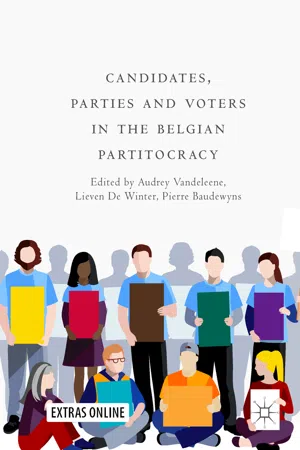
Table of contents

  1. Cover
  2. Front Matter
  3. 1. Introduction: Candidates Between Parties and Voters—A Triadic Relationship in the Belgian Partitocracy
  4. Part I. Candidates’ Background
  5. Part II. Campaigning
  6. Part III. Policy Congruence
  7. Part IV. Representation and Democracy
  8. Back Matter

Frequently asked questions

Yes, you can cancel anytime from the Subscription tab in your account settings on the Perlego website. Your subscription will stay active until the end of your current billing period. Learn how to cancel your subscription
No, books cannot be downloaded as external files, such as PDFs, for use outside of Perlego. However, you can download books within the Perlego app for offline reading on mobile or tablet. Learn how to download books offline
Perlego offers two plans: Essential and Complete
  • Essential is ideal for learners and professionals who enjoy exploring a wide range of subjects. Access the Essential Library with 800,000+ trusted titles and best-sellers across business, personal growth, and the humanities. Includes unlimited reading time and Standard Read Aloud voice.
  • Complete: Perfect for advanced learners and researchers needing full, unrestricted access. Unlock 1.5M+ books across hundreds of subjects, including academic and specialized titles. The Complete Plan also includes advanced features like Premium Read Aloud and Research Assistant.
Both plans are available with monthly, semester, or annual billing cycles.
We are an online textbook subscription service, where you can get access to an entire online library for less than the price of a single book per month. With over 1.5 million books across 990+ topics, we’ve got you covered! Learn about our mission
Look out for the read-aloud symbol on your next book to see if you can listen to it. The read-aloud tool reads text aloud for you, highlighting the text as it is being read. You can pause it, speed it up and slow it down. Learn more about Read Aloud
Yes! You can use the Perlego app on both iOS and Android devices to read anytime, anywhere — even offline. Perfect for commutes or when you’re on the go.
Please note we cannot support devices running on iOS 13 and Android 7 or earlier. Learn more about using the app
Yes, you can access Candidates, Parties and Voters in the Belgian Partitocracy by Audrey Vandeleene, Lieven De Winter, Pierre Baudewyns, Audrey Vandeleene,Lieven De Winter,Pierre Baudewyns in PDF and/or ePUB format, as well as other popular books in Politics & International Relations & European Politics. We have over 1.5 million books available in our catalogue for you to explore.