eBook - ePub
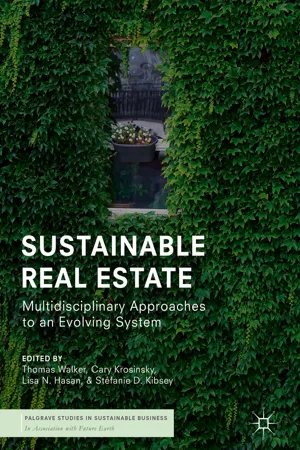
Sustainable Real Estate
Multidisciplinary Approaches to an Evolving System
- English
- ePUB (mobile friendly)
- Available on iOS & Android
eBook - ePub
Sustainable Real Estate
Multidisciplinary Approaches to an Evolving System
About this book
Information
© The Author(s) 2019
T. Walker et al. (eds.)Sustainable Real EstatePalgrave Studies in Sustainable Business In Association with Future Earthhttps://doi.org/10.1007/978-3-319-94565-1_11. Introduction
Lisa N. Hasan1
(1)
David O’Brien Centre for Sustainable Enterprise, John Molson School of Business, Concordia University, Montreal, QC, Canada
This phase of rapid product introduction to an increasingly receptive market has provided the real estate sector with a wide range of solutions. In contrast to the industrial and transportation sectors, the majority of the technologies required to meet resource conservation targets set for the real estate sector are already commercially available and cost effective (IEA, 2013, p. 9). However, this flurry of activity has also created a culture of experimentation, where there is little consensus as to basic definitions and best practices, and capacity building often lags behind innovation implementation. The segmented and conflicting nature of current policies, practices and incentives currently impedes the widespread adoption of the technological and procedural innovations required to meet these ambitious goals (IEA, 2013; UNEP, 2016).
Fortunately, the market is showing signs of maturing. The motivation for engaging in sustainable initiatives is shifting from an idealistic desire to “do the right thing” to a recognition of the business opportunities associated with sustainable practices (McGraw-Hill Construction, 2013). As an increasingly wide spectrum of stakeholders become involved in sustainability around the globe, there is a growing recognition of the need for a shared understanding, common benchmarks and a more holistic approach to sustainability in the real estate sector.
Despite this high-level consensus, achieving a truly sustainable global real estate sector is no small task. Staying abreast of all the changes and their implications is a challenge made all the more daunting by the fact that they have occurred in parallel with the evolution of the definition of sustainability itself. Early reports on sustainable development expressed the need to strike a balance between economic growth and resource conservation (United Nations Conference on the Human Environment, 1972; World Commission on Environment and Development, 1987; United Nations, 1987). These general recommendations evolved into the comprehensive 17 global sustainable development goals and associated targets described in the United Nation’s 2030 Agenda for Sustainable Development (UN General Assembly, 2015). This latest framework for understanding sustainable development has profound implications for the real estate industry. It pushes the boundaries of sustainability further beyond the building’s walls to include responsible resource production and consumption as well as a range of social issues associated with housing and energy affordability, health and well-being, global urbanization and even climate change.
Achieving the sustainable development targets set out by the UN and refined by local governments will require a concerted effort on the part of all stakeholders working together across traditional disciplinary, geographic and political boundaries. The traditional project lifecycle will also need to be redefined in order to involve more stakeholders in preplanning, post-occupancy and even demolition and redevelopment phases. Implementing piecemeal solutions will not be sufficient to reach the targets set by the Paris Agreement1, nor to overcome many of the obstacles to the global adoption and implementation of sustainability measures. Integrated solutions, greater information transparency and the continued development of globally adopted but locally adapted, standards, benchmarks and best practices will shape the future of sustainable real estate practice.
By collecting the latest insights in a single volume, this book aims to provide readers from all disciplines with a better appreciation of sustainable real estate as a grand system and shed some light on its past, present and future evolutions. We begin by examining the role that real estate can play in addressing climate change (Chap. 2). Next, we explore real estate’s new role in building and supporting sustainable and resilient communities (Chap. 3). This broad, forward-looking context provides a backdrop to the subsequent chapters that discuss current public-sector regulatory trends (Chap. 4) and the European Union’s policy framework in particular (Chap. 5).
Market-driven approaches are then discussed, including critical reviews of green building labeling systems (Chap. 6) and global real estate sustainability benchmarking (Chap. 7). These methods for assessing and comparing sustainability levels are followed by more focused discussions on the business case for green buildings for owner-operators (Chap. 8) and the value of sustainability as an organizational effectiveness tool for real estate management companies (Chap. 9).
Chapters 10–12 discuss methods for delivering affordable, reliable and sustainable energy to real estate projects. This topic is approached from both a design standpoint, through a discussion of building energy simulation for sustainable and resilient buildings (Chap. 10), and a finance perspective, exploring the challenges and solutions driving investment in high-performance buildings (Chap. 11). Chapter 12 covers the specific case of financing rooftop solar for single-family rental properties.
The final portion of the book brings us back to the topic of real estate’s role in building and supporting sustainable cities and communities. This section provides case studies from around the globe and shows how multiple stakeholders, under various regulatory and market conditions, have come together to address a number of sustainable real estate issues. A case for sustainable affordable housing in the US (Chap. 13) and an overview of affordable Passive House projects in Nova Scotia (Chap. 14) provide insights into the North American housing market. Investing in Community Sporting Facilities (Chap. 15) outlines a new financing model that is being implemented in Australia to fund social communal infrastructures. Chapter 16 discusses the specificities of sustainable real estate in the Middle East and Chap. 17 provides an overview of sustainable community development in Nigeria.
In sum, the continued success of the sustainable real estate industry hinges on, not only continued technological innovation but also greater integration and awareness of agreed upon best practices. This can only be achieved if a broader spectrum of stakeholders is able to work across traditional disciplinary boundaries at all phases of the real estate development’s lifecycle. The next wave of innovation in sustainable development will assuredly be less technology driven and more focused on creating structures conducive to the development, implementation and monitoring of sustainable solutions in real estate. We hope that this book will ...
Table of contents
- Cover
- Front Matter
- 1. Introduction
- 2. The Relevance of Real Estate in Solving Climate Change
- 3. Evolutions in Sustainability and Sustainable Real Estate
- Part I. Regulatory Approaches
- Part II. Market-Driven Approaches
- Part III. Delivering Affordable, Reliable, Sustainable Energy
- Part IV. Sustainable Cities and Communities
- Back Matter
Trusted by 375,005 students
Access to over 1.5 million titles for a fair monthly price.
Study more efficiently using our study tools.
Frequently asked questions
Yes, you can cancel anytime from the Subscription tab in your account settings on the Perlego website. Your subscription will stay active until the end of your current billing period. Learn how to cancel your subscription
No, books cannot be downloaded as external files, such as PDFs, for use outside of Perlego. However, you can download books within the Perlego app for offline reading on mobile or tablet. Learn how to download books offline
Perlego offers two plans: Essential and Complete
- Essential is ideal for learners and professionals who enjoy exploring a wide range of subjects. Access the Essential Library with 800,000+ trusted titles and best-sellers across business, personal growth, and the humanities. Includes unlimited reading time and Standard Read Aloud voice.
- Complete: Perfect for advanced learners and researchers needing full, unrestricted access. Unlock 1.5M+ books across hundreds of subjects, including academic and specialized titles. The Complete Plan also includes advanced features like Premium Read Aloud and Research Assistant.
We are an online textbook subscription service, where you can get access to an entire online library for less than the price of a single book per month. With over 1.5 million books across 990+ topics, we’ve got you covered! Learn about our mission
Look out for the read-aloud symbol on your next book to see if you can listen to it. The read-aloud tool reads text aloud for you, highlighting the text as it is being read. You can pause it, speed it up and slow it down. Learn more about Read Aloud
Yes! You can use the Perlego app on both iOS and Android devices to read anytime, anywhere — even offline. Perfect for commutes or when you’re on the go.
Please note we cannot support devices running on iOS 13 and Android 7 or earlier. Learn more about using the app
Please note we cannot support devices running on iOS 13 and Android 7 or earlier. Learn more about using the app
Yes, you can access Sustainable Real Estate by Thomas Walker, Cary Krosinsky, Lisa N. Hasan, Stéfanie D. Kibsey, Thomas Walker,Cary Krosinsky,Lisa N. Hasan,Stéfanie D. Kibsey in PDF and/or ePUB format, as well as other popular books in Economics & Energy Industry. We have over 1.5 million books available in our catalogue for you to explore.