- English
- ePUB (mobile friendly)
- Available on iOS & Android
eBook - ePub
Politics and Aesthetics of the Female Form, 1908-1918
About this book
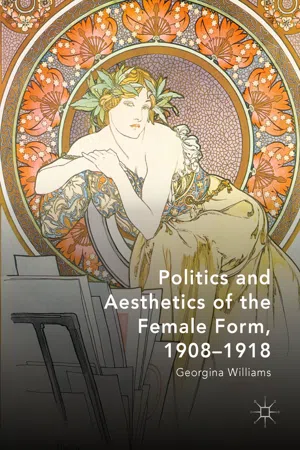
This book examines the pictorial representation of women in Great Britain both before and during the First World War. It focuses in particular on imagery related to suffrage movements, recruitment campaigns connected to the war, advertising, and Modernist art movements including Vorticism. This investigation not only considers the image as a whole, but also assesses tropes and constructs as objects contained within, both literal and metaphorical. In this way visual genealogical threads including the female figure as an ideal and William Hogarth's 'line of beauty' are explored, and their legacies assessed and followed through into the twenty-first century. Georgina Williams contributes to debates surrounding the deliberate and inadvertent dismissal of women's roles throughout history, through literature and imagery. This book also considers how absence of a pictorial manifestation of the female form in visual culture can be as important as her presence.
Information
© The Author(s) 2018
Georgina WilliamsPolitics and Aesthetics of the Female Form, 1908-1918https://doi.org/10.1007/978-3-319-75729-2_11. Introduction: Women in the Frame
At the beginning of the twentieth century , ‘a first generation of educated women sought to correct an historical record that had left them out’. 1 Although often a complicated association, the ties connecting women with modernity nonetheless served to empower them into understanding their position within the changing cultural landscape. 2 Politics and Aesthetics of the Female Form, 1908–1918, examines how the pictorial representation of women in Great Britain during this decade contributes to this positioning, including the ways in which women pictorially represented themselves. Historical periods and events are uniquely exposed through the artwork of the era; by considering visual constructs and pictorial tropes as mechanisms by which certain artworks can be analysed, alternative perspectives are provoked and previously considered explanations and analyses re-evaluated. This book is an art-historical work, with the objective of demonstrating cultural and political impact on contemporary perceptions with regard to imagery of the female form.
Studies within the field of visual culture ‘provide the possibility of unframing some of the discussions we have been engaged in regarding presences and absences, invisibility and stereotypes , desires, reifications and objectifications from the disciplinary fields… which first articulated their status as texts and objects’. 3 Conversations around the art-historical as a method of cultural examination exposes points of view related not only to the artwork as an object, but also to the elemental objects contained within each image . Artworks can be expressive of personal, public, or political narrative, 4 but that is not to say the creation and utilisation of art to dispute previously held suppositions is risk-free; female artists have always fought exclusion, confronting ‘limited options, public anger and professional scorn’ alongside ‘condemnation and censorship ’. 5 Nevertheless, female artists have consistently opted for ‘audacious action over safe acceptance’, enticing risk in pursuing ‘political expression’, seeking ‘provocative subjects’ and, importantly, ‘giving a voice to the voiceless’. 6 When this is expanded, a clear dichotomy can be seen between woman as artist and woman as subject, even when the latter role is facilitated by other women. It is this considered pictorial representation of women that forms the basis of this book as a means by which this era of history can be supplementally explored.
Around the turn of the twentieth century , ‘the arguments in art criticism and art history’ in respect of female artists ‘centred around two critical questions: what are the qualities of women artists’ work … and what is the relationship of women’s work to contemporary concepts of femininity?’ 7 Although the quality of women’s artwork during the prescribed era has some bearing on the aims and objectives of this exploration, of more import is what it was women wanted portrayed and how this may or may not differ from the actuality of their pictorial representation. This is pertinent because during the decade that forms the temporal context of this book many women were fighting both for and against a “feminine” perception, in the sense that in certain circumstances women’s femininity was often used to undermine them. One principal example of this is the opposition women encountered in their fight for equality and which occurred both textually and pictorially. This aspect runs parallel to an exploitation of women’s femininity, including in advertising and in imagery employed by the State during the First World War . These dual perspectives are explored throughout, taking into account decisions the women concerned needed to make regarding what they could use to their advantage, and what aspects, when they had control over the situation, they selected to specifically fight against. In respect of suffrage movements, art historian Lisa Tickner believes the related imagery was ‘Too “artistic” for the interests of political history’ and ‘too political (and too ephemeral) for the history of art’, 8 an observation that can equally be applied to pictorial posters , postcards , pamphlets and banners associated with other propagandist campaigns, including those connected to the First World War . This pictorial archive has not particularly featured even in documented histories specific to pictorial propaganda, nor in those of women working as artists and designers, 9 but is an omission that continues to be productively addressed as this combined genre of art history and visual culture, alongside gender studies, forms a crucial part of contemporary enquiry.
More focused attention on gender studies and comprehensive analyses of feminist theory are areas debated more purposefully elsewhere, however, and do not form the central premise of this book. The emphasis of this particular exploration lies with the pictorial, and the highlighted images are selected specifically to meet the prescribed objectives. Nevertheless, the concern is not just with the more usual analysis pertaining to each image as an object, nor does this investigation centre solely on the genealogy of just one visual trope contained within that image. This book explores and focuses on combinations from within each of these areas and investigates their subsequent formation into a unique whole, acknowledging both commonalities and contrasts between certain representations of women during this decade. Tickner writes of the Artists’ Suffrage League founded in 1907, and the Suffrage Atelier founded in 1909, and their ambition to produce ‘representations… in the sense of actual images and pictures’. 10 However,
images in this sense cannot be separated from images in the sense of mental representations, and concepts that may be put into words rather than pictures. All images are traversed by language, and images are also “texts” in which codes are operative and meanings are produced. 11
This conjecture, which incorporates the ideas pertaining to a ‘huge stock of images stored in the memory’, 12 is relevant to this book in two respects: firstly, the idea of ‘mental representations’ relating to a whole, and secondly a more abstract consideration in the form of a sign or symbol; both are aspects explored more fully in this and later chapters. Although this examination does not concentrate on elements contained within an image in a way that might construe it as a work dedicated to semiotics, French philosopher Jean Baudrillard ’s concept of a ‘visible continuum’ 13 could be...
Table of contents
- Cover
- Front Matter
- 1. Introduction: Women in the Frame
- 2. The Reshaping of Society and the Rise of the Avant-Gardes
- 3. Inside and Outside the Frame: The Female Figure as Subject and Artist
- 4. The Politics of Aesthetics and the Woman Question
- 5. From Presence to Absence: Exploiting Female Sexuality in Visual Culture
- 6. A Visual Genealogy: Tracing the Threads as Nodes Within a Network
- 7. Women in the Frame: To Be Concluded
- Back Matter
Trusted by 375,005 students
Access to over 1.5 million titles for a fair monthly price.
Study more efficiently using our study tools.
Frequently asked questions
Yes, you can cancel anytime from the Subscription tab in your account settings on the Perlego website. Your subscription will stay active until the end of your current billing period. Learn how to cancel your subscription
No, books cannot be downloaded as external files, such as PDFs, for use outside of Perlego. However, you can download books within the Perlego app for offline reading on mobile or tablet. Learn how to download books offline
Perlego offers two plans: Essential and Complete
- Essential is ideal for learners and professionals who enjoy exploring a wide range of subjects. Access the Essential Library with 800,000+ trusted titles and best-sellers across business, personal growth, and the humanities. Includes unlimited reading time and Standard Read Aloud voice.
- Complete: Perfect for advanced learners and researchers needing full, unrestricted access. Unlock 1.5M+ books across hundreds of subjects, including academic and specialized titles. The Complete Plan also includes advanced features like Premium Read Aloud and Research Assistant.
We are an online textbook subscription service, where you can get access to an entire online library for less than the price of a single book per month. With over 1.5 million books across 990+ topics, we’ve got you covered! Learn about our mission
Look out for the read-aloud symbol on your next book to see if you can listen to it. The read-aloud tool reads text aloud for you, highlighting the text as it is being read. You can pause it, speed it up and slow it down. Learn more about Read Aloud
Yes! You can use the Perlego app on both iOS and Android devices to read anytime, anywhere — even offline. Perfect for commutes or when you’re on the go.
Please note we cannot support devices running on iOS 13 and Android 7 or earlier. Learn more about using the app
Please note we cannot support devices running on iOS 13 and Android 7 or earlier. Learn more about using the app
Yes, you can access Politics and Aesthetics of the Female Form, 1908-1918 by Georgina Williams in PDF and/or ePUB format, as well as other popular books in History & British History. We have over 1.5 million books available in our catalogue for you to explore.