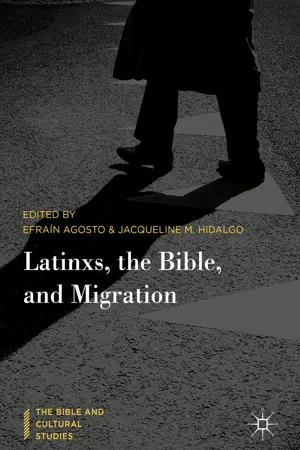
This book examines the conjunction between migration and biblical texts with a focus on Latinx histories and experiences. Essays reflect upon Latinxs, the Bible, and migration in different ways: some consider how the Bible is used in the midst of, or in response to, Latinx experiences and histories of migration; some use Latinx histories and experiences of migration to examine Biblical texts in both First and Second Testaments; some consider the "Bible" as a phenomenological set of texts that respond to and/or compel migration. Cultural, literary, and postcolonial theories inform the analysis, as does the exploration of how migrant groups themselves scripturalize their biblical and cultural texts.
eBook - ePub
Latinxs, the Bible, and Migration
- English
- ePUB (mobile friendly)
- Available on iOS & Android
eBook - ePub
Latinxs, the Bible, and Migration
About this book
Information
Topic
Theology & ReligionSubtopic
Biblical Studies© The Author(s) 2018
Efraín Agosto and Jacqueline M. Hidalgo (eds.)Latinxs, the Bible, and MigrationThe Bible and Cultural Studieshttps://doi.org/10.1007/978-3-319-96695-3_11. Introduction: Reading the Bible and Latinx Migrations/the Bible as Text(s) of Migration
Efraín Agosto1 and Jacqueline M. Hidalgo2
(1)
New York Theological Seminary, New York, NY, USA
(2)
Williams College, Williamstown, MA, USA
This book represents several years of reflection and writing on this inexorable fact: Migration remains a topic of political controversy and subaltern urgency in the United States of 2018. We currently reside under a president who launched his campaign by attacking Mexican migrants, and extending that attack to encompass migrants from all Latin America and the Middle East.1 On the day we submitted this introduction, US President Donald J. Trump stated that the United States was deporting immigrants who “aren’t people. These are animals.”2 We share these comments to underscore the dehumanizing perceptions that migrants encounter and live with daily. Although it can be easy to vilify only Trump or only the United States, antagonism to migrants has been a global problem even as migration—impelled by war, politics, economics, and human-caused climate change—has increased dramatically. The chapters in this volume do not strictly grapple with our contemporary migration crises; rather we consider the Christian Bible as a space of migrant urgency.3 Fundamentally, we read with migrant humanity, alongside migrant perspectives, and for the humanization of migrants in broader discourse.
The focus of this collection then is not on those whose acts of domination continue to push migrants to risk their lives in the Arizona desert or the Mediterranean Sea. Rather, this collection plays with and around the Bible with a focus on those persons—historical and contemporary—who have undertaken migration as well as their descendants living in a land that is no longer quite the land of their ancestors. We have drawn together some Latinx biblical critics who reconsider the Bible and the people who read it through the lens of migration, exile, and diaspora with a focus on migrants and the children of migrants.
Who Is Latinx? Why Migration?
In order to frame this collection of chapters, a brief clarification of terms is required.
“Migration” is the broad term for what Jean-Pierre Ruiz has called “people on the move.”4 It has been much in the news lately, along with the term “immigration,” because of a variety of complex issues. For example, war and strife in Syria has compelled migrations across the region, migrations which have been chronicled in the news, including with stirring visual images of thousands of refugees risking their lives across the Mediterranean Sea and other crossings, fleeing war, and violence. As one report put it, “The Syrian war has displaced millions who are desperately seeking an existence free from barrel bombs and chemical weapons. Others travel thousands of miles over land and water to escape poverty and authoritarian governments.”5 These forced migrations from Syria are not the only tragedies, of course; the flight and plight of Rohingya Muslims from Myanmar after military violence against them comes to mind, along with all too many other examples of people forced to move because of a range of injustices.6
In the United States, “immigration” across the Southwestern border has occupied the attention of the current presidential administration in the most harmful of ways. Most recently, an order from US Attorney General Jeff Sessions has called for arrests of families attempting to cross into the United States including the separation of children from their parents. Even though border crossings have decreased in recent years, the anti-immigration rhetoric of the current US president and his supporters unduly demonizes the efforts of families from Central America in particular to escape difficult circumstances. In fact, before the actions of the Trump administration, US policy has been to support migrant refugees from both Syria and Central America, as a broader strategy to bring a measure of stability to these regions and in particular those affected refugees who have “hit the road” to save their lives and those of their families.7
Indeed, even before the current Trump administration and its “build the wall” mentality, similar proposals and other “draconian measures” were being proposed in Congress, state houses, and local governments across the country.8 For example, one of the failures of the pre-Trump era Congress was to pass legislation to protect young immigrants that came here as children, brought by their parents, who lacked proper documentation. These so-called Dreamers, the narrative about them insists, were “American” in every sense of the term, but could be deported without such protections. President Barack Obama enacted executive orders to protect them, which, of course, have since been rescinded by his successor. Still, Congress, despite various promises and attempts, has been unable to enact legislation to permanently protect the Dreamers, and, except for court orders, they stand in limbo.9 In short, migration and immigration are issues of vital import and impact, especially in our contemporary political moment in the United States. Given the complexities of political weight that different terms carry, we have chosen to employ the terms “migrant” and “migration” because we understand migration as a universal human activity irrespective of the definitions wielded by particular modern nation-states or ancient regimes. The term “migrant” allows us to think globally and in historically comparative ways, putting Puerto Rican histories in conversation with Mexican ones, African Americans alongside Cubans, and all of them alongside ancient communities.
This volume focuses on the import and impact of the migration of different Latinx populations.10 The very term “Latinx” itself is contested in meaning and usage, coming out of a fraught history in terms of US politics and naming practices, and we have let each author broadly choose their own approach to this term.11 Whatever its fraught history, the term is generally taken to encapsulate people who trace their descent to territories conquered by Iberia—Spain and Portugal—in the Americas during early modernity. This term includes ethnic Mexicans who lived in Texas before it was part of the United States as well as Brazilians. The oft-used government term “Hispanic” includes people from Spain and the Philippines, who are not included in the understanding of “Latinx” in this volume. Others might argue for an even more expansive sense of Latinx (see, for example, the critical questions Margaret Aymer raises in the conclusion to this volume), that perhaps all descendants of the Caribbean—both the islands of the Antilles and the continental regions that border the Caribbean Sea—also share some of the histories in relationship to Europe and the United States that should require the incorporation under this shared term. Recognizing a kinship among varying migration histories from the Caribbean, we therefore asked Margaret Aymer to respond to the volume, but our authors have mostly retained a more focused attention on particular Latinx histories and experiences that fit with dominant definitions of “Latin American” descent. It is the methodological contention of those who work in Latina/o/x biblical studies that attention to particularities is more important than trying to make universal summaries that incorporate everyone. We hope that other Latinxs, however broadly the term is construed (indeed we hope all migrants or children of migrants), can find a way to converse with the diverse readings here.
Partially, the scope of this volume is limited simply on account of who has training in biblical studies. There are few Latinx scholars in the United States, so voices even from sizable Latinx communities, such as Salvadorans, Brazilians, and Dominicans, are absent because the structures of biblical studies as a field have not fostered much of their membership in our guild. Latinx communities in the United States are often members of the working class, and broader structural challenges with education impact all working class communities. Latinxs of greater European descent and especially Latinxs of Cuban heritage tend to belong to better educated and better paid middle classes, and thus class is a significant and understudied variable in Latinx migration narratives. Moreover, women constitute a remarkably low proportion of biblical scholars, and this truth holds among Latino/as in biblical studies. Numbers on LGBT+ biblical scholars are not available for discussion, but they also constitute a low proportion of Latinx biblical scholars.
The absence of many critical Latinx perspectives in this volume speaks to another challenge around the term “Latinx.” What does it mean to delimit around a larger, almost hemispheric, ethnic label? What about the racial and ethnic differences internal to Latin America? Here we are not concerned only with the quite distinct histories of, for instance, Puerto Rico and Mexico both in this hemisphere and with the United States, we are also concerned about the distinct experiences of, for instance, Zapotec and Afro-Mexicans. On the one hand, we must bear in mind the diverse histories of migration that different Latinx communities have in the United States, some dating back to the nineteenth century, with others living in lands that were conquered as a consequence of US Manifest Destiny and expansionary imperialism in the nineteenth century.12 On the other hand, we must also bear in mind the histories of internal ethnic and racial differences within distinctive Latinx cultures. Practically absent from the broader biblical studies guild are Afro-Latinx and Asian-Latinx scholars as well as Native Latinx scholars who identify primarily with an indigenous community rather than with belonging to a category of mestizaje.13 Also broadly absent is an attention to the increasing numbers of mixed Latinxs—those who have one Latinx parent and one non-Latinx parent as well as those whose parents are Latinxs of different ethnic backgrounds. These complexities can make it difficult to know of whom we speak when we speak of Latinxs. It also means that no one book or essay can do justice to the full diversity of Latinx experiences with migration, or even to the full diversity of one community’s (i.e., Cuban, etc.) experiences.
Bearing in mind the challenges of defining who falls under the umbrella term “Latinx,” demographics vary and are ever-changing, but recent statistics indicate close to 50 million Latinxs present in the United States, constituting almost 18% of the overall US population. Luis N. Rivera-Pagán, writing in 2014, reports that in 1975, the Latinx population stood at 11 million, just over 5% of the US population.14 Thus, there has been a major increase in the presence of Latinx populations in the last 40 years, such that it is now the largest minoritized community in the United States. B...
Table of contents
- Cover
- Front Matter
- 1. Introduction: Reading the Bible and Latinx Migrations/the Bible as Text(s) of Migration
- 2. The Bible as Homing Device Among Cubans at Claremont’s Calvary Chapel
- 3. Gendering (Im)migration in the Pentateuch’s Legal Codes: A Reading from a Latina Perspective
- 4. Channeling the Biblical Exile as an Art Task for Central American Refugee Children on the Texas–Mexico Border
- 5. “Out of Egypt I Called My Son”: Migration as a Male Activity in the New Testament Gospels
- 6. The Flight to Egypt: Toward a Protestant Mariology in Migration
- 7. Whence Migration? Babel, Pentecost, and Biblical Imagination
- 8. Islands, Borders, and Migration: Reading Paul in Light of the Crisis in Puerto Rico
- 9. Border Crossing into the Promised Land: The Eschatological Migration of God’s People in Revelation 2:1–3:22
- 10. Reading (Our)Selves in Migration: A Response
- Back Matter
Trusted by 375,005 students
Access to over 1.5 million titles for a fair monthly price.
Study more efficiently using our study tools.
Frequently asked questions
Yes, you can cancel anytime from the Subscription tab in your account settings on the Perlego website. Your subscription will stay active until the end of your current billing period. Learn how to cancel your subscription
No, books cannot be downloaded as external files, such as PDFs, for use outside of Perlego. However, you can download books within the Perlego app for offline reading on mobile or tablet. Learn how to download books offline
Perlego offers two plans: Essential and Complete
- Essential is ideal for learners and professionals who enjoy exploring a wide range of subjects. Access the Essential Library with 800,000+ trusted titles and best-sellers across business, personal growth, and the humanities. Includes unlimited reading time and Standard Read Aloud voice.
- Complete: Perfect for advanced learners and researchers needing full, unrestricted access. Unlock 1.5M+ books across hundreds of subjects, including academic and specialized titles. The Complete Plan also includes advanced features like Premium Read Aloud and Research Assistant.
We are an online textbook subscription service, where you can get access to an entire online library for less than the price of a single book per month. With over 1.5 million books across 990+ topics, we’ve got you covered! Learn about our mission
Look out for the read-aloud symbol on your next book to see if you can listen to it. The read-aloud tool reads text aloud for you, highlighting the text as it is being read. You can pause it, speed it up and slow it down. Learn more about Read Aloud
Yes! You can use the Perlego app on both iOS and Android devices to read anytime, anywhere — even offline. Perfect for commutes or when you’re on the go.
Please note we cannot support devices running on iOS 13 and Android 7 or earlier. Learn more about using the app
Please note we cannot support devices running on iOS 13 and Android 7 or earlier. Learn more about using the app
Yes, you can access Latinxs, the Bible, and Migration by Efraín Agosto, Jacqueline M. Hidalgo, Efraín Agosto,Jacqueline M. Hidalgo in PDF and/or ePUB format, as well as other popular books in Theology & Religion & Biblical Studies. We have over 1.5 million books available in our catalogue for you to explore.