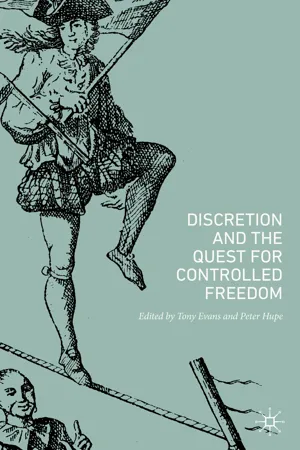
Looking at discretion broadly as the exercise of controlled freedom, this edited volume introduces insights from a range of social sciences perspectives. Traditionally, discussions of discretion have drawn on legal notions of the appropriate exercise of legitimate authority specified by legislators. However, empirical and theoretical studies in the social sciences have extended our understanding of discretion, moving us beyond a narrow legal view. Contributors from a range of disciplines explore the idea of discretion and related notions of freedom and control across social and political practices and in different contexts. As this complex and important topic is discussed and examined, both total control and unconstrained freedom appear to be illusions.
eBook - ePub
Discretion and the Quest for Controlled Freedom
- English
- ePUB (mobile friendly)
- Available on iOS & Android
eBook - ePub
Discretion and the Quest for Controlled Freedom
About this book
Information
Subtopic
Lingüística© The Author(s) 2020
T. Evans, P. Hupe (eds.)Discretion and the Quest for Controlled Freedom https://doi.org/10.1007/978-3-030-19566-3_11. Conceptualizing Discretion
Tony Evans1 and Peter Hupe2
(1)
Department of Social Work, Royal Holloway, University of London, Egham, UK
(2)
Public Governance Institute, Catholic University of Leuven, Leuven, Belgium
1.1 The Illusion of Total Control
Discretion presumes some form of hierarchical relationship. A body or person grants a degree of circumscribed freedom to another body or person, to be exercised in a particular setting according to particular standards. As such, the phenomenon of discretion is generic and ubiquitous—although its occurrence is pluriform and dynamic.
Once there was a time in which life had a quiet pace. When men came home after a hard day’s work, their wives offered them a drink. The children were doing their homework, enabling the maid to prepare the evening meal. All were looking forward to the family outing on Sunday afternoon, with a car ride after church attendance.
This could be a scene from an early episode of Mad Men. It seems an idyllic picture—but only if seen from a very particular perspective of white heterosexual male privilege. The scene is a complete caricature which cannot be read without irony or, for that matter, retrospective indignation. At most we may watch re-runs of Happy Days or similar television series cherishing the 1950s, as a form of nostalgia (Halberstam 1993). The picture above suggests a stable order, in which everyone knows his and her place. What seems at stake here is an illusion of total control, as well as the current demise of that illusion.
As with any illusion, the picture is one-sided. The image of the happy family ignores the shadow-sides: harsh class relationships, segregation and discrimination, violence and abuse, oppression of counter-voices. The hierarchical relationships pictured above, the hegemonic status of a particular cultural orientation and submissiveness as a standard mode of conduct, no longer prevail. Of course, these features, to a smaller or larger extent, in various contexts do remain reality. In contrasting then and now, here and there, while we have to recognize the differences, we also need to acknowledge continuities. At least, however, the mentioned features have lost their self-evident character.
Giving an assessment of ‘modern times’, Hupe and Edwards (2012) speak of de-centring, multi-sourced sense-making and autonomization as characteristics of the current era. De-centring means that a variety of action locations set the stage for all kinds of ‘political’ activities outside the formal locus of politics in its narrow sense. Multi-sourced sense-making implies that giving meaning to one’s life in terms of common interests, concerns and identities may be based on the intersection of different aspects of social characteristics, such as class position, ethnicity and gender. As Hupe and Edwards (2012: 181) point out, people ‘draw eclectically from a variety of sources’ to give meaning to their lives. Autonomization refers to an extended number and range of autonomous or quasi-autonomous actors, constituting a plurality of publics. Contemporary individuals believe that they are in charge of their own lives; they define their identity and mutual relationships in their own terms.
It is against this background that discretion is a topic more than ever worthwhile studying. The occurrence of a multi-dimensional diversity and the recognition of a range of perspectives—and potential insights from these different perspectives—invite thorough reflection on the subject of discretion. If power relationships cannot be taken for granted as hierarchies, if orientations cannot be assumed as monochrome and hegemonic, while actors serve in all kinds of representational roles, then the ideas of control and freedom suggested by the very term ‘discretion’ need to be reflected upon. Furthermore, the macro setting in which discretion in the public sphere is being formulated and practised shows dualistic developments, tending towards both enhanced discretion and more freedom and diminished discretion and greater control.
Information and communication technologies can enlarge the freedom of action. The internet, for instance, has turned the world into a global village, allowing individual actors to directly interact with each other and access and exchange information at speed. At the same time, search engines monitor and direct behaviour, while algorithms channel processes such as trading across a range of commodities and currencies, amplifying problems (and occasionally creating ‘flash crashes’). The result is diminished freedom and increased surveillance. Where freedom does exist it can be abused in destructive ways—as hate speech, abusive images, ‘fake news’. These in turn lead to calls for more human supervision, judgement and discretion to bring a sense of perspective and control to unbounded systems.
This interdisciplinary edited collection provides a state-of-the-art account of scholarly analysis of discretion—we have asked authors to bring their insights on this topic of shared concern from a range of disciplinary perspectives. Discretion tends to be a central topic in disciplines such as law and sub-disciplines such as the sociology of professionals and policy implementation . Amongst these disciplines and sub-disciplines, to a greater or smaller extent, there has been a history of exchange of ideas and debates about discretion. Currently, discretion is re-emerging as an area of study. As it shows, there are also novel insights into discretion as a concept and as an empirical phenomenon.
1.2 Disciplines on Discretion
The Renaissance essayist Montaigne, in the essay ‘A trait of certain ambassadors’, reflects on the idea that it is better that servants obey the instructions of their masters, rather than challenge them. Looking back to classical antiquity, he describes the case of the Roman general Crassus, who, having seen a ship’s mast in the harbour, instructed an engineer to get it for him to use as a battering ram. The engineer saw a better mast, more suited to the task and brought that instead. Crassus had the engineer whipped for disobeying orders.
Montaigne reflects on this event, pointing out that commanders often have to ignore the letter of the instruction in order to better achieve the aim in ever-changing circumstances. The risk of waiting for new instructions is that nothing will be done. In a rhetorical question Montaigne observes: ‘[D]id not Crassus, when he wrote to an expert and advised him of the use for which that mast was destined, seem to consult his judgement and invite him to interpose his opinion?’ (Montaigne trans Frame 1958: 51).
Montaigne, writing in the late sixteenth century, draws on the classical idea of discretion as judgement and anticipates the predominant modern idea of discretion as the freedom to act on judgement. Two centuries later, the German philosopher Hegel (1977) explored the relationship between knowledge and power in his seminal exposition of the master/servant relationship. Hegel helps us to understand the dynamic and unstable relationship of knowledge, freedom and power in the operation of control and delegation. The imposition of control and a particular world view by a master on a servant paradoxically creates power and freedom for the servant. The master imposes and continues to occupy this world view uncritically. For the servant, his/her view of the world is confronted with another perspective which he/she has to incorporate and in this process, moves to create a new, richer and more productive understanding of the world that supersedes that of his/her master.
More recently, the philosopher Baier (1986) has directed our attention to the social ecology of formal relationships that entail discretion such as delegation, principal/agent agreements and contractual powers and obligations. Discretion does not merely exist in the contract that established a principal/agent relationship; for instance, it assumes broader social conventions and norms that ground the trust that makes sense of these relationships—the broader network of social expectations, assumptions and conventions that support the conditions of trust that allow contracts and formal agreements to operate. For Baier, these background conditions reflect ideas of justice and fairness that facilitate the trust that underpins discretion, allow it to operate and also provide criteria against which to evaluate and challenge its abuse.
Contemporary ideas of discretion elide the ideas of judgement, trust and freedom to act. The nature of the judgement that is to be exercised and the extent of the freedom within which it can operate are open questions. They regard issues about power as a constraint on and potential within discretionary roles. Different academic disciplines have approached these questions and the term ‘discretion’ itself in varying ways.
In a review of disciplinary approaches to discretion, one of the present authors made a comparison of theoretical lenses through which discretion is examined (Hupe 2013). In law, for example, discretion refers to the appropriate exercise of legitimate authority within limits specified by legislators. In studies of public administration, public management and public policy, ‘discretion’ tends to be used to describe and evaluate the freedom of public officials—particularly of those working at the street level of government. In this context, the term indicates the legitimate space for the officials to make their own decisions and exercise their own judgement about how public services are delivered and the degree of freedom from external control they have in doing this. In economics, sociology and other social sciences, the idea of discretion is more wi...
Table of contents
- Cover
- Front Matter
- 1. Conceptualizing Discretion
- Part I. Discretion in Context
- Part II. Perspectives on Discretion
- Part III. Discretion in Governance
- Part IV. Practising Freedom and Control
- Back Matter
Trusted by 375,005 students
Access to over 1.5 million titles for a fair monthly price.
Study more efficiently using our study tools.
Frequently asked questions
Yes, you can cancel anytime from the Subscription tab in your account settings on the Perlego website. Your subscription will stay active until the end of your current billing period. Learn how to cancel your subscription
No, books cannot be downloaded as external files, such as PDFs, for use outside of Perlego. However, you can download books within the Perlego app for offline reading on mobile or tablet. Learn how to download books offline
Perlego offers two plans: Essential and Complete
- Essential is ideal for learners and professionals who enjoy exploring a wide range of subjects. Access the Essential Library with 800,000+ trusted titles and best-sellers across business, personal growth, and the humanities. Includes unlimited reading time and Standard Read Aloud voice.
- Complete: Perfect for advanced learners and researchers needing full, unrestricted access. Unlock 1.5M+ books across hundreds of subjects, including academic and specialized titles. The Complete Plan also includes advanced features like Premium Read Aloud and Research Assistant.
We are an online textbook subscription service, where you can get access to an entire online library for less than the price of a single book per month. With over 1.5 million books across 990+ topics, we’ve got you covered! Learn about our mission
Look out for the read-aloud symbol on your next book to see if you can listen to it. The read-aloud tool reads text aloud for you, highlighting the text as it is being read. You can pause it, speed it up and slow it down. Learn more about Read Aloud
Yes! You can use the Perlego app on both iOS and Android devices to read anytime, anywhere — even offline. Perfect for commutes or when you’re on the go.
Please note we cannot support devices running on iOS 13 and Android 7 or earlier. Learn more about using the app
Please note we cannot support devices running on iOS 13 and Android 7 or earlier. Learn more about using the app
Yes, you can access Discretion and the Quest for Controlled Freedom by Tony Evans, Peter Hupe, Tony Evans,Peter Hupe in PDF and/or ePUB format, as well as other popular books in Política y relaciones internacionales & Lingüística. We have over 1.5 million books available in our catalogue for you to explore.