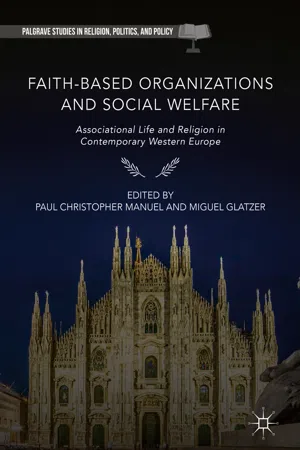
This volume examines the role and function of religious-based organizations in strengthening associational life in a representative sample of West European countries: newly democratized and long-established democracies, societies with and without a dominant religious tradition, and welfare states with different levels and types of state-provided social services. It asks how faith-based organizations, in a time of economic crisis, and with declining numbers of adherents, might contribute to the deepening of democracy. Throughout, the volume invites social scientists to consider the on-going role of faith-based organizations in Western European civil society, and investigates whether the concept of muted vibrancy aids our theoretical understanding.
eBook - ePub
Faith-Based Organizations and Social Welfare
Associational Life and Religion in Contemporary Western Europe
- English
- ePUB (mobile friendly)
- Available on iOS & Android
eBook - ePub
Faith-Based Organizations and Social Welfare
Associational Life and Religion in Contemporary Western Europe
About this book
Information
© The Author(s) 2019
Paul Christopher Manuel and Miguel Glatzer (eds.)Faith-Based Organizations and Social WelfarePalgrave Studies in Religion, Politics, and Policyhttps://doi.org/10.1007/978-3-319-77297-4_11. “Use Words Only If Necessary”: The Strategic Silence of Organized Religion in Contemporary Europe
Paul Christopher Manuel1 and Miguel Glatzer2
(1)
American University, Washington, DC, USA
(2)
La Salle University, Philadelphia, PA, USA
Paul Christopher Manuel (Corresponding author)
Miguel Glatzer
The consideration of religious variables in comparative politics entered the scholarly discussion relatively late, but a number of important works over the past few years have considered the possibilities and obstacles religion presents to a democratic society.1 Among other concerns, this literature examines how the work of religious interest associations might promote greater social capital, civic engagement, empowerment, and participation among the poor and other socially marginalized groups. This literature is consistent with the concept of muted vibrancy and builds on both the social capital and democratic deepening approaches.
The concept of muted vibrancy carves out a promising research area for how religion and politics, or even faith and culture, may interact in a society historically dominated by one religion. Derived from the work on Roman Catholicism in France (traditionally referred to as the eldest daughter of the church) by a number of scholars, including historian René Rémond, Jesuit philosopher Paul Valadier, and historian Steven Englund in a notable 2001 review article in Commonweal, this concept suggests that social scientists need to move beyond the lens normally applied to the question of Catholicism in contemporary Europe (i.e., it is a dying, anti-modern, anti-rational, and conservative institution) and instead examine its ongoing societal functions.2 Valadier, for instance, examines the continued relevance of Catholicism in French society in his 1999 book L’Eglise en Procès: Catholicisme et Société Moderne.3 The Spanish Jesuit Gonzalo Villagrán has asked similar questions about the church in Spanish society.4 For his part, Steven Englund, in “L’Eglise de France, The Church in a post-religious age,” following Rémond, laments the ongoing anti-clericalism of the French intelligentsia, and asks “why is [French Catholicism] … judged on its past and not its present.”5 The muted-vibrancy approach seeks to provide a nuanced understanding of the contemporary role of lived religion in a given society and therefore avoid the pitfalls of a facile reading of the role of religion in the public square.
We use the term muted vibrancy to denote two elements that are key to our understanding of the work of faith-based organizations in contemporary Western Europe. First, while acknowledging that reduced religious attendance, secularization, and increased religious pluralism constitute important trends, it is important not to overstate the case. As the chapters in this volume illustrate, identification with the dominant traditional religions (Roman Catholicism, Anglican, Lutheran, and Greek Orthodox Christianity) still plays a vital role in the lives of large percentages of the population. Traditional religious observance and identity is diminished, but is certainly not dead.
Second, we recognize that churches have lost most of the high-profile battles on moral issues that dominate much of the press coverage and discussion. Whereas many states once took their cues explicitly or implicitly from religious traditions on matters of divorce, abortion, and homosexuality, particularly in countries where Catholicism or Greek Orthodoxy was dominant, the battles to preserve such traditions have been decisively lost. Legalization, or in some cases, decriminalization, of abortion, divorce, and gay marriage now constitutes an important part of law across Western Europe; further, these previously controversial positions now enjoy majority support in virtually every Western European country.
Having lost these battles, churches essentially face three choices: they could perhaps continue to loudly proclaim their opposition; second, they could engage in doctrinal or structural reform to reflect contemporary social views (expanded roles for women, or the ability of the divorced to receive communion); or, third, they could possibly focus on other relatively non-controversial issues (compassion, good works), or where public opinion is still in flux (policy on migration and refugees) . Building on that third option, this volume argues that while churches may have lost power and prestige relative to the past, they remain powerful, if often unheralded, vital actors in social services and welfare provision; we use the concept of muted vibrancy as a lens through which to understand their contribution to West European civil society.
This theoretical approach also helps us overcome—as several of the authors in this volume note—a seeming paradox. That is, even as formal religious adherence declines and as the prestige of the church, rocked in some cases by scandals, diminishes, its role in the provision of services continues to grow. While the church may be muted in some respects (experiencing declines in attendance, rising secularism, losing battles on moral issues, and, in some cases, choosing to downplay its continued opposition to society’s new positions), it is vibrant in others, namely in its commitment to serving the poor and vulnerable.
Muted vibrancy is also in harmony with the notion of strategic silence. The “strategic actor” model, most notably developed by Carolyn Warner in Confessions of an Interest Group, contends that the post–Vatican II institutional Catholic Church has comported itself not unlike an interest group in the European public square—and this insight can be certainly be applied to other religious groupings in Europe.6 There have been multiple efforts to influence public policies to ensure that health and welfare benefits are available to those in need, for example. At the same time, in some of our cases, the Catholic Church has been remarkably muted on national debates over abortion and same-sex marriage. We wonder if this represents a sort of “strategic silence” on behalf of the religious groupings to de-emphasize politically divisive social issues where the battle has been lost in favor of the important work of meeting basic human needs and of advocacy on issues not yet settled in the public arena.
We argue that the literature on social capital and civic engagement is consistent with the emphasis on social services, attention to socio-economic needs, and response to new social risks that the concept of muted vibrancy tries to highlight. Putnam has argued that social capital, meaning “features of social life—networks, norms, and trust—that enable participants to act together more effectively to pursue shared objectives,” is necessary to the promotion of a robust associational life in a democracy.7 Likewise, Schmitter suggests that “interest associations may be important (if subsidiary) sites at which the legitimacy of democracy is accorded … therefore the long-term viability of a given democratic regime may come to depend on the configuration and behavior of such.”8 Stepan has noted as well that “democracy should not be considered consolidated in a country unless, among other things, there is an opportunity for the development of a robust and critical civil society.”9 Combined, there is a shared concern that social scientists examine “bottom-up” civic associations—religious or secular—in order to effectively assess how well such social groupings add to democratic processes, legitimacy, and stability.
For its part, the deepening democracy scholarship is particularly concerned with how social divisions may prove to be an obstacle for democratic consolidation. Fishman argues that “the literature on the deepening of democracy emphasizes institutional factors in the opening—or closing—of spaces for effective participation by the poor and other socially subordinate sectors, but also examines social movements and social pressure from below.”10 If interest associations are to have a crucial l...
Table of contents
- Cover
- Front Matter
- 1. “Use Words Only If Necessary”: The Strategic Silence of Organized Religion in Contemporary Europe
- Part I. Countries with a Dominant Religious Society
- Part II. Countries with Competing Religious Societies and with a Formerly Dominant Church
- Back Matter
Trusted by 375,005 students
Access to over 1.5 million titles for a fair monthly price.
Study more efficiently using our study tools.
Frequently asked questions
Yes, you can cancel anytime from the Subscription tab in your account settings on the Perlego website. Your subscription will stay active until the end of your current billing period. Learn how to cancel your subscription
No, books cannot be downloaded as external files, such as PDFs, for use outside of Perlego. However, you can download books within the Perlego app for offline reading on mobile or tablet. Learn how to download books offline
Perlego offers two plans: Essential and Complete
- Essential is ideal for learners and professionals who enjoy exploring a wide range of subjects. Access the Essential Library with 800,000+ trusted titles and best-sellers across business, personal growth, and the humanities. Includes unlimited reading time and Standard Read Aloud voice.
- Complete: Perfect for advanced learners and researchers needing full, unrestricted access. Unlock 1.5M+ books across hundreds of subjects, including academic and specialized titles. The Complete Plan also includes advanced features like Premium Read Aloud and Research Assistant.
We are an online textbook subscription service, where you can get access to an entire online library for less than the price of a single book per month. With over 1.5 million books across 990+ topics, we’ve got you covered! Learn about our mission
Look out for the read-aloud symbol on your next book to see if you can listen to it. The read-aloud tool reads text aloud for you, highlighting the text as it is being read. You can pause it, speed it up and slow it down. Learn more about Read Aloud
Yes! You can use the Perlego app on both iOS and Android devices to read anytime, anywhere — even offline. Perfect for commutes or when you’re on the go.
Please note we cannot support devices running on iOS 13 and Android 7 or earlier. Learn more about using the app
Please note we cannot support devices running on iOS 13 and Android 7 or earlier. Learn more about using the app
Yes, you can access Faith-Based Organizations and Social Welfare by Paul Christopher Manuel, Miguel Glatzer, Paul Christopher Manuel,Miguel Glatzer in PDF and/or ePUB format, as well as other popular books in Politics & International Relations & Economic Theory. We have over 1.5 million books available in our catalogue for you to explore.