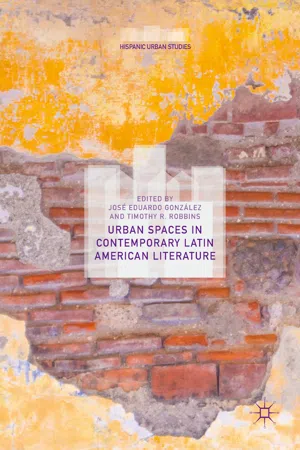
This collection of essays studies the depiction of contemporary urban space in twenty-first century Latin American fiction. The contributors to this volume seek to understand the characteristics that make the representation of the postmodern city in a Latin American context unique. The chapters focus on cities from a wide variety of countries in the region, highlighting the cultural and political effects of neoliberalism and globalization in the contemporary urban scene. Twenty-first century authors share an interest for images of ruins and dystopian landscapes and their view of the damaging effects of the global market in Latin America tends to be pessimistic. As the book demonstrates, however, utopian elements or "spaces of hope" can also be found in these narrations, which suggest the possibility of transforming a capitalist-dominated living space.
eBook - ePub
Urban Spaces in Contemporary Latin American Literature
- English
- ePUB (mobile friendly)
- Available on iOS & Android
eBook - ePub
Urban Spaces in Contemporary Latin American Literature
About this book
Information
Print ISBN
9783319924373
© The Author(s) 2019
José Eduardo González and Timothy R. Robbins (eds.)Urban Spaces in Contemporary Latin American LiteratureHispanic Urban Studieshttps://doi.org/10.1007/978-3-319-92438-0_11. The Spatial Turn and Twenty-First Century Latin American Fiction
José Eduardo González1
(1)
Department of Modern Languages and Literatures, University of Nebraska-Lincoln, Lincoln, NE, USA
The project of compiling a volume focusing on studying the representation of the city in contemporary Latin American fiction originated as an upshot of a previous attempt by Timothy R. Robbins and I to contribute to the periodization of the most recent literary production in the region. 1 The main assumption driving our initial impulse was simple: not only has fictional representation of the city always been a popular motif in literature, it has been employed, more often that one would like to admit it, to contrast literary styles, even literary periods. Even in the most sophisticated analyses, James Joyce’s literary experiments never fail to be associated to the modern urban life at the turn of the twentieth century. I am aware, of course, of how problematic this could be as it postulates the existence of a mimetic relationship between writers and the urban spaces (in both their historical and literary periods) that negates the authors’ artistic idiosyncrasies. Because of this critical tradition, it became evident to me that it was equally important to pay attention in this introduction to the way critics have read that relationship between literature and the city—and, obviously, how that relationship has changed in the last couple of decades. As it often happens, it is difficult to distinguish between how the literature of a period represents an object—the city, in this case—and how critics have interpreted that representation. While the original question was essentially a problem about literary history, it also became a problem about how to write literary history. This is a long way of saying that this volume about urban spaces in twenty-first century fiction exists not only because the cities we inhabit now are different from the ones in twentieth century Latin America, but also because of the influence of the so-called “Spatial Turn” in contemporary literary criticism.
The Spatial Turn refers to the current awareness of the need to study the impact of space as a social construction in many aspects of our lives, including the creation of cultural products. 2 In the last couple of decades, the discipline of geography, especially human geography, has become one of the most influential fields for both the humanities and social sciences, while “recent works in the fields of literary and cultural studies, sociology, political science, anthropology, history, and art history have become increasingly spatial in their orientation” (Warf and Arias 2008, p. 1). Although both Foucault and Lefebvre theorized in the 1970s about the connection of space to the development of capitalism, the current rise in spatial scholarship began during the 1990s and owes a great deal to the work of David Harvey and Edward Soja. 3 The latter must also receive credit for bringing back the work of Lefebvre to the attention of scholars when he devoted a large section of his seminal study Postmodern Geographies (1989) to the encounter between modern geography and Western Marxism. For the topic of the relationship between literature and space, which is the focus of our attention, one could say that there are at least two conceptualizations of space that originated during the postmodern/poststructuralist period. One of them—strongly associated to the views of Lefebvre and Foucault—defines space in terms of domination. For the thinkers who adhere to this idea, explains Eric Prieto, “space is not a neutral featureless void within which objects and events are situated but a dimension that has been produced by social forces that in turn constrain future possibilities” (2011, p. 17). This view of space has led literary critics to look for traces of the constraining social forces in their studies of literary geographies. The other one, which has been repeatedly described by Bertrand Westphal in his work of geocriticism, was best “summed up in Jacques Derrida’s laconic formula: Il n’y pas de hors-texte. There is nothing outside the text” (2011, p. xii), thus severing the link between reality and representation, and blocking the possibility of analyzing the fictional depiction of space as referring to a real world. 4
Of these two ideas, it was the notion of space as produced or constructed that informed a group of studies that in the late 1990s joined the Spatial Turn wave and began to change the literary analysis of urban space in Latin America. For example, Marcy E. Schwartz’s Writing Paris (1999), to mention one of the key texts from this period in the American academia, researched the image of Paris in Latin American literature as it changed throughout historical and artistic periods. 5 “From Sarmiento through the modernistas and regional writers,” explains Schwartz, “Latin American writing has manipulated a cluster of conflicting desires associated with Paris” (1999, p. 11). Sometimes seen as the source of prestige and refinement, other times associated with “orgiastic decadence,” the Paris described in these texts “is an imagined space that is repository for cultural yearnings” (Schwartz 1999, p. 25). Both images of Paris remained significant until early twentieth century and even later in some cases. While most of Schwartz’s book studies the perception of Paris in several canonical (male) figures, the last chapter is devoted to Luisa Futoransky’s fiction and its innovative way of challenging the conventional image of Paris produced by the Latin American literary tradition.
Her novels challenge common Parisian themes in Latin American writing by revealing their gender bias and revising women’s passive roles. She most critically rewrites the role of Paris in stories of sexual experimentation, traditionally presumed a male domain. Her female protagonist must reconfigure the roles assigned to her in an anachronistic script written by and for men in order to write openly about women’s search for sexual fulfillment. (Schwartz 1999, p. 115)
A similar approach—to study first the tradition of spatial perception in Latin American literature and culture and then to look for the challenges to it, especially in the work of female writers—can also be perceived in Amanda Holmes’s City Fictions (2007), which focuses on the discursive relationship between language, body and the city in texts from the last three decades of the last century. Interested in the meaning of the images of fragmented bodies, Holmes mentions that “disquieting analogies for the city in late twentieth-century Spanish American literature reflect an oppressive political and economic environment” (2007, p. 25). The relevance of space for determining genre relations is evident in Holmes’s reading of Chilean writer Diamela Eltit’s Lumpérica.
Contrasts between the male and the female responses to this urban space illustrate the multiple codification of this site, one that includes both the extremities of a centralized dominating presence and the deteriorating body of the urban inhabitant. The city’s hostile oppression of the female body opposes the male ambivalence toward the space. …Sergio’s body is described as “ausente” (absent) in relation to his surroundings, contrasting dramatically with the pained presence of the female body. Sergio does not even understand the feelings of oppression aroused by the city in the female narrator. (2007, p. 138)
Without a doubt, the most significant work in the study of the city in Latin American fiction in recent times has been done by feminist readings of women writers’ fictional representations of urban space in a male-dominated society like the previous two examples show. Here is where the impact of the post-structuralist rethinking of the relationship between urban space, power and the subject has yielded some of its most important results. The gendering of urban space, which as we have seen was only part of larger studies of the literary urban space in Schwartz and Holmes, became the central emphasis of Unfolding the City, an important collection of essays edited by Elisabeth Guerrero and Anne Lambright focusing on how women “belonging to the intellectual and professional elite, as well as to marginalized or disenfranchised groups, negotiate their dwellings and articulate their urban lives” (2007, p. xi). Collectively, the essays included in the volume, the editors assess, employ a wide variety of literary texts to study how women writers decode the “signs of the city,” “interpret race, ethnic, and class dynamics” (2007, p. xii) or respond to contemporary disorder and the presence of mass media in their urban environment (2007, p. xv).
A shared theme and target of critique for many of these feminist approaches to literary geography has been the traditional relationship between literature and the city in Latin America described in Ángel Rama’s The Lettered City (1984). 6 Rama’s well-known and influential study argues that since colonial times a Latin American lettered elite or letrados has existed in a relationship of dependency with the city. Latin America provided a blank canvas on which Europeans could realize their dream of creating a city from which they could control and mold reality to their liking. The city became the center of power and one of the ways it could use that power to order the surrounding environment was through writing. The early lettered elite gained its prestige from its connection to writing and to the city that validated the power of writing to shape reality. As the original functions the city assigned to them changed, the letrados saw the need to continuously reinvent themselves. In order to protect their privileged position, with every major social change, intellectuals needed to prove their usefulness to the political power. Rama’s book recounts the history of the transformations that the letrados as a social group, or the “lettered city,” as he calls them, undergo in their search to protect their interests. After the book’s initials comments about the connection between the foundations of the Latin American cities and the power of the written word, the city becomes a synecdoche for political power. In his historical overview of the letrados , Rama details the social and political changes that took place from Colonial times to the early twentieth century and how the lettered elite managed to fend most attempts to question its connection to power. In Rama’s reading, the lettered city remains unchanged as it is able to co-op the social groups seeking to challenge it. However, for many contemporary critics, toward the end of the twentieth century begins to emerge the notion of la ciudad posletrada, a moment in which the Latin American writer has lost its privileged position in part due to the social and cultural changes brought about by mass media and globalization.
The gendering of space has been a long-time concern of feminist criticism and, as we have seen, recent readings of women writers’ fictional representations of urban space have brought a necessary corrective view of the city in Latin American fiction. In some of these readings, the notion of the lettered city plays a central role as it obviously designated of a group of (overwhelmingly male) scholars defending a patriarchal system. 7 Guerrero and Anne Lambright explain that “a careful reading of Rama’s work reveals the masculine nature of his model of the lettered city, to the exclusion of women intellectuals, who were still rare during the periods that Rama studies (first the colonial era, and then the years of literary expansion following independence, particularly from 1880 to 1920)” (2007, p. xix). Hence, as Schwartz has noticed, the notion of the post-lettered city, so essential to the relationship between twenty-first century writers and their fictional representation of the urban space, needs to take into account the impact of women rewriting the city: “The concept of a post-lettered city, a social space not just vaguely ‘beyond’ but more critically after the earlier functioning of the written, stretches Rama’s work on urban elite cultural space in the broadest contemporary perspective, where women’s writing, not only their resistance, their orality, or their sexuality, can play a role… The feminine and feminist voice is an essential avenue of this expansion, serving to reassess the power dynamic where earlier considerations of urban hegemony ignored women’s experience and inscription” (2007, p. 14). 8 As Eduard Arriaga’s chapter in our book shows, moving away from the old...
Table of contents
- Cover
- Front Matter
- 1. The Spatial Turn and Twenty-First Century Latin American Fiction
- 2. Beyond the Ruins of the Organized City: Urban Experiences Through the Metro in Contemporary Mexican Literature
- 3. Spectral Spaces: Haunting in the Latin American City
- 4. A Tale of Three Cities: Urban Space in the Crack Novels (1995–1997)
- 5. The Night That Repeats Itself: Social Dystopia in Managua, Salsa City (¡Devórame Otra Vez!), by Franz Galich
- 6. Urban Debris and Networking Imperialism in Un Arte de Hacer Ruinas by Antonio José Ponte
- 7. Place-Making in the Solitude of the City: Valeria Luiselli’s Los ingrávidos
- 8. Dislocated Subjects in the Global City: Santiago Gamboa’s Hotel Pekín
- 9. Roberto Bolaño’s Urban Labyrinths: The City as Metaphor for the Silent Universe
- 10. The Tourist Aesthetic and Empire in Rodrigo Fresán’s Mantra and Jardines de Kensington
- Back Matter
Trusted by 375,005 students
Access to over 1.5 million titles for a fair monthly price.
Study more efficiently using our study tools.
Frequently asked questions
Yes, you can cancel anytime from the Subscription tab in your account settings on the Perlego website. Your subscription will stay active until the end of your current billing period. Learn how to cancel your subscription
No, books cannot be downloaded as external files, such as PDFs, for use outside of Perlego. However, you can download books within the Perlego app for offline reading on mobile or tablet. Learn how to download books offline
Perlego offers two plans: Essential and Complete
- Essential is ideal for learners and professionals who enjoy exploring a wide range of subjects. Access the Essential Library with 800,000+ trusted titles and best-sellers across business, personal growth, and the humanities. Includes unlimited reading time and Standard Read Aloud voice.
- Complete: Perfect for advanced learners and researchers needing full, unrestricted access. Unlock 1.5M+ books across hundreds of subjects, including academic and specialized titles. The Complete Plan also includes advanced features like Premium Read Aloud and Research Assistant.
We are an online textbook subscription service, where you can get access to an entire online library for less than the price of a single book per month. With over 1.5 million books across 990+ topics, we’ve got you covered! Learn about our mission
Look out for the read-aloud symbol on your next book to see if you can listen to it. The read-aloud tool reads text aloud for you, highlighting the text as it is being read. You can pause it, speed it up and slow it down. Learn more about Read Aloud
Yes! You can use the Perlego app on both iOS and Android devices to read anytime, anywhere — even offline. Perfect for commutes or when you’re on the go.
Please note we cannot support devices running on iOS 13 and Android 7 or earlier. Learn more about using the app
Please note we cannot support devices running on iOS 13 and Android 7 or earlier. Learn more about using the app
Yes, you can access Urban Spaces in Contemporary Latin American Literature by José Eduardo González, Timothy R. Robbins, José Eduardo González,Timothy R. Robbins in PDF and/or ePUB format. We have over 1.5 million books available in our catalogue for you to explore.