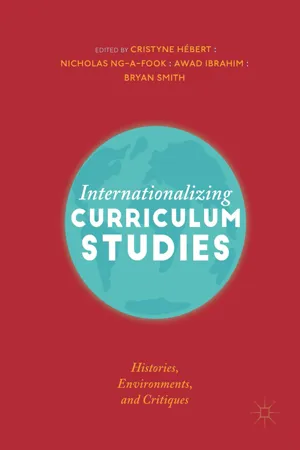
This book seeks to understand how to internationalize curriculum without imperializing or imposing the old, colonial, and so-called first-world conceptualizations of education, teaching, and learning. The collection draws on the groundbreaking work of Dwayne Huebner in order to invite scholars into conversation with histories of curriculum studies and to posit them within it, opening up new spaces to work in and through curricular issues. This book will appeal to scholars, teachers, and students looking to reconceptualize international curriculum development and theory.
eBook - ePub
Internationalizing Curriculum Studies
Histories, Environments, and Critiques
- English
- ePUB (mobile friendly)
- Available on iOS & Android
eBook - ePub
Internationalizing Curriculum Studies
Histories, Environments, and Critiques
About this book
Information
Topic
ÉducationSubtopic
Éducation comparative© The Author(s) 2019
Cristyne Hébert, Nicholas Ng-A-Fook, Awad Ibrahim and Bryan Smith (eds.)Internationalizing Curriculum Studieshttps://doi.org/10.1007/978-3-030-01352-3_11. Internationalizing Curriculum Studies: Histories, Environments, and Critiques
Cristyne Hébert1 , Awad Ibrahim2 , Nicholas Ng-A-Fook2 and Bryan Smith3
(1)
Faculty of Education, University of Regina, Regina, SK, Canada
(2)
Faculty of Education, University of Ottawa, Ottawa, ON, Canada
(3)
College of Arts, Society and Education, James Cook University, Townsville, QLD, Australia
Cristyne Hébert (Corresponding author)
How do we internationalize that which is deeply provincial and national? Situating our focus on and interest squarely within curriculum studies, how do we internationalize without imperializing or imposing old, colonial, and so-called “First World” conceptualizations of education on teaching, learning, and curriculum? Let us not anticipate simple answers to such complex questions. Being under no illusion that we hold Solomonic wisdom, we editors turned to the wisdom of others. A curricular response to such pedagogical questions is this edited volume. In it, we called on contributors to speak and write from their cultural, linguistic, and national locations, from the places they know best. We invited them to grapple with these questions in an increasingly globalized world while also thinking through the general and particular tasks of curriculum theorists (Derrida 2000).
We present this volume as a dialogic tapestry where our discursive exchanges are taken up as complicated conversations (Pinar et al. 1995). In turn, such conversations, as the chapters in the volume make clear, are suggestive of two dialogic frameworks. The first uses history to complicate local and global understandings of curriculum theorizing. The second involves a radical push of curriculum theorizing toward (re)imagining a better future that promises, without promise, bringing into existence that which is yet to come. Internationally oriented conversations start, as Pinar (2010) suggests elsewhere, at the national level where the “nation-state” continues to be a territorial and political domain from which important and consequential educational reforms are made and in turn need to be understood. For Pinar, the project of “internationalization denotes the possibility of nationally distinctive fields in complicated conversations with each other” (p. 3). But why understand the tasks of curriculum theorists in relation to internationalization versus globalization?
In Curriculum Studies as an International Conversation, Johnson-Mardones (2018) reminds us that the potential of thinking through the concept of internationalization “is not limited to ‘moving beyond the nation’ in order to reconstruct the national narrative or to reformulate a national cannon; it also includes the exploration of international conversations as in-between scholarly spaces” (p. 5). Despite the critiques, Hardt and Negri (2000) tell us, globalization cannot be reduced to not one thing. For them, “the multiple [curricular and pedagogical] processes that we recognize as globalization are not unified or univocal” (p. 219). With this in mind, this collection seeks to understand the local—with its history, environment, and critique—as the starting point for different disciplinary—vertical and horizontal—dimensions of an internationalization of curriculum studies in relation to globalization (Pinar 2015). How might we recognize the analytical and synthetical tensions and possibilities between internationalization and globalization, and how can we root (route) our differing international approaches for studying, or better yet understanding, a concept we call curriculum? This is what we are calling, to lean on Huebner’s term, “the task of the curriculum theorist”: to think through and re/direct the familiar into new, and more hopeful educational and societal directions.
In a time of uncertainty, as education becomes increasingly corporatized, monetized, and de-intellectualization, in the form of alt-right politics, continues to grow and be further embedded in public consciousness, the need to think through the task of the curriculum theorist is becoming more urgent than ever (Epstein 2016; Spring 2015). In light of (or sitting in the dark shadows caused by) Islamophobia, police brutality, hate-fueled attacks, and refusals to respond to the injustices that have been inflicted upon Indigenous communities across the globe, we began this work in careful consideration. We came together, from different parts of the world, to attend the International Association for the Advancement of Curriculum Studies Conference (IAACS) in May 2015. People spoke from their own accentuated political stances, listened to one another with a sense of loving humility, and tried to rearticulate and reimagine what Huebner (1975/1999) calls language forms and their respective radical possibilities.
It is worth noting that the Ottawa IAACS conference was the fifth iteration of our gathering together. The first iteration of this conference began 15 years ago at Louisiana State University. At that time, a community of curriculum scholars congregated to “talk about issues in curriculum, hearing what people do, how they do it, [and] how they think about things” with the hope that we could learn from each other (Trueit 2003, p. ix). Like Aoki (2000/2005) suggested then, the IAACS and its associated conference provided a potential space to “generate newness and hope” (p. 457). Then titled The Louisiana State University Conference on the Internationalization of Curriculum Studies, it was organized with the intention of both “encourag[ing] the internationalization of curriculum studies” and calling on curriculum theorists to “contribute to the formation of a world-wide field of curriculum studies” (Pinar 2003, p. 1). At this first gathering, Pinar (2003) offered the following cautionary note:
Despite the bitterness and our despair over the development in the schools, many of us Americans still exude a naïve, if more than occasionally imperialistic, confidence that “the world is ours.” Of course this is nonsense, but somewhere in the American unconsciousness such nonsenses is it seems, always at work. (p. 4)
Since then, the conference has been held triennially, hosted by universities in China (2003), Finland (2006), South Africa (2009), and Brazil (2012). In December of 2018, the conference will be held in Australia.
Forty-five years prior to this triennial gathering, in his groundbreaking article, Dwayne Huebner (1975/1999) first thought through The Tasks of the Curriculum Theorist. Huebner challenged readers to reconceptualize the field of curriculum studies as a space for multiplicity, recognizing the variety of shapes and forms various curricular phenomena, research about said phenomena, and the language we ascribe to them could assume. He tasked us with the following three areas for our future field of study: history, the environment, and critique. This collection is organized around these three areas, and we expand upon each briefly. First, when it came to history, Huebner argued, process and continuity were at the forefront of our conversations. And in many ways, they still are. For Huebner, we always need to ground ourselves in a time and a place so that we know where we come from and where we are going. This is what we are calling “histories,” in the plural, because history can never be singular interpretation of our relationships with the past. Consequently, there are as many histories as there are interpreters and interpretations. Huebner stressed then, that what has begun is never quite finished, while at the same time reminding us of our allegiances to the past, in terms of tracing our intellectual histories within their particular and partial contextual states.
Huebner (1975/1999) also warned against a tendency toward ahistorical curriculum studies, a proneness for being “messianic” in the adoption of “new and permanent vehicles of salvation” positioned as “the only and only best way to talk about curricular phenomena” (p. 218). “To be aware of our historical nature,” he continued, “is to be on top of our past, so we can use it as a base for projection into the future” (p. 218). Considering his comment in light of current global challenges, this projection need not be linear; tracing a clear line from past to present may not be possible, or indeed, desirable. Instead, projection might be interpreted as a metaphysical force, a movement or motion that disrupts certain ascendant historical logics while advancing alternative narratives. Here, we are looking not to “draw forth old solutions” but rather to be pushed as he put it, “to new levels of awareness” (p. 221).
Second, beyond a more general grounding of curricular work, Huebner’s (1975/1999) tasks for curriculum theorists extend to an engagement with what he labels the “environment” of education, consisting of both the places of education—inside and outside of the school—and subjective experiences within these spaces. To fully understand Huebner’s approach to the “environment,” which is the second pillar of this book, we need to distinguish between the “school” (as the place, the geography, the building) and “schooling” (as the experiences people have in that place, what they do in it, and in turn what the place does to them). The building does not determine people’s lived experiences but rather is directly related to them. Situating curriculum theory, in part, within Huebner’s “environment” might help us understand and in many ways reverse the process of alienation that detaches “the individual from the history of the situation” and makes challenging the aforementioned process of change and growth (p. 223). Locating our selves in relation to others and spaces aids in the recognition of curriculum as a “form of human praxis, a shaping of the world” (p. 226) that requires reaching out, drawing from, and contributing to an active, political, and aesthetic community committed to imaging the world around us anew.
The third and final pillar of the book is centered around what Huebner calls “critique.” Huebner (1975/1999) tasks curriculum theorists with a continued responsibility for conducting research as a means of determining the viability and vitality of institutions by “subjecting [them] to empirical and social criticism appropriate to given historical communities” (pp. 227–228). Apart from institutions, we might consider Huebner’s move toward research as an effort to ground the field in a type of critique, wherein its language, form, and function are placed under the microscope. As he explains, “the empirical critique determines the adequacy of the form for the facts [and] the social critique determines the adequacy of the form in terms of the logical, esthetic, economic, and political values of users” (p. 227). Today, such callings upon curriculum theorists may ground our curriculum inquiries, while also moving them toward a reconceptualization of our practices and policies in particular spaces, opening up larger theoretical questions of how we might create spaces, in curriculum studies, for new ways of sitting with and thinking through both general and particular curricular issues.
Inspired by Huebner’s (1975/1999) call to reconsider the tasks of the curriculum theorist, the 2015 meeting of IAACS provided an opportunity for our community to examine more closely what it might mean to curriculum theorize in the present time, in a moment of crisis; to reconsider what it might mean to live hopefully, radically, ethically, and lovingly with one another, across borders that are becoming increasingly real and more difficult to traverse (Lear 2008); to imagine what it might mean to open up new spaces, and to “look at things as if could be otherwise” (Greene 1995, p. 19). These complicated conversations were conducted through a variety of ever-expanding interpretive traditions: historical, political, racial, gendered, phenomenological, post-structural/deconstructive/postmodern, (auto)biographical, aesthetic, theological, institutional, international, environmental, indigenous, postcolonial, and cosmopolitan. The chapters offered in this collection represent a move to ground curriculum studies as an international conversation. While grounding connotes a certain permanence when considering the etymology of the term—solidifying a foundation, constructing a firm basis, or rooting down—the chapters call attention to the possibilities for multiplicity suggested through rerouting (re-rooting) our conceptions of curriculum studies.
Turning to Others: What to Expect in What Follows
In the first section, “Grounding Curricular Histories,” the authors invite us to reconsider different historical conversations within the field of curriculum studies. Christou and De Luca offer a brief history of the movement in curriculum studies frequently referred to as reconceptualization. Identifying three tensions in the current state of the field—contemporaneity, discursive balkanization, and methodological diffusion—they challenge curriculum scholars to open up curricular spaces, to consider “who is able to participate in the conversation, how that conversation is referenced, the degree of coherence within the conversation, and the value and function of the conversation” (p. 29). Quinn and Christodoulou unearth curriculum by constructing an alternative world devoid of curriculum theory, examining its presence through absence. Describing curriculum theory as “the interdisciplinary study of educational experience, involving [an] extraordinarily complicated conversation,” they recount their histories in curriculum theory, calling attention to both the historical roots that ground them in particular spaces and time and the fecund “cross-fertilizing” space between them (p. 36). In so doing, curriculum theory becomes a generative force of nourishment, one that has the potential to both maintain and transform.
Moreira and Ramos provide an important histor...
Table of contents
- Cover
- Front Matter
- 1. Internationalizing Curriculum Studies: Histories, Environments, and Critiques
- Part I. Grounding Curricular Histories
- Part II. Grounding Educational Environments
- Part III. Grounding Curricular Critique
- Back Matter
Trusted by 375,005 students
Access to over 1.5 million titles for a fair monthly price.
Study more efficiently using our study tools.
Frequently asked questions
Yes, you can cancel anytime from the Subscription tab in your account settings on the Perlego website. Your subscription will stay active until the end of your current billing period. Learn how to cancel your subscription
No, books cannot be downloaded as external files, such as PDFs, for use outside of Perlego. However, you can download books within the Perlego app for offline reading on mobile or tablet. Learn how to download books offline
Perlego offers two plans: Essential and Complete
- Essential is ideal for learners and professionals who enjoy exploring a wide range of subjects. Access the Essential Library with 800,000+ trusted titles and best-sellers across business, personal growth, and the humanities. Includes unlimited reading time and Standard Read Aloud voice.
- Complete: Perfect for advanced learners and researchers needing full, unrestricted access. Unlock 1.5M+ books across hundreds of subjects, including academic and specialized titles. The Complete Plan also includes advanced features like Premium Read Aloud and Research Assistant.
We are an online textbook subscription service, where you can get access to an entire online library for less than the price of a single book per month. With over 1.5 million books across 990+ topics, we’ve got you covered! Learn about our mission
Look out for the read-aloud symbol on your next book to see if you can listen to it. The read-aloud tool reads text aloud for you, highlighting the text as it is being read. You can pause it, speed it up and slow it down. Learn more about Read Aloud
Yes! You can use the Perlego app on both iOS and Android devices to read anytime, anywhere — even offline. Perfect for commutes or when you’re on the go.
Please note we cannot support devices running on iOS 13 and Android 7 or earlier. Learn more about using the app
Please note we cannot support devices running on iOS 13 and Android 7 or earlier. Learn more about using the app
Yes, you can access Internationalizing Curriculum Studies by Cristyne Hébert, Nicholas Ng-A-Fook, Awad Ibrahim, Bryan Smith, Cristyne Hébert,Nicholas Ng-A-Fook,Awad Ibrahim,Bryan Smith in PDF and/or ePUB format, as well as other popular books in Éducation & Éducation comparative. We have over 1.5 million books available in our catalogue for you to explore.