This book critically explores the development of radical criminology through a range of written Ancient Greek works including epic and lyrical poetry, drama and philosophy, across different chapters. It traces the development of political power and the concepts of law, legitimacy, crime, justice and deviance in the Ancient Greek world and the political struggles that propelled that development, using the conflict perspective as a conceptual tool of the sociological analysis of reality. Theoretical discussions of crime and justice typically stem from the better known works of Plato or Aristotle although this book explores the works preceding these. This book will appeal to those interested in the (pre)history of criminology and the historical production of criminological knowledge.
eBook - ePub
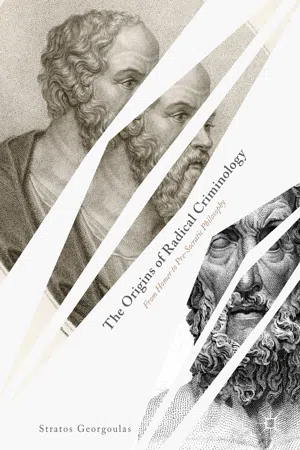
The Origins of Radical Criminology
From Homer to Pre-Socratic Philosophy
- English
- ePUB (mobile friendly)
- Available on iOS & Android
eBook - ePub
About this book
Information
© The Author(s) 2018
Stratos GeorgoulasThe Origins of Radical Criminologyhttps://doi.org/10.1007/978-3-319-94752-5_11. Introduction
Stratos Georgoulas1
(1)
Sociology, University of the Aegean, Mytilene, Greece
Stratos Georgoulas
Keywords
New criminologyConflictArchaeology of knowledgeDiscourseGenealogyTheories of crime and deviance and social theories are, in general, partly creations of their time. A great deal of literature on deviance is characterized by a consensual societal view and the assumption not only that there is a fundamental agreement between people in terms of the objectives of social life, but that there are also rules or norms that should govern the pursuit of these rules. This specific paradigm has been challenged several times, but it is important that controversies have been more effective in times of political uncertainty or, in other words, in times when people feel less secure about stability, permanence or legitimacy of social arrangements.
Such a period during the second half of the twentieth century resulted in the formation of a “new” approach to crime and deviance, which was named by its founders as new criminology (Taylor et al. 1973). According to this approach, crime and criminal policies should be one of the central issues of social theory. This particular view is not only the legitimization of the need for an integrated or pluralistic approach, but above all of the need to study crime so that restrictive interpretations of the phenomenon are avoided, which at the same time attempted to blur its social consequences.
The risk of the research object becoming autonomous can legitimize its status quo. For example, scientific questions about the nature of crime, when they focus on trying to discover its very nature, as if investigating an “other” reality, lead to answers recording a form of expert “know-how”, produced under laboratory conditions. Although experts positivize any scientific conclusions, as these are recorded through the use of scientific methods and techniques, nevertheless their framework of action itself is idealistic. The main ideology supported in this way is the ideology of preserving and reproducing a particular social situation and status. The social situation that produces this scientific question is neither researched, nor studied. If the scientific question raised is scientific in nature (that is, what the cause is, what the result of this act is) and cultural, historical, social, political and economic perspectives are excluded, then the answer is in advance teleological and obviously conservative.
A social scientist who explores modern reality can contribute to the criticism of such a simplified analysis by recording conflicts in value and behaviour patterns using the scientific method of comparison: comparison in time, comparison in place, comparison at the same place and time, between different groups of people. The conflict perspective as a conceptual tool of a sociological analysis of reality is a clearly defined framework for the development of interpretations, which is opposed to positivism and functionalism and has also exerted influence on the field of criminological thought. The “indisputable evil” product of a social consensus is replaced by evil that is defined as a result of a criminalization process controlled by the socially strong—the winners in the social conflict—at the expense of the socially weak—the losers.
Such a social conflict can occur at the level of cultural values, interest groups or social classes, and always results in attempting to preserve and reproduce the power of the winner. This is, in principle, law that primarily protects goods and values and attitudes of the powerful and continues with the operation of mechanisms of official social control exercised by the powerful who with their actions or omissions preserve the result of pre-existing conflict. The greater the social conflict, the more likely are the powerful to criminalize the behaviour of those who have questioned their authority and threaten their interests.
The historical social context within which this conflict takes place is also of utmost importance. For example, the advent of capitalism meant the replacement of social relations (and penal agreements) of feudalism with capital and labour relations, implying a fundamental change in the content, function and jurisdiction of law. It is not only that crimes—which replaced the “feuds” among related groups—entailed sanctions under official laws of the state. It is also that these crimes have been understood in terms of individual offences for which people as individuals should be held accountable. That was not just the victory of a specific interest group over another for historically specific reasons. It was also the victory of a morality of individualism that gave meaning to and supported a particular economic and social system at an early stage of its evolution. The structure and operation of whole bodies of law in an advanced capitalist society can now be seen as a reflection of this morality (acquiring autonomous and “self-evident” character) and not as an accumulation of activities by independent and autonomous interest groups in different historical periods. Besides, with a few exceptions, criminal laws were established primarily for the protection and development of the institutions of capitalism. And it is not just criminal sanctions against robbery, theft, burglary, or other private property violations. It also concerns sanctions to control how social structure would develop within capitalist cities and sanctions that had a direct effect on defining how the division of labour within society and consequently, class structure, are organized.
“New” and critical criminological thinking is certainly neither unified nor a single approach. All in all, however, it is possible to identify the points of convergence along the path that was opened by Marxist perspectives and socialist thought, the path that the initiative of conflict criminology has theoretically strengthened. This path of analysis has been enriched by a number of theoretical perspectives that cannot be ignored because they offer much to the empowerment of this interpretation in relation to criticisms that call for oversimplification and a superficial explanation of power relations that exist in a community. At the same time it is characterized by socially researched assumptions—evaluations such as the following (Vold et al. 2002, pp. 240–2):
(a) A person’s values and interests are shaped by their living conditions. In modern societies people live in different circumstances, so their values and interests differ. (b) People act in accordance with their values and interests. When their values are contrary to their interests, they adjust their values to interests. (c) Laws come to support individuals’ values and interests. When there are opposing interests and values, then law supports the interests and values of sovereign or dominant social groups. (d) Usually, law enforcement officers, because they operate within bureaucratic structures, do more quickly and dynamically in easy cases than in difficult ones. The easy cases are those of offences committed by individuals or groups with low levels of political and economic power. On the contrary, difficult cases are violations of the powerful. (e) It is precisely because of the previous selective operation of law enforcement officers that the officially recorded criminality, which is a record of their action, will present elements that are in line with the distribution of power in a community. That is, most criminals are expected to be individuals without economic and political power who violate values and interests of the powerful. More specifically, the basic context in its analysis is the association of social class, crime and social control, as it mainly emanates from state actors. It investigates criminalization, the expansion of social control and enforcement of laws by the police and the judicial system, legalization by the community of the institutionalized repression, that is, the relationship between individuals or social groups of action and structure.
Michel Foucault (2002) proposed a specific way of looking at the areas and ways of producing knowledge as well as of the produced truth and scientific objectivity as the results of the fundamental interdependent practices of knowledge-power and their historical transformation.
Every interpretative endeavour is mediated by power relations, whereas each theory does not constitute clear knowledge but a practice of discourse. Historical practice is replaced with the archaeology of knowledge. More specifically, Foucault studied the processes and rules out of and by which the “discourses” or “discursive formations” historically emerged and formed, especially in human sciences. “Exclusion procedures”, principles of prohibition, division and rejection, define what the legitimate object of thinking is and what is not, and thus participate in delineating and constructing objects of thought themselves, determining when, where, how and why it is allowed or not to speak and delimit areas of discourse beyond the limits of legitimacy. Relationships that are developed, both inside and outside of “discursive formations”, are relations of power.
Knowledge production practices themselves are mostly carried out, most of the time, in a defined framework of discourse formations, within specific political, economic and institutional truth production regimes. Therefore they constitute, from the outset, more or less controlled and “disciplined” practices. The very world of the production of scientific knowledge is a world of power governed by historically shaped boundaries, divisions, rules, bans, hierarchies and controls.
Knowledge can never be returned to a subject that is free in relation to a power diagram, as power can never be separated from the forces of knowledge that activate it.
What is going on, however, when a socio-political rupture produces a break in knowledge production? How does this happen? And how is it concretized in a field of knowledge, such as the study of deviance and social control?
This is precisely the object of the present research, with special reference to an era and an area, that is, Archaic Greece, which is unique and interesting for reasons that will be discussed below and which have yet to be studied by scholars who deal with issues of the (pre-) history of criminology and historical production of criminological knowledge.1
Within this political context and especially within its final political situation—that is, radical democracy that was called “tyranny”—epic and lyric poetry, drama and philosophy, which we will use as written evidence on the journey of this genealogy of radical criminology, were developed or transcribed.
The journey starts from Homer and his works that have been saved and attributed to him, that is, the epics of The Iliad and The Odyssey, which are the first “seam” of Greek history. After having discussed the literary “Homeric question” and analysed the historical and social context within which the Homeric epics were written, recited and transcribed, we will focus more specifically and analytically on these two works. In The Iliad, we learn that the power of the king-judge is not unlimited; it is often challenged by (other) third parties to whom he has to answer with arguments. Conflict is something given in the relationships of people and gods, and the final dominance decides on rules. Not everyone has the same price and value. However, retaliation as a judicial mechanism is already characteristic of a previous era. There is now a process of justice that involves the participation of a wider public.
What is recorded as the beginning in The Iliad, is further developed in The Odyssey. Good and evil are not given by the gods, but are human actions and law is exercised by folk assemblies or public meetings that even kings are afraid of. Besides, these kings are often not distinguished by merciful feelings, but just like the gods, they exploit people. Those who do not convene public meetings to do justice are considered to be uncultured. Conflict challenges authority and restitution can no longer lead to compromise and consensus, like in the old days.
In his Theogony Hesiod re-invents the gods of ancient Greeks and, at the same time, incorporates them in a context of continuous conflicts, where through tota...
Table of contents
- Cover
- Front Matter
- 1. Introduction
- 2. The Historical Context: From Renaissance to Radical Change
- 3. Homer
- 4. Hesiod
- 5. Lyric Poetry
- 6. Greek Drama: Aeschylus
- 7. Pre-Socratic Philosophy
- 8. Concluding Note
- Back Matter
Trusted by 375,005 students
Access to over 1.5 million titles for a fair monthly price.
Study more efficiently using our study tools.
Frequently asked questions
Yes, you can cancel anytime from the Subscription tab in your account settings on the Perlego website. Your subscription will stay active until the end of your current billing period. Learn how to cancel your subscription
No, books cannot be downloaded as external files, such as PDFs, for use outside of Perlego. However, you can download books within the Perlego app for offline reading on mobile or tablet. Learn how to download books offline
Perlego offers two plans: Essential and Complete
- Essential is ideal for learners and professionals who enjoy exploring a wide range of subjects. Access the Essential Library with 800,000+ trusted titles and best-sellers across business, personal growth, and the humanities. Includes unlimited reading time and Standard Read Aloud voice.
- Complete: Perfect for advanced learners and researchers needing full, unrestricted access. Unlock 1.5M+ books across hundreds of subjects, including academic and specialized titles. The Complete Plan also includes advanced features like Premium Read Aloud and Research Assistant.
We are an online textbook subscription service, where you can get access to an entire online library for less than the price of a single book per month. With over 1.5 million books across 990+ topics, we’ve got you covered! Learn about our mission
Look out for the read-aloud symbol on your next book to see if you can listen to it. The read-aloud tool reads text aloud for you, highlighting the text as it is being read. You can pause it, speed it up and slow it down. Learn more about Read Aloud
Yes! You can use the Perlego app on both iOS and Android devices to read anytime, anywhere — even offline. Perfect for commutes or when you’re on the go.
Please note we cannot support devices running on iOS 13 and Android 7 or earlier. Learn more about using the app
Please note we cannot support devices running on iOS 13 and Android 7 or earlier. Learn more about using the app
Yes, you can access The Origins of Radical Criminology by Stratos Georgoulas in PDF and/or ePUB format, as well as other popular books in Social Sciences & Ancient History. We have over 1.5 million books available in our catalogue for you to explore.