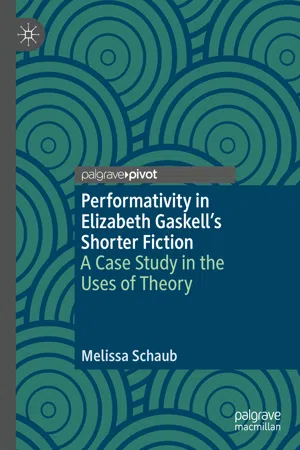
This book simultaneously examines the specific theoretical issues raised by Elizabeth Gaskell's use of characterization in her shorter fiction, and addresses the larger question of how literary critics ought to use theory. The text gives a history of Judith Butler's theory of performativity and the uptake of that theory in literary criticism, and also provides detailed close reading of Gaskell's fiction—both frequently examined texts like Cranford, Mary Barton, and Wives and Daughters, and some that are less often studied, such as "Lizzie Leigh" and Cousin Phillis. The book argues that as theory becomes naturalized into the vocabulary of literary scholars, it often becomes more optimistic and less specific. In discussing the naturalization of theory exemplified by the application of performativity to Gaskell, the book advances general principles on the use of theory. It can be read as scholarship or used as a textbook in literary methods courses.
eBook - ePub
Performativity in Elizabeth Gaskell’s Shorter Fiction
A Case Study in the Uses of Theory
- English
- ePUB (mobile friendly)
- Available on iOS & Android
eBook - ePub
Performativity in Elizabeth Gaskell’s Shorter Fiction
A Case Study in the Uses of Theory
About this book
Information
© The Author(s) 2019
M. SchaubPerformativity in Elizabeth Gaskell’s Shorter Fictionhttps://doi.org/10.1007/978-3-030-26314-0_11. Introduction: The Paradox of Subjectivity and the Naturalization of Theory
Melissa Schaub1
(1)
University of North Carolina at Pembroke, Pembroke, NC, USA
Melissa Schaub
Abstract
This chapter establishes both the intellectual history of Judith Butler’s theory of performativity and the main conflict in how that concept has been applied to Elizabeth Gaskell’s fiction, using J. Hillis Miller’s formulation of the “cheerful hypothesis” versus the “gloomy hypothesis.” The chapter provides a history of the concept of performativity beginning with J.L. Austin, and a detailed analysis of Butler’s Gender Trouble and Bodies That Matter. The central paradox of Butler’s theory is the way that it depicts people as being wholly constructed and compelled to “perform” their roles by discourses, and yet also able to “resignify” those discourses through failed performances. When critics apply Butler, they generally choose to emphasize only the cheerful side of this paradox. The chapter illustrates this tendency by a survey of criticism applying Butler to nineteenth-century literature in general and to Gaskell in particular.
Keywords
Elizabeth GaskellJudith ButlerPerformativity Gender Trouble Bodies That MatterIn a frequently quoted passage from one of her letters, Elizabeth Gaskell describes the difficulties that arise from having a “great number” of “Mes” whose desires and duties conflict: “How am I to reconcile all these warring members?” ( Letters , 108).1 Gaskell’s explicit awareness that personal identity can be multiple and unstable has led scholars to read her fiction through the lens of postmodern anti-essentialism about the self. Many of these readings directly or indirectly rely on Judith Butler’s theory of performativity—the basic belief “that human beings have no innate selfhood or subjectivity but become what they are through more or less forced repetition of a certain role” (Miller 2009, 146). However, rather than emphasizing the frozen and “forced” qualities of an identity that is called into being by the performative power of discourse, scholars tend to see Gaskell’s fiction as illustrating the potential freedom for individuals that might result if there are no fixed or essential selves, only roles. That is, they treat performativity as though it were theater (performance), rather than a compulsory response to words that have the force of actions (performatives ). While the theatrical sense of performance is partially validated by the initial version of performativity Butler described in Gender Trouble (1990), Butler went to great lengths to nuance this reading of what it means to perform gender and other elements of identity in Bodies That Matter (1993) and in later writings. Nevertheless, the uptake of her theory by practicing literary scholars (those who read texts using theory, rather than constructing theory with occasional references to texts) has emphasized the theatrical version of the theory, and has also leaned more toward what J. Hillis Miller has called the “cheerful hypothesis” rather than the “gloomy hypothesis” (2010, 33) that can equally well be derived from her works.2 Readings that use the terminology of performativity without the larger theoretical apparatus around it, those for which performativity is detached from any specific theorist, are even more likely to produce readings on the cheerful side.
Gaskell scholars are representative of literary scholars generally in this tendency to prefer the cheerful hypothesis and also to dilute theoretical concepts by detaching them from their original context. The desire to emphasize the subversive potential in the texts they study is understandable to some degree, since Gaskell is thought of primarily as a novelist, and characters in realist novels are written to be complex in ways that align more easily with a theatrical understanding of performativity. But Gaskell also provides many examples of characters who exemplify the gloomy hypothesis, particularly in her shorter fiction, and it is important to read them as well. More broadly, the way Butlerian performativity is applied to the characters of Elizabeth Gaskell illustrates the process of literary-theory-at-work, in which key terms and ideas from theorists are, over time, detached from their original contexts and naturalized into the critical vocabulary of literary scholars who are primarily concerned with reading texts rather than with constructing theories. This naturalization is a sign of success in the competitive marketplace of ideas, but in the process, theories lose some of their specificity. Thus a case study of Gaskell’s shorter fiction constitutes an excellent means by which to examine our larger practice as a discipline, one in which I myself, as a scholar primarily concerned with reading texts rather than with constructing theories, am fully implicated.
Before embarking on a discussion of Elizabeth Gaskell in specific, it is necessary to establish the history of the terms “performative” and “performativity.” Scholars broadly agree that the original use of the word “performative” belongs to J.L. Austin, whose 1962 book How to Do Things with Words explored the kinds of speaking that have the force of action: speech acts or what he called performative utterances, such as legal pronouncements, vows, and marriage ceremonies. This concept has had influence in many disciplines beyond literary studies, but for literary analysis, the most relevant development is the addition to the theory made by Jacques Derrida (1972) in his insistence on the “citationality” of performative utterances, their openness to being repeated, and the necessity for them to conform to a previously existent model to have force (18). Butler extends that insight to maintain that the citation is not necessarily to specific texts, but to larger discourses. She argues that bodies/sex are as constructed as gender is, and in doing so invokes Michel Foucault’s notion of discourse in its role as a “regulatory ideal”3 by which bodies manifest the law. The law, specified as compulsory heterosexuality, is ascribed to Sigmund Freud in Gender Trouble , but in a more detailed way to Jacques Lacan in Bodies That Matter . There, the regulatory ideals of gender and other discourses act as performatives to “interpellate” subjects into existence under the law in the way described by Louis Althusser.4 The first such moment for any subject is his or her experience of Lacan’s “mirror stage,” when the child first perceives his or her formerly disjointed collection of physical parts and sensations as a singular self, idealized in the moment of seeing it in the mirror as a whole rather than a collection (BTM, 75), and when it becomes a subject through the power of “the name, which installs gender and kinship” and acts as a “performative” (BTM, 72) in Austin’s sense. I have tried here to highlight the way that Butler’s theory of the performative blends together almost every major strand of poststructuralist theory. Because of that relationship, performativity makes an excellent case study in the uses to which theory has been put by practicing scholars, since much of what can be said about performativity applies to other theories as well.
The fiction of Elizabeth Gaskell is also well suited to a case study discussing the application of theory. Since the 1990s, critics have read her fiction as political both because of her often explicit focus on social issues like industrialization, and because her narrative complexity dovetails well with the kind of approach to ideology and discourse outlined above—the politics of class and the politics of gender. In the influential study of Victorian women writers, Nobody’s Angels, Elizabeth Langland (1995) describes the Victorian home as a “theater for the staging of a family’s social position” (9), a theater primarily managed by the performances of the women of the house. Mrs. Gibson of Gaskell’s Wives and Daughters is one of her main examples of such performance. Many critics have followed Langland’s lead in using this theatrical metaphor for class and domestic management in their readings of Gaskell and other women authors, and still do today.5 Such analyses privilege the characters’ shifting identities and their frequently knowing performances of class and gender roles as signs of Gaskell’s complex and resistant relation to Victorian ideologies of self. But while class and gender roles are often performed in the novels that more scholars emphasize, identity in Gaskell’s short fiction is more truly performative . The homes that serve as the stage in tales as diverse as “The Old Nurse’s Story” and “The Crooked Branch” are the stages of melodrama, frequently featuring emotional tableaus in which the characters are frozen into their roles. Identity in the short stories is not performed knowingly, but is a tragic and repeated imperative that few characters escape, exemplifying the gloomy hypothesis that is so frequently bracketed in applications of performativity, but which ought to be more common if one takes Butler and her intellectual context at face value.
The contrast between the forms of Gaskell’s fiction tracks a conflict in the theory of performativity and the philosophical theories of mind that preceded it. Langland (1995) speaks of women of the “genteel bourgeoisie” (17) as managers, whose conduct manuals explained their roles in the language of “generalship” (40) or psychology—implying their consciousness of the “constructed nature of experience” (11). Dorice Williams Elliott (2010) goes further and ascribes that self-consciousness of performance to the servants who are being managed as well (125). But Langland also describes the end results of that process of construction as discourses in which categories appear “inevitable” and “natural” (60). If the women generals are aware that their reality is staged and constructed, and so are the servants, to whom do the discourses of gender and class seem inevitable and natural? This tension between the artificial origin and the totalizing power of discourse is not unique to Langland; since she takes her theoretical grounding from both Pierre Bourdieu and Judith Butler, it is inevitable that she will describe middle-class women as “produced by domestic discourses even as they reproduced them” (11). The paradox of discourses that both form subjects and are formed by them is the central prob...
Table of contents
- Cover
- Front Matter
- 1. Introduction: The Paradox of Subjectivity and the Naturalization of Theory
- 2. Strict Performativity and the Limits of Resignification in Stories and Novels
- 3. Turning the Glacier: Modernity and Complex Identity in the Novellas
- 4. Conclusion: Principles for the Uses of Theory
- Back Matter
Trusted by 375,005 students
Access to over 1.5 million titles for a fair monthly price.
Study more efficiently using our study tools.
Frequently asked questions
Yes, you can cancel anytime from the Subscription tab in your account settings on the Perlego website. Your subscription will stay active until the end of your current billing period. Learn how to cancel your subscription
No, books cannot be downloaded as external files, such as PDFs, for use outside of Perlego. However, you can download books within the Perlego app for offline reading on mobile or tablet. Learn how to download books offline
Perlego offers two plans: Essential and Complete
- Essential is ideal for learners and professionals who enjoy exploring a wide range of subjects. Access the Essential Library with 800,000+ trusted titles and best-sellers across business, personal growth, and the humanities. Includes unlimited reading time and Standard Read Aloud voice.
- Complete: Perfect for advanced learners and researchers needing full, unrestricted access. Unlock 1.5M+ books across hundreds of subjects, including academic and specialized titles. The Complete Plan also includes advanced features like Premium Read Aloud and Research Assistant.
We are an online textbook subscription service, where you can get access to an entire online library for less than the price of a single book per month. With over 1.5 million books across 990+ topics, we’ve got you covered! Learn about our mission
Look out for the read-aloud symbol on your next book to see if you can listen to it. The read-aloud tool reads text aloud for you, highlighting the text as it is being read. You can pause it, speed it up and slow it down. Learn more about Read Aloud
Yes! You can use the Perlego app on both iOS and Android devices to read anytime, anywhere — even offline. Perfect for commutes or when you’re on the go.
Please note we cannot support devices running on iOS 13 and Android 7 or earlier. Learn more about using the app
Please note we cannot support devices running on iOS 13 and Android 7 or earlier. Learn more about using the app
Yes, you can access Performativity in Elizabeth Gaskell’s Shorter Fiction by Melissa Schaub in PDF and/or ePUB format, as well as other popular books in Literature & Literary Criticism Theory. We have over 1.5 million books available in our catalogue for you to explore.