- English
- ePUB (mobile friendly)
- Available on iOS & Android
eBook - ePub
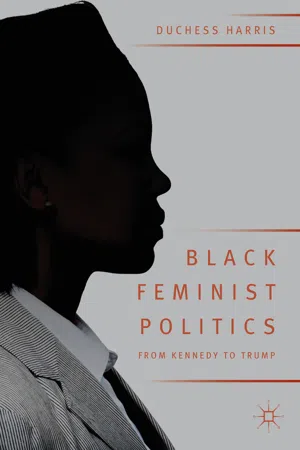
Black Feminist Politics from Kennedy to Trump
About this book
From "black girl magic" to Black Lives Matter, the second decade of the 21st century is defined by black feminist politics. Black Feminist Politics from Kennedy to Trump is a definitive investigation of the mainstreaming of black feminist politics in the 21st century. Following on the success of Black Feminist Politics from Kennedy to Clinton and Black Feminist Politics from Kennedy to Obama, this volume incorporates the black women leaders of Black Lives Matter; contemporary black feminist political stars like Rep. Maxine Waters and Senator Kamala Harris; and the transformative influence of black feminist political strategy and principles in mainstream U.S. politics, especially in the 2016 U.S. election. The text also deepens earlier editions' consideration of sexuality and gender identity in black feminist politics and explores the role of digital organizing and social media in setting the terms of contemporary political struggles. A must-read for scholars in Political Science, American Studies, Africana Studies, History, and Gender/Feminist/Women's Studies, Black Feminist Politics from Kennedy to Trump also breaks down the complexity of contemporary politics for an everyday reader eager to understand how black women have been defining leadership and politics since the mid-century.
Information
© The Author(s) 2019
Duchess HarrisBlack Feminist Politics from Kennedy to Trumphttps://doi.org/10.1007/978-3-319-95456-1_11. Introduction: The Departure of Michelle Obama from the White House and the Need for Black Feminism
2017 was a monumental year for Black women in America due to two important events: First Lady Michelle Obama left the White House, and it was the 40th anniversary of the Combahee River Collective Statement .
When I first published Black Feminist Politics in 2009 and 2011, the cover art was Faith Ringgold’s “The Purple Quilt.” In “The Purple Quilt,” panels of text from Alice Walker’s The Color Purple reinforce portraits of characters found in the novel. In hindsight, I would have chosen Ringgold’s “The Flag is Bleeding.” Ringgold has long used her art to voice her opinions on racism and gender inequality. In 1967, she created a series of paintings, “The American People,” focused on racial conflict and discrimination. “The Flag is Bleeding,” number 18 in the series, depicts an African-American man standing next to a white couple. Although the three seem united, the African-American man’s wound indicates otherwise. I love this work of art because its significance is not solely about who is represented in the flag. When I share “The Flag is Bleeding” in the classroom, I often ask students, “Who do you think is missing, and what do you think Ringgold is trying to say about America?”
Many Americans are missing, but my principal concern is the absence of the Black woman. I think Ringgold is trying to say that Black women are often invisible in America’s political narrative, despite the fact that we are integral to its very fabric.
In the wee hours of the morning on Wednesday, November 9, 2016, we found out that the next president of the United States A would be Donald J. Trump. As a demographic, Black women supported him less than any other group at a mere four percent. The inverse of this equation is that Black women voted for Democratic presidential nominee and former Secretary of State Hillary Clinton at a whopping 94%. Notice I said “voted for.” I didn’t say that we were #WithHer, because many of us weren’t. The main reason? Feminism—that is to say, white feminism —has historically taken credit for Black women’s ideas and achievements while at the same time writing them out of narratives, failing to welcome them at the metaphorical (and often literal) table. In this way, Hillary Clinton was no different from most white feminists. For many Black women voters, she simply was the lesser of two evils.
In Black Feminist Politics from Kennedy to Clinton, I noted that Vijay Prashad wrote that once Bill Clinton was sworn into office in 1993, “The braying of the right was so abhorrent and hypocritical that Bill Clinton gained some measure of forgiveness from those who were otherwise livid with him. It was in this context that Toni Morrison said that he was being treated like a Black man: given no quarter, shown no mercy, but treated as guilty as charged without any consideration or process.” Prashad explained how things changed between 1998 and 2008, when Hillary Clinton first ran for president:
But now, finally Bill Clinton has given us some honesty. He has opened his heart during this primary season, joining Hillary Clinton in pandering to the Old South, the hard core racist bloc that was never reconciled to Civil Rights, that continues to blame Blacks for the vivisections of their economic fortunes. It is this bloc that handed Hillary Clinton the primaries of Pennsylvania, Indiana, West Virginia, and Kentucky. After her loss in the South Carolina primary, where the Democratic electorate is substantially Black, Hillary Clinton’s husband, Bill, told the press, “Jesse Jackson won South Carolina in 1984 and 1988. Jackson ran a good campaign and Obama ran a good campaign here.”1
It was after these remarks were made that I predicted that Toni Morrison would take back Bill Clinton’s invitation into the Black family, and indeed she did. Some say that it’s unfair to entangle Hillary with the actions of her husband, but elite white feminism teaches us that marrying a president is the best way for a woman to become a presidential candidate.
Hillary’s pandering to the Old South in 2008 might have been forgiven by some once the Obamas campaigned for her, but an early colossal mistake—one underscoring that her feminism was largely for white women—was treating the women from #BlackLivesMatter with dismissive condescension in 2016. When Ashley Williams confronted Clinton during a fund-raiser in February of that year—a fund-raiser for which she had paid the $500 ticket—to ask why, in 1996, Clinton had defended her husband’s crime bill by denigrating Black communities by referring to some kids within them as “super-predators.” The super-predator image and Clinton’s crime bill are largely considered to be the precursors to the current and escalating epidemic of the mass incarceration of Black people, and Williams demanded during the fund-raiser that Clinton explain herself and apologize. Clinton’s response? “Well, can I talk? And then maybe you can listen to what I say.”2
By August 2016, the tensions between the Clinton campaign and Black Lives Matter activists had escalated. Many BLM activists and people of color generally were deeply dissatisfied when Clinton spoke publicly in response to the July shooting in Dallas, in which five police officers were killed and nine were wounded. Following the shooting, she met with police chiefs from around the country and went on record as saying that the Dallas officers “represent officers who get up every day, put on their uniforms, kiss their families goodbye and risk their lives on behalf of our communities.”3 Meanwhile, BLM activists were urging her to be clear about her positions regarding aggressive policing and mass incarceration. Clinton, speaking to the General Conference of the African Methodist Episcopal Church, seemed to be keenly aware that she was on a tightrope, one that would leave nearly everyone dissatisfied. “I’m talking about criminal justice reform the day after a horrific attack on police officers,” she said. “I’m talking about courageous honorable police officers just a few days after officer-involved killings in Louisiana and Minnesota…. I know that just by saying all these things together, I may upset some people.”
Within weeks, the BLM-Clinton relationship would simmer into a boil.
When activists were not allowed into a campaign event in New Hampshire (the campaign said the local fire marshal prevented them from allowing more people into the venue), Clinton scheduled a meeting to discuss concerns with the activists, who included Daunasia Yancey, founder of Boston’s Black Lives Matter chapter. Far from assuming a posture of listening, Clinton instead assumed the posture so familiar to white feminist leaders: The white woman knows best. CNN’s Dan Merica described Clinton’s attitude in the encounter as follows:
Throughout the 15-minute conversation, Clinton disagreed with the three activists from Black Lives Matter who had planned to publicly press the 2016 candidate on issues on [sic] mass incarceration…. The 2016 candidate even gave suggestions to the activists, telling them that without a concrete plan their movement will get nothing but “lip service from as many white people as you can pack into Yankee Stadium and a million more like it.”4
In the weeks following the encounter, Yancey told the media that at no point during the meeting did she hear “a reflection on (Clinton’s) part in perpetuating white supremacist violence.”5 That reflection, in fact, never came during the campaign, nor in any post-mortems of it once Trump won the election. Black women might have been disappointed, but they were hardly surprised.
What did occur in the postmortem, however, was an analysis of the ways in which white women failed to show up for Clinton. Former Slate editor L. V. Anderson (who is white) argued that white women decided that defending their position of power as white people was more important than defending their reproductive rights, their sexual autonomy, their access to health care, family leave, and child care.6 White women bought into Trump’s lies about immigrant rapists and decided they’d rather have the respect of their angry white fathers, brothers, and husbands than the respect of literally everyone else in the world.
The bifurcations among women as expressed in the 2016 election are important to the intellectual project of American Studies, which centers the question of gender. Anderson wrote,
The results of the election indicate[d] that most white women don’t consider themselves part of the coalition of non-white, non-straight, non-male voters who were supposed to carry Clinton to a comfortable victory. Most white women still identify more with white men than they do with Black women, Latina women, Muslim women, transwomen, and every other woman who will have good reason to fear for her physical safety under a Trump regime. And while it’s nonwhite and queer women who have the most to lose under Trump, white women will have to live with the consequences of their own actions in a country without a right to abortion , without access to health insurance, without an adequate family leave policy, and with a head of state who values them only insofar as he wants to fuck them.7
Education was also a great divide, for women as well as for men. The president-elect won 62% of white women without college degrees; Secretary of State Clinton, 34%. “Class shapes gender identity,” says Nancy Isenberg, the author of White Trash, which examined how elites have derided rural, working-class Americans from the colonial era to this day. “I think a lot of people who support Trump think of themselves as being disinherited. They resent the fact that everything they believe in is mocked by the media elite, and Hollywood. That resentment is shared by men and women.”8
While Clinton might have made token appearances in blue-collar communities, it could hardly be argued that Clinton was “in touch” with the 99%. Journalist Liza Featherstone noted that the campaign endlessly touted endorsements from the ranks of celebrity one-percenters, especially women. In the end, Clinton enjoyed a gender advantage only among the college-educated. Among white women without college degrees, Clinton lost to Trump by 28 points. Featherstone sarcastically commented, “It was almost as if waitresses in Ohio didn’t care that [Vogue editor-in-chief] Anna Wintour was #WithHer.”9 All the talk about angry white men glossed over the fact that they were married to angry white women. This is also why class analysis is critical to the discipline of American Studies. Salamishah Tillet, an associate professor of English and Africana Studies at the University of Pennsylvania reflected, “It’s not like Black people or Latino people aren’t sexist and patriarchal. But when we thought about ourselves and collective best interest, we voted for Clinton.”10
As a Black feminist, I know that I can’t “lean in” to a democracy that was built on a bridge called my back. Race is a central dimension of US social, political, cultural, and economic life. The prevailing concepts of citizenship, community, freedom, and individuali...
Table of contents
- Cover
- Front Matter
- 1. Introduction: The Departure of Michelle Obama from the White House and the Need for Black Feminism
- 2. A History of Black American Feminism
- 3. Black Women’s Relationships with Party Politics
- 4. The ’90s in Context: A History of Black Women in American Politics
- 5. Doubting the Democrats: Current Disenchantment and Political Futures
- 6. The State of Black Women in Politics Under the First Black President
- 7. Your President Is (a) White (Supremacist): Post Obama and Black Feminist Politics
- 8. Conclusion: Reclaiming Our Time—Black Feminist Politics in the Trump Era
- Back Matter
Trusted by 375,005 students
Access to over 1.5 million titles for a fair monthly price.
Study more efficiently using our study tools.
Frequently asked questions
Yes, you can cancel anytime from the Subscription tab in your account settings on the Perlego website. Your subscription will stay active until the end of your current billing period. Learn how to cancel your subscription
No, books cannot be downloaded as external files, such as PDFs, for use outside of Perlego. However, you can download books within the Perlego app for offline reading on mobile or tablet. Learn how to download books offline
Perlego offers two plans: Essential and Complete
- Essential is ideal for learners and professionals who enjoy exploring a wide range of subjects. Access the Essential Library with 800,000+ trusted titles and best-sellers across business, personal growth, and the humanities. Includes unlimited reading time and Standard Read Aloud voice.
- Complete: Perfect for advanced learners and researchers needing full, unrestricted access. Unlock 1.5M+ books across hundreds of subjects, including academic and specialized titles. The Complete Plan also includes advanced features like Premium Read Aloud and Research Assistant.
We are an online textbook subscription service, where you can get access to an entire online library for less than the price of a single book per month. With over 1.5 million books across 990+ topics, we’ve got you covered! Learn about our mission
Look out for the read-aloud symbol on your next book to see if you can listen to it. The read-aloud tool reads text aloud for you, highlighting the text as it is being read. You can pause it, speed it up and slow it down. Learn more about Read Aloud
Yes! You can use the Perlego app on both iOS and Android devices to read anytime, anywhere — even offline. Perfect for commutes or when you’re on the go.
Please note we cannot support devices running on iOS 13 and Android 7 or earlier. Learn more about using the app
Please note we cannot support devices running on iOS 13 and Android 7 or earlier. Learn more about using the app
Yes, you can access Black Feminist Politics from Kennedy to Trump by Duchess Harris in PDF and/or ePUB format, as well as other popular books in Politics & International Relations & American Government. We have over 1.5 million books available in our catalogue for you to explore.