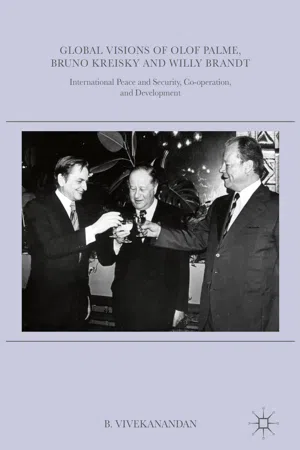
This book analyses the global visions of Olof Palme, Bruno Kreisky and Willy Brandt, European social democratic statesmen who earned international esteem for their contributions to global developments during the second half of the twentieth century. Their visions encompassed, inter alia, international peace and security, East-West and North- South Cooperation, and other important domains pertinent to developing countries of Asia, Africa and Latin America. In this volume, the author closely examines the advancements Palme, Kreisky and Brandt made and demonstrates how their visions remain valid for shaping the future of mankind.
eBook - ePub
Global Visions of Olof Palme, Bruno Kreisky and Willy Brandt
International Peace and Security, Co-operation, and Development
- English
- ePUB (mobile friendly)
- Available on iOS & Android
eBook - ePub
Global Visions of Olof Palme, Bruno Kreisky and Willy Brandt
International Peace and Security, Co-operation, and Development
About this book
Information
© The Author(s) 2016
B. VivekanandanGlobal Visions of Olof Palme, Bruno Kreisky and Willy Brandt 10.1007/978-3-319-33711-1_11. Introduction
B. Vivekanandan1
(1)
Jawaharlal Nehru University, Trivandrum, Kerala, India
1.1 I
Post-war Europe gifted to the world an outstanding trio of social democratic statesmen who distinguished themselves by their global visions and their perseverance in the goal of accomplishing those visions. Olof Palme, Bruno Kreisky and Willy Brandt belonged to an exciting class of global statesmen who had the courage of their convictions to view humanity as one, and strove to take those convictions closer to what Wendell Willkie, in 1943, called the ‘one world’. Whether they were holding ministerial office or outside government, their endeavours revolved around the welfare of the whole of humanity, transcending cultures and continents. They made their mark in the international arena by putting forward global reform agendas based on key social democratic principles of freedom, equality, democracy, justice and solidarity, to be universally applied for the benefit of everyone in the world. They pursued those agendas with concrete action plans.
Significantly, these statesmen were contemporaries who held official positions as ministers and heads of government of their countries. Therefore, their primary obligation would have been expected to be treading narrow nationalist paths to promote the welfare of their countrymen, and protecting their national interests by ensuring the safety of their countries. Of course, they carried out those duties remarkably well and in an enlightened manner. At the same time, their concerns transcended the borders of their countries, and even of the European continent, to encompass the welfare of peoples of other cultures and continents under the basic guiding social democratic principle of international solidarity. Since they were birds of the same feather, wedded to the social democratic ideology, they flocked together in the global arena, carrying messages of peace, solidarity, development and welfare of mankind.
In the footprints of the history of the world, global statesmen stand out as symbols of wisdom of the eras in which they lived, whose farsightedness could have an impact on the course of history through their visionary intervention on behalf of the whole of humanity. In the second half of the twentieth century, Olof Palme, Bruno Kreisky and Willy Brandt earned international esteem and pre-eminent positions in the galaxy of world statesmen through their thoughtful contribution to the peace and welfare of people everywhere in the world. They became models of what individuals can contribute to the reform of world society. Their visions have provided a master plan of what the present generation should do for the future welfare of mankind.
There are times in the course of history when great personalities make enlightened interventions and point the way for changes which would be beneficial to humanity as a whole. The greatness of Palme, Kreisky and Brandt rests on the fact that together they made a spectacular intervention in the second half of the twentieth century by pointing the way towards building a world society wedded to peace, equality, freedom, justice and solidarity. They could thus impact on the reformulation of global policies.
It is a coincidence that three world statesmen could emerge at the same time from the same continent, and think and act in unison to promote equal justice for all in the world under the framework of international solidarity, freeing the global population from the bondage of fear and want. They thought ahead of their time, signalled the way for global change and acted for the long-term benefit of humanity. They attuned their foreign, economic and security policies to the peace and welfare of mankind. What guided them were the overall interests of future generations. They envisaged a reformed world where peace, security and solidarity would reign supreme, and where a new type of international relations, free from thorny problems, would flourish. They were confident that the anchor of their common security would engender this kind of global environment. They envisaged a world community marked by solidarity and mutual concern. Owing to their efforts, the interdependence of countries and their international obligations are increasingly being recognized.
1.2 From Divisiveness Springs Conflict
The world today is marked by innumerable divisions that segregate members of the human race on narrow grounds. These man-made, narrowly drawn dividing lines, variously defined at different times, have in general generated a suspicion-based confrontationist psyche, mostly based on narrow loyalties and identities of various kinds that have become the fountainhead of all troubles and conflicts in the world. To free the world from confrontations and conflicts, it is imperative to wipe out the psyche of divisiveness that has become rooted in the minds of people over the years. As most of troubles and conflicts in the world occur as a result of inequalities preserved by these dividing lines, their remedies should also come from the acceptance of equality and mutual respect as the bases for relationships across the world—between humans and between nations.
1.3 Advaita Answer to Divisiveness
The provision of a credible answer to divisiveness in the world, and the assertion of fundamental equality among humans, is Indian philosophy’s gift to world thought. The Indian answer to the divisiveness in the world is the quintessence of the advaita (indivisibility, non-duality) philosophy embedded in Indian Upanishads, which proclaims the equality and indivisibility of all human beings, whichever continent they live on at present. So the advaita philosophy exemplifies a universal approach, based on equality and human solidarity, as the right approach to dealing with the life situations of humanity as a whole. Indeed, according to the advaita philosophy, the equality of human beings is quite deep rooted and fundamental.
Consciously or intuitively, Palme, Kreisky and Brandt captured the spirit of equality and oneness embedded in India’s advaita philosophy. In 1953, at the age of 24, Olof Palme had the opportunity of staying in a South Indian temple for some time, although whether he had the chance to study the essence of advaita philosophy at that time is not clear. However, his approach to human problems in the world contained the spirit of equality and universality embedded in the advaita philosophy. It has fortified the metaphysical foundations of the “one world” concept promoted by the trio.
In a general global environment in which many rich countries are striving to build walls around themselves to protect their islands of prosperity against an ocean of poverty and underdevelopment, it was a grand vision of great significance for statesmen like Palme, Kreisky and Brandt from the developed world to come forward to view humanity as one and plan for a common future for all. It is an expression of readiness to share a universal common goal based on cooperation and solidarity. They conveyed a message that people everywhere should be ready to share more and more common goals in the interests of universal welfare.
Today, planet Earth remains more or less divided geographically and demographically into mutually exclusive independent entities of states and nations. But, as the exclusiveness of states and peoples becomes increasingly untenable due to unfolding changes in the global scenario, the tendency to think in terms of “one world” is gradually gaining ground. People show greater awareness of the need to approach problems and their solutions under wider common frameworks. Advances in science and technology, environmental issues, security, and so on, have increased the pace of this “one world” thinking.
1.4 “One World” Goal
Palme, Kreisky and Brandt were adherents of the political philosophy of ‘one world’, which connects people of all countries and all cultures. They envisaged a new universal socio-economic system based on equality and sharing among the people of the world. It is a world of reconciliation, common welfare, common security and international solidarity. They believed in the unity and equality of the human condition, recognized the organic nature of the world community and underlined the need to develop a universal socio-economic-political system for building a just society everywhere in the world. For them, international solidarity was the spirit of the age, which would make every country part of an interdependent world community. Common security would provide them all with peaceful frontiers. They underlined the picture of the world as a community of peoples, and stressed the value of solidarity between countries and peoples. They were realistic that islands of prosperity in an ocean of poverty would not be safe for long: it was therefore imperative for the world to move increasingly towards a responsible and responsive global society.
Today the ‘one world’ approach is not a flight of fantasy; it is increasingly becoming a necessity. As planet Earth is constantly shrinking, thanks to the communications revolution, ‘one world’ is no longer an utopia, but is very much in the realm of reality. Environment and ecology are intertwined in the developed and the developing countries alike to face the consequences of environmental disasters of high magnitude. The destinies of people from various countries are therefore becoming more and more fused, as most of the environmental and ecological problems are becoming trans-boundary issues. Climate change, for example, defies all geographical boundaries. Therefore, it is imperative to build up relations based on mutual trust and mutual concern. Equally imperative is the recognition of the dangers emanating from environmental and ecological exploitation.
Olof Palme, Bruno Kreisky and Willy Brandt were comrades-in-arms and, therefore, they had regular contacts and intellectual exchanges. They knew each other’s efforts and agenda for change. They were thinkers and activists who were moved by their visions, and had the resolution to realize those visions. They were universalists who believed in solving problems through international solidarity actions. They were profoundly human, and yearned to see a more humane world, free from fear and want, and from exploitation and injustice. They had a common perception of the welfare state system and full employment. They had a deep feeling for the deprived people of all countries, approaching issues from the angle of ordinary people in the world and seeking solutions beneficial to them. They welcomed situations when a sharing mentality became intertwined with the spirit of international solidarity, and underlined the connection between the eradication of poverty and peace in the world, between disarmament and development. They recognized the right of all people to have a safe future, and opposed the arms race, since they saw in it a threat to human survival. For them, human security meant the security of all peoples of all continents, and therefore, they strove for the peace, freedom and independence of all countries. As persons who believed in the common future of mankind, they reasoned that in a rapidly shrinking world, international solidarity and universal social justice are imperatives. Indeed, the trio became symbols of this approach who had articulated the necessity of a close cooperative relationship between the North and the South. They brought the issue of the development of the developing countries to the forefront of the agenda of global debate, making it a matter of concern also for the developed countries.
1.5 Equality, Freedom and Justice
The desire for equality, freedom and equal justice, which is innate in all human beings, can be met meaningfully in a framework of international solidarity. It is a recognized fact that there is an uneven distribution of the bounty of the planet Earth among its inhabitants. This is prevalent inside countries and between countries, and needs to be rectified. The situation at both these levels can be remedied through an approach based on solidarity at national and international levels. Developed countries cannot turn a blind eye to this disturbing situation. In this context, North–South cooperation is seen as the beginning of an action plan for social and economic justice in the world.
The world of today is undeniably faced with an unacceptable, paradoxical situation of having large unmet needs on the one side, while vast resources in the world remain idle on the other. Finding the right solution to this paradox is a major global challenge. The solution revolves around international cooperation based on international solidarity, which can ensure an orderly movement of resources between countries and continents for the purpose. For fruitful results, the domestic policies of countries should also be attuned to universal social justice. It means that the web of North–South cooperation based on international solidarity should be complemented by a web of domestic policies for equality and equal justice. Saving resources from the military budget to assist the development of poor countries is one part of the resource mobilization strategy, for example, prioritizing provision of bread for the hungry over the production and acquisition of Atomic, Biological and Chemical (ABC) weapons. South–South cooperation also sought to complement these efforts.
The trio held that the deterrence doctrine has merely promoted an adversarial system of international relations entailing a costly national defence set-up, with little emphasis on matters like common interests and cooperative commitments to national security. The Common Security doctrine provides the most effective set-up for national defence at the lowest cost. They held that many prevalent perceptions, such as deterrence, nationalism, and so on, are detrimental to the peace and security interests of all nations. That also led them to underline the imperative need for adherence to the principles of international solidarity and global interdependence for the promotion of common interests. They wanted it to be done through a process of constant renewal of the global system on more and more egalitarian lines, in tune with the changing character of world society, and also in tune with the aspirations of the world’s people. They strengthened people’s faith in ‘one world’, the bounty of which the whole of humanity should share fairly equally.
The steady reduction in distances between countries and continents calls for new approaches and new arrangements. The trio aspired to enhance the quality of the human condition everywhere on the planet, which required a change in the basic attitudes of the developed countries towards an international solidarity approach. A fundamental change in social and economic relationships in the world, and the building up of just societies everywhere was needed. They held that the application of the principles of solidarity and social justice should not stop at national borders, but should be applied on a global scale. It is a shared responsibility of all countries, they contended. They underlined the inter-locking character of the human condition and the global convergence of national destinies, and stressed the practical dimension and dynamism of the solidarity approach at all levels as a meaningful corrective to the problems of inequality and injustice in the world. That approach approximated the welfare state approach to fulfilling the needs of all peoples across the world.
1.6 A New Global Architecture
There is clearly a need for a new architecture of global relationships based on international solidarity and promoting genuine global partnership. The new architecture should be geared to reducing the current gap of inequalities in, and between, societies. The new situation requires a review of the definition of the national interest in the context of growing interdependence and partnership in the world. The global dimension of the problems of environment, biosphere, depletion of non-renewable resources, and so on, are factors to be taken into account while doing so. Nationalism will have to become reconciled with international solidarity and be marked by equality and sharing among peoples in a universal system.
The future direction of science and technology has a significant role to play in moulding new global relationships. Science and technology has not only helped man to increase human comfort and happiness, but has also provided the world with the wherewithal to destroy everything on earth many times over. It has been found that in national budget allocations across the world, war preparedness has received the highest priority in science and technology research and development (R&D). Such preferential treatment of war preparations would not be required at all under a ‘common security’ set-up. The R&D preferences would go to non-military sectors of national life. It must also be acknowledged that the technological revolution of the last century has provided the world with ways of bypassing the self-centred divisiveness that has created many barriers around countries and peoples, and to build bridges between them.
1.7 II
In the post-war global scenario, Olof Palme, Bruno Kreisky and Willy Brandt were not just catalysts, but springboards for new ideas and action plans for change to raise living standards for all people across the world. A look at their formative years will show that, to a great extent, their attitudes were moulded by their experiences early in life. Bruno Kreisky and Willy Brandt, for example, had undergone harrowing experiences during the two world wars. Kreisky had an early exposure to human suffering caused by the First World War. The son of a soldier at the front, who also lived quite close to a makeshift military hospital, where a constant stream of military trucks brought screaming, wounded, and maimed soldiers from the front for treatment, Kreisky grew up detesting war and violence. During the Second World War, he had to flee his own country, Austria, and lived as an exile in Scandinavia which promoted in him an international mind. These experiences made him also a man of compassion who became a natural opponent of war and violence. He had vivid memories of war-ravaged Vienna, where on his return after D-day he found people suffering untold poverty and penury.
Kreisky’s 12-year long stay in Sweden, a benign welfare state, as a persecuted refugee from Austria during the Nazi dictatorship, also made a tremendous impact on him. For the first time he was experiencing the practical value of the social democratic principle of international solidarity at critical times. Swedes are by nature compassionate and generous to people in distress. Their gentle behaviour, even to their opponents, impressed him. In Sweden, he realized the importance of the dual dimensions of the principles of social democracy, such as equality, justice, and solidarity. And he became more sensitive to the problems of the needy and the persecuted. He also imbibed the Scandinavian spirit of compromise and peaceful settlement of disputes, and later applied them fruitfully to tackling some very difficult international disputes. He viewed intransigence as a bane that had caused the outbreak of an avoidable, and unnecessary, First World War.
The early experience of Willy Brandt was much the same, and helped the development of his global vision. As an adolescent, at the age of 19, he had to flee his country, Germany, to escape the Nazis, arriving in Norway as an exile. As in the case of Bruno Kreisky, Willy Brandt’s internationalism also became vibrant in Scandinavia which taught him also, in practice, the social democratic value of international solidarity at both critical and normal times. After Norway was overrun by Hitler’s forces, Brandt crossed over to Sweden, and stayed there till the end of the Second World War. In all, he was an exile in Scandinavia for 15 years, from the age of 19 to 34, which taught him many lessons in life. It was during this period of exile that Brandt met Bruno Kreisky is Stockholm. They worked together as a team, founded the Little International, and thought out loud about the post-war re-construction of Europe, which was detailed in a publication entitled: “Peacetime Aims of Democratic Socialists”. Since then, Brandt and Kreisky remained close friends for the rest of their lives.
As an exile, Brandt was active in organizing resistance groups against Hitler and the Nazis. He was active in the London Bureau, a study group of independent socialist parties and organizations, and participated at its international conferences in London and Paris in 1937 and 1938. During the period of his exile, Brandt revelled in using mysterious ways to escape from difficult situations. He travelled in disguise, under assumed names, and with forged travel documents, to dodge the Nazis’ Gestapo and to save himself. The name “Willy Brandt” was one such assumed name, which he got stuck with. He could indulge in dare-devil acts, like making a secret visit...
Table of contents
- Cover
- Frontmatter
- 1. Introduction
- 2. Olof Palme
- 3. Bruno Kreisky
- 4. Willy Brandt
- 5. When All Is Said
- Backmatter
Trusted by 375,005 students
Access to over 1.5 million titles for a fair monthly price.
Study more efficiently using our study tools.
Frequently asked questions
Yes, you can cancel anytime from the Subscription tab in your account settings on the Perlego website. Your subscription will stay active until the end of your current billing period. Learn how to cancel your subscription
No, books cannot be downloaded as external files, such as PDFs, for use outside of Perlego. However, you can download books within the Perlego app for offline reading on mobile or tablet. Learn how to download books offline
Perlego offers two plans: Essential and Complete
- Essential is ideal for learners and professionals who enjoy exploring a wide range of subjects. Access the Essential Library with 800,000+ trusted titles and best-sellers across business, personal growth, and the humanities. Includes unlimited reading time and Standard Read Aloud voice.
- Complete: Perfect for advanced learners and researchers needing full, unrestricted access. Unlock 1.5M+ books across hundreds of subjects, including academic and specialized titles. The Complete Plan also includes advanced features like Premium Read Aloud and Research Assistant.
We are an online textbook subscription service, where you can get access to an entire online library for less than the price of a single book per month. With over 1.5 million books across 990+ topics, we’ve got you covered! Learn about our mission
Look out for the read-aloud symbol on your next book to see if you can listen to it. The read-aloud tool reads text aloud for you, highlighting the text as it is being read. You can pause it, speed it up and slow it down. Learn more about Read Aloud
Yes! You can use the Perlego app on both iOS and Android devices to read anytime, anywhere — even offline. Perfect for commutes or when you’re on the go.
Please note we cannot support devices running on iOS 13 and Android 7 or earlier. Learn more about using the app
Please note we cannot support devices running on iOS 13 and Android 7 or earlier. Learn more about using the app
Yes, you can access Global Visions of Olof Palme, Bruno Kreisky and Willy Brandt by B. Vivekanandan in PDF and/or ePUB format, as well as other popular books in Politics & International Relations & Diplomacy & Treaties. We have over 1.5 million books available in our catalogue for you to explore.