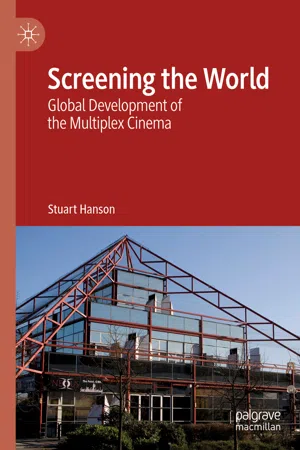
This book charts the development of the multiplex cinema as the pre-eminent form of film exhibition across the world. Going from its origins in the USA in the 1960s to its expansion overseas from the mid-1980s across Europe, Australia and other parts of Asia-Pacific, the book considers the emergence of a series of initially regional, then national and then international exhibition circuits. However, more than a consideration of US overseas expansion on the part of companies, this book examines the hegemony of the multiplex as a cultural and business form, arguing for its significance as a phenomenon that has transcended national and global boundaries and which has become the predominant venue for film viewing. Implicit in this analysis is a recognition of the domination of US media multi-nationals and Hollywood cinema, and the development of the multiplex cinema as symbolic of the extension and maintenance of the USA's cultural and economic power. With case studies ranging from European countries such as Belgium, France, Germany and The Netherlands, to Pacific-Asian countries such as Australia, China, Japan and South Korea, this book is the first to explore the development of multiplexes on a global scale.
- English
- ePUB (mobile friendly)
- Available on iOS & Android
eBook - ePub
About this book
Information
Subtopic
Film & Video© The Author(s) 2019
Stuart HansonScreening the Worldhttps://doi.org/10.1007/978-3-030-18995-2_11. Introduction
Stuart Hanson1
(1)
De Montfort University, Leicester, Leicestershire, UK
This book examines the development of the multiplex from its beginnings in the USA in the early 1960s to its expansion overseas from the mid-1980s, across Europe and into parts of Asia-Pacific, including Australia. More than a consideration of overseas expansion on the part of US companies, the book considers the hegemony of the multiplex as a cultural and business form. It argues for the significance of the multiplex cinema as a phenomenon that has transcended national boundaries, and which has become the predominant venue for film viewing globally. In many countries, indigenous exhibition companies have adopted the multiplex template and adapted it to their own domestic markets. Finally, this book will be concerned with understanding how the development of the multiplex cinema has been shaped by broad social, economic, cultural, and political contexts, whilst avoiding an over-deterministic focus on simply technology. Implicit in this analysis is a recognition of the domination of US media multinationals and Hollywood cinema, and the development of the multiplex cinema as symbolic of the extension and maintenance of US cultural and economic power. Writing in 1992, Larry Gleason from Paramount Pictures argued that the:
decade of the ‘90s will see the multiplex cinema strengthen its position as the single most innovative concept in the last 25 years in the world of exhibition. It has caused a rebirth and resurgence of cinema-going throughout the world. Starting in the U.S. in the late ‘60s, this phenomenon has in the last five years spread throughout the world, from Europe to Australia.1
Before we go any further though, we need to ask: what is a multiplex? In 1973, Sumner Redstone, owner of National Amusements, was mulling over what to call one of his sixplex cinemas that scheduled more films in a week than it had the number of screens, largely as a way of making it harder for distributors to monitor how many films were showing. “The word plex was in the lexicon and I worked with that” he said, and then “it came to me. ‘Multiplex!’ I jotted down the word down and said it out loud. That’s what we had, a multiplex.”2 Redstone then sought legal advice as to whether the term could be trademarked and he discovered it could be, so, as he recalled, “National Amusements now owns the trademark to the word “multiplex.” Although it has become common worldwide, when you see the word “multiplex” attached to a theatre in the United States, it belongs to National Amusements.”3
For Redstone, as we have seen, it was, pragmatically, a cinema with six screens or more. In India, such was the complexion of the existing single-screen cinema infrastructure, a multiplex is any modern cinema with more than one screen.4 Nonetheless, the term began to be used in the US trade press in the early 1970s, to describe both the subdividing of an existing cinema into multiscreen venues and the construction of dedicated multiscreen cinemas. In January 1974, Variety considered the major trends in film in the previous year, pointing to the exhibition sector as experiencing “multiplex fever, on the grounds that two to six screens on one plot have at least the potential for bettering the odds of paying the rent on the single facility.”5 The antecedents of the multiplex were in the double- and triple-screen cinemas located within, or located adjacent to, the shopping malls springing up across the US suburbs in the 1960s. Since the shopping mall and the suburb were the site of subsequent developments and the enlargement of the twins and triplexes to quadruplexes, sixplexes, and eightplexes, the multiplex has come to be defined as a purpose-built cinema of eight or more screens, with a shared lobby and shared projection rooms for multiple screens. More often than not, it was also defined by its adjacent parking and ancillary attractions such as restaurants and arcades. MEDIA Salles sought to define the multiplex as distinct from the multiscreen cinema, with the latter suited to “sites where a traditional theatre has been divided up, and to make specific design a criteria for calling a theatre a multiplex.”6
Though the criteria for a multiscreen cinema were clear, for the multiplex it was less so, largely as the focus on new, purpose-built multiscreen cinemas could include any number of screens starting from 4–5 and going up to 25 or more. Nonetheless, based upon research of the European market, and echoing the experience of the USA, MEDIA Salles concluded that the term ‘multiplex’ should apply only to a “purpose-built multiscreen facility of 8 screens or more,” with their rationale being that this:
approach, which aims at evaluating chiefly the efficiency of the multiplex formula (in terms of the degree to which the facilities are utilised), seems preferable to an approach based on the presence of a series of qualitative features (not only the previously mentioned car parks and refreshments, but also screen size, steeply tiered seating, distance between seats, space in the foyers, air conditioning, quality of sound, etc.), which might also be found in theatres which are not multiplexes; moreover these are features that may not be considered equally necessary for the definition of a multiplex as such.7
These criteria for the multiplex will largely dictate this study, though it is the case that in many countries official definitions differ. In Japan and South Korea, for instance, the considerable pressures on space and price of real estate, and the necessity of incorporating cinemas into high rise developments, mean that here a multiplex can be smaller. Similarly, in China, the average screens per site are more like five screens. In any event, the key distinction of the multiplex is that, according to Delmestri and Wezel, it represents “a substantive innovation, which aimed at offering a new experience to the visitor.”8
Structure
This book is divided up into four parts: Part I considers the development of the multiplex in the USA, from the 1960s; Part II opens out the discussion of the international rollout starting with the development of the multiplex in Britain from the building of the first purpose-built multiplex cinema in 1985; Parts III and IV consider two large regional case studies, designed to complement the book’s previous focus on the USA and Britain and enable a focus on some key territories. These are Europe and Asia-Pacific. Each regional case study has been selected for its own intrinsic value due to the particular political, economic, and/or social/cultural issues raised in particular territories.
Chapter 2 considers the origins of the multiplex in the USA, from the 1960s, and examines the importance of the shopping mall, and the suburb as the main focus for the development of a new kind of cinema—purpose built and multiscreen. In the wake of the Paramount Decrees and the relinquishing of their first-run cinemas, the major studios ceded their place to a new group of pan-regional exhibition companies like American Multi-Cinema (AMC), General Cinema Corporation, and National Amusements. The 1960s and early 1970s were a significant period in the development of the multiplex cinema, not simply in terms of the imperatives of design, but in the ways in which cinemas were recast with new forms of marketing, consumerism, leisure, and business management.
Chapter 3 charts the emergence of the multiplex in the USA, with 8, 10, and 12 screens or more, and the ways in which these new forms of cinema signalled a radical change in the perception of where cinemas ‘belonged,’ as the mall space gave way to the freestanding complex. The diffusion of the multiplex across the country was the result of companies that had previously been regionally based beginning to look further afield, utilising market research in evolving suburbs and forging alliances with large developers. The result was the creation and growth of several national chains (Showcase, United Artists Theatres, Loews, Cineplex Odeon, AMC, Carmike Cinemas, and General Cinema) by the 1980s.
Chapter 4 examines the development of the megaplex—giant multiscreen cinemas with 16–30 screens—in the context of the hegemony of the multiplex as the de facto norm for cinemas in the USA by the 1990s. The megaplex signalled the maturity of the multiscreen cinema and was based upon a new kind of relationship with the major distributors, especially with the development of the film blockbuster.
Chapter 5 considers the decision by a series of US exhibitors to enter the British market, with particular attention to Britain’s first multiplex—The Point opened by AMC in 1985 and the first US multiplex opened in a foreign country. As one of the first countries to import the multiplex from the USA, Britain can be considered a kind of ‘test bed’ for the concept. To this end, some consideration is afforded to the exhibition landscape in the period prior to 1985, especially as 1984 was the nadir of cinema attendance in Britain, when annual admissions were only 54 million.
Chapter 6 considers the complex patterns of ownership and volatile nature of the British market, as the existing exhibition duopoly of Cannon and Odeon was first challenged by US operators such as AMC, Warner Bros., and National Amusements, before this initial wave of US companies...
Table of contents
- Cover
- Front Matter
- 1. Introduction
- Part I. The Multiplex Cinema in the USA
- Part II. The Multiplex Cinema in Britain
- Part III. The Multiplex Cinema in Europe
- Part IV. The Multiplex Cinema in Asia-Pacific
- Back Matter
Trusted by 375,005 students
Access to over 1.5 million titles for a fair monthly price.
Study more efficiently using our study tools.
Frequently asked questions
Yes, you can cancel anytime from the Subscription tab in your account settings on the Perlego website. Your subscription will stay active until the end of your current billing period. Learn how to cancel your subscription
No, books cannot be downloaded as external files, such as PDFs, for use outside of Perlego. However, you can download books within the Perlego app for offline reading on mobile or tablet. Learn how to download books offline
Perlego offers two plans: Essential and Complete
- Essential is ideal for learners and professionals who enjoy exploring a wide range of subjects. Access the Essential Library with 800,000+ trusted titles and best-sellers across business, personal growth, and the humanities. Includes unlimited reading time and Standard Read Aloud voice.
- Complete: Perfect for advanced learners and researchers needing full, unrestricted access. Unlock 1.5M+ books across hundreds of subjects, including academic and specialized titles. The Complete Plan also includes advanced features like Premium Read Aloud and Research Assistant.
We are an online textbook subscription service, where you can get access to an entire online library for less than the price of a single book per month. With over 1.5 million books across 990+ topics, we’ve got you covered! Learn about our mission
Look out for the read-aloud symbol on your next book to see if you can listen to it. The read-aloud tool reads text aloud for you, highlighting the text as it is being read. You can pause it, speed it up and slow it down. Learn more about Read Aloud
Yes! You can use the Perlego app on both iOS and Android devices to read anytime, anywhere — even offline. Perfect for commutes or when you’re on the go.
Please note we cannot support devices running on iOS 13 and Android 7 or earlier. Learn more about using the app
Please note we cannot support devices running on iOS 13 and Android 7 or earlier. Learn more about using the app
Yes, you can access Screening the World by Stuart Hanson in PDF and/or ePUB format, as well as other popular books in Media & Performing Arts & Film & Video. We have over 1.5 million books available in our catalogue for you to explore.