- English
- ePUB (mobile friendly)
- Available on iOS & Android
eBook - ePub
About this book
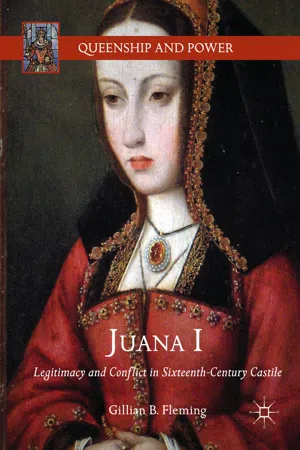
This book examines the deep and lengthy crisis of legitimacy triggered by the death of Prince Juan of Castile and Aragon in 1497 and the subsequent ascent of Juana I to the throne in 1504. Confined by historiography and myth to the madwoman's attic, Juana emerges here as a key figure at the heart of a period of tremendous upheaval, reaching its peak in the war of the Comunidades, or comunero uprising of 1520–1522. Gillian Fleming traces the conflicts generated by the ambitions of Juana's father, husband and son, and the controversial marginalisation and imprisonment of Isabel of Castile's legitimate heir. Analysing Juana's problems and strategies, failures and successes, Fleming argues that the period cannot be properly understood without taking into account the long shadow that Juana I cast over her kingdoms and over a crucial period of transition for Spain and Europe.
Information
© The Author(s) 2018
Gillian B. FlemingJuana I Queenship and Powerhttps://doi.org/10.1007/978-3-319-74347-9_11. In the Footsteps of Juana I
Gillian B. Fleming1
(1)
Brighton, UK
Gillian B. Fleming
The castle of Benavente (Zamora), in northwest Spain, was once celebrated for its gardens. Separated from the castle by a bridge spanning a tributary of the Órbiga river, they formed a series of walled parks where copses and avenues of black poplars offered shelter from the sun. There were orchards, fountains, hunting lodges, pleasure domes and ponds containing trout and barbells. The bosquet was packed with game and, in the menagerie, in 1494, the German humanist scholar Hieronymus Münzer was startled to see two lions eating with a wolf and being stroked by, and in turn caressing, a black servant. 1
On the evening of 28 June 1506, the gardens formed the backdrop to a less tranquil scene when Alonso Pimentel, count of Benavente, played host to the new monarchs of Castile. Isabel I had died almost two years earlier, leaving her twenty-four-year-old daughter, Juana, heir to a dazzling inheritance: the realms of Castile, León, Granada , Seville, Córdoba, Murcia, Jaén, the Algarves, Algeciras, Gibraltar, the Canary Islands and the “Indies and terra firma of the Ocean Sea.” She was also “lady of Vizcaya and Molina.” As proprietary monarch, she, and she alone, embodied the kingdoms of Castile and only she could dispose of them. But Juana was living in Brussels when Isabel died, and her father, Fernando II of Aragon, governed Castile in her name.
In January 1506, Juana and her husband, Philip, count of Flanders, duke of Burgundy and archduke of Austria, set out to receive the oaths of allegiance of the Cortes (the Castilian parliament), and to swear, in return, to uphold Castilian rights and privileges. They travelled together, but with diametrically opposed intentions. Juana was tenaciously loyal to her father. Philip was determined to oust him from Castile and marginalise Juana, through whom he claimed his legitimacy as king, and whom he treated not only as his wife but as his hostage.
That day, Philip broke catastrophic news to Juana—from her point of view. Philip and Fernando had signed a treaty ceding Castile to Philip and excluding her from power. Feigning indifference, Juana expressed a wish to visit the famous gardens. But, as she turned back to the castle, she suddenly galloped off across the park and down the hill, leaving her escorts dumbfounded. The alarm was raised. Philip’s German soldiers gave chase. Juana took refuge in a bakery or flourmill. There she spent the rest of the day, the night and the following day, surrounded by hundreds of infantry under the command of Oberster Hauptmann Wolfgang zu Fürstenberg. Philip tried to persuade her to leave the place, but “I do not know,” wrote Venetian ambassador, Vincenzo Querini, “how he will do it.” 2
This incident was one of several to mark the crisis of legitimacy with which this study is concerned, and was variously interpreted. Philip argued that it demonstrated her unfitness to assume the mantle of a ruling queen and asked the deputies to the Cortes to agree to her imprisonment. Others saw it as a desperate bid to escape captivity by foreign forces, poised to seize charge of kingdoms that were hers by right.
As in the case of her youngest sister, Katherine, it is against the background of her marriage that Juana has mainly been defined. Of the five children of Isabel and Fernando, she and Katherine were caught in events of immense historical significance: in the first case, through a turbulent marriage and problematic legacy that brought about a highly troubled dynastic transition, with all that this entailed for Spain and the Western world; in the second, through a no less turbulent divorce that brought about the establishment in England of a national church separated from Rome.
Juana’s life and position were far from simple. She was a Trastámara queen and the last monarch of her dynasty, but she was also the mother of Charles V and thus of the Spanish Habsburg line. From 1504, she was a sovereign queen , but also a wife subjected to the ambitions of a husband of inferior status, a wily father who had ruled Castile before her and was determined to do so again, and a son who thirsted after his Spanish inheritance and controversially proclaimed himself king after Fernando’s death. Juana dwelt always on and between frontiers: the shifting frontiers of the territories through which she travelled as a child; the frontiers between the Low Countries and Spain; between contractual government and creeping royal absolutism; sovereign queenship and female submission; freedom and captivity; ‘sanity’ and ‘madness.’ Beyond these considerations, and at the core of Juana’s story, is a crisis that culminated in what was arguably the first modern revolutionary uprising of its kind in Europe.
To place Juana at the heart of such a crisis is to grant her an importance that has generally been denied to her by a historiographical confinement—over and above the terrible years of her real imprisonment—to the madwoman’s attic or black servant’s kitchen (see preface). Until relatively recently, Juana was invariably referred to as ‘the Mad.’ But madness, or locura, was a term used, in her lifetime, to cover a wide range of behaviour, from idiocy to political transgression, and applied to Juana far less frequently than the word ‘indisposition.’ The subsequent focus on her ‘madness,’ her ‘insanity,’ her ‘dementia,’ her ‘crazed’ this-and-that, has obscured the political dimension of her thoughts and actions and significance for Castile. Historians have brushed examples of political agency aside by recourse to the convenient device of ‘moments of lucidity.’ An a priori acceptance of her madness has created a tendency to see it everywhere as the mainspring of her conduct, with the very moniker ‘Juana La Loca’ rendering such remarks irresistible, where elsewhere they might seem gratuitous. In his study of Henry VII (1999), Chrimes rightly comments on the lack of a critical approach to the “very successful propaganda put out by her ruthless and unscrupulous father and son.” He believes it “probable that Henry VII knew or suspected the truth, which oddly appears largely to have evaded the serious consideration of modern historians.” 3
A second consequence of this approach has been a curious periodisation. Use of the word ‘reign’ in relation to Juana still raises eyebrows. General histories often skip from the Catholic monarchs (1474–1516) to Charles V, without any reference to the proprietary queen of Castile and Aragon and, as a specialist in fiscal history has pointed out, “in the first two decades of the sixteenth century every historian has used a different chronology.” 4 Thus, the ‘first regency’ of Fernando (1504–1506) preceded the ‘reign’ of Philip of Burgundy (1506); the ‘regency’ of archbishop Cisneros (1506–1507) preceded the ‘second regency’ of Fernando (1507–1516), which was followed by the ‘second regency’ of Cisneros (1516–1517), eating into the ‘reign’ of Charles V (1516–1558). Alternatively, many historians and history textbooks extend the dual monarchy of Isabel and Fernando to the latter’s death in 1516, although he ceased to be king of Castile on Isabel’s death in 1504. This allows historians to refer to Charles as the heir not of his mother, but of his grandparents. However, the confusion does not stop there. Since Charles was absent from the Spanish kingdoms for most of his life, he had to leave them in the hands of a string of ‘regents.’ The traditional failure to recognise a reign of Juana I, who remained the legitimate proprietary monarch until her death, muddies the waters of history and prevents us from being able to fully interpret the reason things happened as they did.
Over time, Juana’s story shifted to suit successive preoccupations. In the Fronde years of seventeenth-century France, Juana surfaced in a mazarinade called La Chronologie des Reynes Malheureuses—a dire warning about the dangers of jealous passions in queens . 5 In the eighteenth century, the Augustinian monk Flórez asserted that Juana’s nickname was based on her extravagantly grief-stricken response to Philip’s death. This enduring notion, emptied by time of the political concerns that motivated and troubled Juana I, was crystallised in the popular, early twentieth-century pasodoble that many Spaniards can still cite or sing by heart:
¿Reina Juana por qué lloras
si es tu pena la mejor?
porque no fue un mal cariño
que fue locura de amor.
This verse has its visual counterparts in a series of nineteenth-century romantic paintings and sketches that pathologise widowed grief; and in...
Table of contents
- Cover
- Front Matter
- 1. In the Footsteps of Juana I
- 2. ‘Señora Archiduquesa’ (1496–1497)
- 3. A Troubled Transition (1497–1504)
- 4. Fernando’s House (1504–1505)
- 5. Castaway (1505–1506)
- 6. Cortes (1506)
- 7. Queen and Archbishop (1506)
- 8. The Personal Rule of Juana I (1506–1507)
- 9. Entrapment (1507–1511)
- 10. Coup (1516–1519)
- 11. The Giants’ War (1519–1520)
- 12. Vengeance (1520–1522)
- 13. The Politics of Penitence (1521–1539)
- 14. The Demons of Tordesillas (1550–1555)
- 15. Out of the Shadows
- Back Matter
Trusted by 375,005 students
Access to over 1.5 million titles for a fair monthly price.
Study more efficiently using our study tools.
Frequently asked questions
Yes, you can cancel anytime from the Subscription tab in your account settings on the Perlego website. Your subscription will stay active until the end of your current billing period. Learn how to cancel your subscription
No, books cannot be downloaded as external files, such as PDFs, for use outside of Perlego. However, you can download books within the Perlego app for offline reading on mobile or tablet. Learn how to download books offline
Perlego offers two plans: Essential and Complete
- Essential is ideal for learners and professionals who enjoy exploring a wide range of subjects. Access the Essential Library with 800,000+ trusted titles and best-sellers across business, personal growth, and the humanities. Includes unlimited reading time and Standard Read Aloud voice.
- Complete: Perfect for advanced learners and researchers needing full, unrestricted access. Unlock 1.5M+ books across hundreds of subjects, including academic and specialized titles. The Complete Plan also includes advanced features like Premium Read Aloud and Research Assistant.
We are an online textbook subscription service, where you can get access to an entire online library for less than the price of a single book per month. With over 1.5 million books across 990+ topics, we’ve got you covered! Learn about our mission
Look out for the read-aloud symbol on your next book to see if you can listen to it. The read-aloud tool reads text aloud for you, highlighting the text as it is being read. You can pause it, speed it up and slow it down. Learn more about Read Aloud
Yes! You can use the Perlego app on both iOS and Android devices to read anytime, anywhere — even offline. Perfect for commutes or when you’re on the go.
Please note we cannot support devices running on iOS 13 and Android 7 or earlier. Learn more about using the app
Please note we cannot support devices running on iOS 13 and Android 7 or earlier. Learn more about using the app
Yes, you can access Juana I by Gillian B. Fleming in PDF and/or ePUB format, as well as other popular books in History & European History. We have over 1.5 million books available in our catalogue for you to explore.