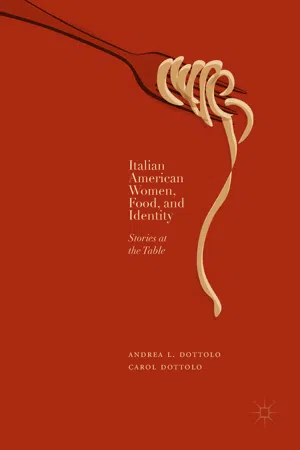
This book is about Italian American women, food, identity, and our stories at the table. This mother-daughter research team explores how Italian American working-class women from Syracuse, New York use food as a symbol and vehicle which carries multiple meanings. In these narratives, food represents home, loss, and longing. Food also stands in for race, class, gender, sexuality, immigration, region, place, and space. The authors highlight how food is about family and tradition, as well as choice and change. These women's narratives reveal that food is related to celebration, love, power, and shame. As this study centers on the intergenerational transmission of culture, the authors' relationship mirrors these questions as they contend with their similar and disparate experiences and relationships with Italian American identity and food. The authors use the "recipe" as a conversational bridge to elicit narratives about identity and the self. They also encourage readers to listen closely to the stories at their own tables to consider how recipes and food are a way for us to claim who we are, who we think we are, who we want to be, and who we are not.
eBook - ePub
Italian American Women, Food, and Identity
Stories at the Table
- English
- ePUB (mobile friendly)
- Available on iOS & Android
eBook - ePub
About this book
Information
Topic
PhilosophySubtopic
Mind & Body in Philosophy© The Author(s) 2018
Andrea L. Dottolo and Carol DottoloItalian American Women, Food, and Identityhttps://doi.org/10.1007/978-3-319-74757-6_11. “You Were Right Down the Street”: Place and Space
Andrea L. Dottolo1, 2 and Carol Dottolo3
(1)
Department of Psychology, Rhode Island College, Providence, RI, USA
(2)
Brandeis Women’s Studies Research Center, Brandies University, Waltham, MA, USA
(3)
Liverpool, NY, USA
Utica Greens
Pauline
1 large bunch of escarole or spinach
2 cup of chicken broth
2 cloves of crushed garlic
4 thin slices of prosciutto chopped
Hot cherry peppers of Jalapeno peppers chopped. (amount is to your taste)
2 tablespoons of olive oil
¼ cup of grated Romano cheese
½ cup of seasoned bread crumbs
Salt and pepper to taste
- 1.Clean and rinse the escarole or spinach twice. Chop into large pieces.
- 2.Place in deep pan with chicken broth and boil down for 5–6 minutes. Long enough for the greens to wilt.
- 3.Place olive oil in a saute pan and heat. Add chopped garlic and prosciutto and cook about 2–3 minutes, making sure not to burn the garlic. Now add peppers and cook another minute or so.
- 4.Add the escarole and all other ingredients to the saute pan. Gradually add the bread crumbs and grated cheese , tossing gently until blended.
- 5.Taste for final salt and pepper seasoning.
- 6.Place in a casserole dish and sprinkle some bread crumbs on top. Now place under the broiler for 3–4 minutes.
…Our daily life, our psychic experience, our cultural languages, are today dominated by categories of space … . (Jameson, 1984, p. 16)
- Carol:
- How long have you lived in Syracuse?
- Nana:
- All my life.
- Carol:
- Yeah? So you grew up here?
- Nana:
- Yes.
- Carol:
- Did you grow up on the North side ?
- Nana:
- Yes, North side .
- Carol:
- Where—did you grow up on Wadsworth Street and—
- Nana:
- Well, I went to Webster school.
- Carol:
- Oh wow! I went to Webster school too. And did you go to Grant and North high school?
- Nana:
- Yup, North high school.
- Carol:
- Yup, yup. Did that too. Small world, Nana. North side , everybody has a connection to somebody.
Carol and Nana share an important moment of recognition and identification in this exchange. Once they establish that Nana has lived in Syracuse her whole life, Carol follows with asking her about the North side , the Italian American enclave of the city. Carol recognizes that Nana not only attended Webster school for her elementary education as Carol did but also Grant junior high school and North high school. These common experiences and shared knowledge of place and space are connected to an understanding, a comradery, a shared identity . Carol remarks that this point of connection (“small world”) is tied to the geographic region of the Italian American neighborhood of the “North side ,” where “everybody has a connection to somebody.”
The recognition of the place and space also conveys a shared understanding of the cultural expectations, environment, and features of daily living in which these women were raised. What Carol does not mention in the above exchange is that she lived directly across the street from Webster school, so that Nana’s attendance at the same school meant that Nana had unknowingly seen Carol’s home every day, entering and leaving the school, and on the playground. In mentioning these common spaces, Carol and Nana, along with many other women we interviewed, shared a sense of recognition, intimacy, and connection, when these references to common places and spaces were mentioned. In this way, their shared geography indicates other similarities among the women, about gender , race , ethnicity , class, and culture , to name a few.
While place and space are concepts that overlap, we use them to indicate slightly distinct connotations, although they are mutually dependent upon one another (Harvey, 1993; Massey, 1994). Generally speaking, we use place to refer to a physical location, a spot, such as an apartment or neighborhood . Space includes the three-dimensional elements of place , and the relative position of the people and objects within it, such as the layout of a kitchen , or the inside of a bakery . In the quote at the beginning of this chapter, Jameson (1984) asserts the influence of space on our lives, experiences, cultures, shaping our realities. In this way, place and space function as a lens of analysis, a way of considering the geographies of experience in meaning-making. Here, we explore how place and space were part of our conversations about food in the interviews , and how place and space connected to the identities of the women. We focus a lens of place and space on discussions about a bakery , neighborhoods, and the home , especially regarding working-class cultural norms about who is allowed in the home , and what it means to have “company .”
We want to begin by telling you about Syracuse , New York, especially the Italian neighborhood of the city, the “North side ” where the highest concentrations of Italians traditionally lived. The neighborhood was predominately working class , characterized by single family homes, where families sat on their front porches. Most streets are lined with strong, sturdy maple trees and in the fall, the smell of decomposing leaves mixed with car exhaust was common. There were small, well-kept lawns, which often included vegetable gardens and the sidewalks were regularly lined with flowerbeds. In the summer, the streets smell like hot asphalt, and in the winter, these same streets were buried in extraordinary amounts of snow which makes most Syracusans experts at snow removal. Traffic lights swing from wires overhead. One might hear the sounds of cars honking, tires squealing, bicycle bells, and mothers calling for their children . Or, music spilling from cars, coffee cups clinking, chatter and laughter, and yelling. Mostly, this characterization of the North side coincides with the memories of those who lived there in the 1950s, perhaps until the 1990s. After that, many of the residents left as other immigrant groups moved in.
Cultural theorists, social geographers, and anthropologists have long understood the relationship between identity and place (Keith & Pile, 1993; Lefebvre, 1991; Massey, 1991; Soja, 1989; Taylor, 2010; Zukin, 1991). Psychologists , however , are challenged by this idea, often concerned with more “universal” models of identity development that somehow seem to transcend, and sometimes even ignore, geography. Here we explore, as Jameson (1984) mentions at the beginning of this chapter, how place and space converge with identity . McDowell (1999) explains, “people derive their knowledge from the locations where they live, and so… space is a crucial aspect of identity construction” (p. 101).
As early as 1922, Cooley discussed group identity and war, invoking place and space . He said,
The group self or ‘we’ is simply an ‘I’ which includes other persons. One identifies himself with a group and speaks of the common will, opinion, service, or the like i...
Table of contents
- Cover
- Front Matter
- 1. “You Were Right Down the Street”: Place and Space
- 2. “Even a Medigan Could Do It”: Racial Identities and Whiteness
- 3. Gendered Identities: Love and Labor
- 4. “She Was Always on a Diet”: Bodies and Shame
- 5. “I Remember You Most in the Kitchen”: Nostalgia—Love, Loss, and Longing
- 6. “But My Mother Ruled the Table”: Food and Power
- 7. Method: How to Survive Writing a Book with Your Mother/Daughter
- 8. “Beat Everything”: The Recipes
- Back Matter
Trusted by 375,005 students
Access to over 1.5 million titles for a fair monthly price.
Study more efficiently using our study tools.
Frequently asked questions
Yes, you can cancel anytime from the Subscription tab in your account settings on the Perlego website. Your subscription will stay active until the end of your current billing period. Learn how to cancel your subscription
No, books cannot be downloaded as external files, such as PDFs, for use outside of Perlego. However, you can download books within the Perlego app for offline reading on mobile or tablet. Learn how to download books offline
Perlego offers two plans: Essential and Complete
- Essential is ideal for learners and professionals who enjoy exploring a wide range of subjects. Access the Essential Library with 800,000+ trusted titles and best-sellers across business, personal growth, and the humanities. Includes unlimited reading time and Standard Read Aloud voice.
- Complete: Perfect for advanced learners and researchers needing full, unrestricted access. Unlock 1.5M+ books across hundreds of subjects, including academic and specialized titles. The Complete Plan also includes advanced features like Premium Read Aloud and Research Assistant.
We are an online textbook subscription service, where you can get access to an entire online library for less than the price of a single book per month. With over 1.5 million books across 990+ topics, we’ve got you covered! Learn about our mission
Look out for the read-aloud symbol on your next book to see if you can listen to it. The read-aloud tool reads text aloud for you, highlighting the text as it is being read. You can pause it, speed it up and slow it down. Learn more about Read Aloud
Yes! You can use the Perlego app on both iOS and Android devices to read anytime, anywhere — even offline. Perfect for commutes or when you’re on the go.
Please note we cannot support devices running on iOS 13 and Android 7 or earlier. Learn more about using the app
Please note we cannot support devices running on iOS 13 and Android 7 or earlier. Learn more about using the app
Yes, you can access Italian American Women, Food, and Identity by Andrea L. Dottolo,Carol Dottolo in PDF and/or ePUB format, as well as other popular books in Philosophy & Mind & Body in Philosophy. We have over 1.5 million books available in our catalogue for you to explore.