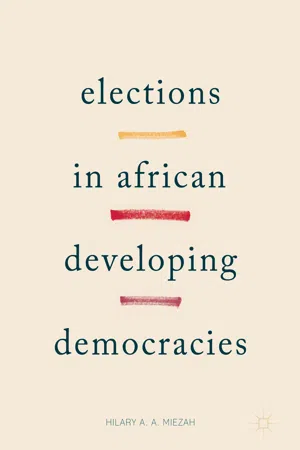
The book explores the organization, conduct and supervision of elections in emerging democracies. It covers the broad spectrum of the democratic electoral process. This project is a synthesis of the author's practical knowledge and experience in the management of elections with the United Nations and other international organizations in Africa and Asia. The author addresses election practitioners, political parties, and all other stake holders, and provides a vision for building and blending indigenous traditions and systems of election into universally accepted norms and practices.
- English
- ePUB (mobile friendly)
- Available on iOS & Android
eBook - ePub
Elections in African Developing Democracies
About this book
Information
© The Author(s) 2018
Hilary A. A. MiezahElections in African Developing Democracieshttps://doi.org/10.1007/978-3-319-53706-1_11. Introduction
Hilary A. A. Miezah1
(1)
ELECTION AID (ELECTA), London, UK
Following a face-to-face TV programme in March 1978 on the Union Government Referendum
in Ghana,1 Mr. Justice I.K. Abban
, the Sole Electoral Commissioner, passed on to me a message from the Chief Justice, His Lordship Justice F.K. Apaloo, the next day: “How His Lordship wished Ghana had ten courageous young men like you. Congratulations!” This message fortified me in my resolve always to preside over manifestly free, fair, transparent and credible elections boldly, courageously and fearlessly.
I had gone to the national radio and television studio to assure the Ghanaian electorate of a really free, fair, transparent and credible referendum. The nation had been gripped by fear as a result of growing rumours that the referendum was going to be rigged. Plans were allegedly afoot to have the Electoral Commissioner and the Secretary to the Commission assassinated. Coincidentally, a Major in General Acheampong’s office at Castle Osu, the seat of administration, had threatened the Electoral Commissioner and the Secretary to the Commission with death at the Castle a few days before the TV programme.
A delegation of women supporters of “Union Government—Yes” had protested to the symbol assigned to the “Union Government—No” issue. The symbol for the “Union Government—Yes” was two hands interlocked in a handshake on a blue background. That for the “Union Government—No” issue was two heads looking in opposite directions on a red background. According to the protesters, opponents of Union government (Unigov) were interpreting the symbol for no to mean “one head does not go into council”, a popular Ghanaian adage.
General Acheampong
had invited Mr. Justice I.K. Abban
to the Castle to direct the Commission to change the symbol for the No issue. This request was in flagrant violation of the decree establishing the Electoral Commission
and of the fact that, to quote in part, “in the performance of its functions the Electoral Commission shall not be subject to the direction or control of any person or authority”. Ghanaians wanted assurance from the Electoral Commission that the referendum would be free and fair and I was on air to give that assurance.
I took the opportunity to restate the stand of the Electoral Commission
and to condemn undue interference in the work of the Commission by outsiders. I appealed to the Ghanaian public for support and cooperation, emphasizing that “there can be no free and fair referendum without the support, vigilance and cooperation of the electorate”.
Then came the Union Government Referendum on 30 March 1978. Voting stated at 7.00 am and ended at 5.00 pm. There were no major incidents during the voting. Confrontations started after 6.00 pm. The Western Regional Commissioner, Colonel Dawuni, had instructed the regional electoral officer, Mr. J.K. Mould,
not to have the votes cast initially counted, as the law provided, at the polling stations before the final count at the constituency counting centres. Mr. Mould asked the Regional Commissioner to speak to headquarters, if he wanted to vary the regulations. The Colonel spoke to me. I told him we could not accede to his instruction. He took offence and reported the matter to the Castle, the seat of government in Accra. Following a similar request from Kumasi, the Ashanti capital, I sent a radio message to all regional electoral officers not to vary the procedures without express directives from the Sole Electoral Commissioner.
About 8.30 pm the referendum results started coming in from the regions. Each regional headquarters had a scoreboard on which all the constituency results were recorded. Accra, the Ghanaian capital, had a gigantic national scoreboard on which all the regional results were recorded. A press centre for the international media had been set up at the Black Star Square
, where the national scoreboard was erected with telephone, fax and telex facilities. At the Electoral Commission
was an operations room with hotlines connecting all the regional capitals to the Commission. The police band was in attendance, providing Ghanaian highlife music under bright multicoloured lights in a tropical night breeze.
The first result came from Bawku East in the Upper region. Union government had won in that constituency. Several constituencies in the region had voted for union government, on which confirmation had been received from the Regional Electoral Officer, Mr. Doku. Next came the result from Bantama in the Ashanti region. Union Government—No had won there. The result from Kumasi Manhyia followed. It was a landslide for No. A constituency in Greater Accra followed with another landslide for No. Immediately, a call came from the Castle before the official release of the remaining Accra results. The Castle directed that all the results should be sent to the Castle, the seat of government, before the official release. The response from the Electoral Commissioner was an emphatic no. Colonel Yanney, the Secretary for Information, was dispatched to ask the Electoral Commissioner to comply with the directive, but to no avail. The police band continued providing music and supporters of the two issues danced their way to either endorsement or rejection of Unigov.
About 10.30 pm we had information from the Commission’s security guards in the first yard that there were some unusual movements. We were on the third floor. Five minutes later we learnt that some armed soldiers had come to the Commission and were arguing fiercely with the armed police on duty. We put out the lights on the third and fourth floors and left the Commission through a passage from the fourth floor. Through the southern yard we left the premises and went to the Holy Spirit Cathedral Accra, about 500 yards from the Commission. We rang the Commission from the cathedral, to learn to our chagrin that the soldiers had taken over and were ransacking the offices. The Electoral Commissioner, Justice I.K. Abban, my deputy in charge of operations, Mr. E.K. Asillijoe
, a security officer, Mr. Brown and I separated and went into hiding at different locations.
The next day we learnt that “Union Government
—Yes” had won by a 51 per cent majority. The Ghanaian rumours continued: “the Sole Electoral Commissioner and the Secretary to the Commission had been allegedly murdered and thrown into the sea”. The world’s media, especially the BBC, carried the news of our disappearance. We were in hiding for two to three days before resurfacing separately. Justice Abban, then a High Court judge, went back to the bench. Asilijoe, Brown and I returned to the Commission.
General Acheampong, Chairman of SMC
1 was overthrown in a palace coup and on 4 June 1979, SMC 11 led by General Akufo was overthrown. Generals Acheampong, General Akufo and many other high-ranking officers of the Ghana Armed Forces were killed by firing squad by the Armed Forces Revolutionary Council (AFRC), led by Flight Lieutenant J.J. Rawlings.
In his maiden radio and television address to the nation, Rawlings pledged to continue the SMC
11 programme for return to constitutional rule. The date for the election remained unchanged and on 18 June and 9 July 1979, Ghanaians went to the poll to elect in combined and simultaneous elections the Parliament and President of the Third Republic.
It may seem unusual to commence a book on elections in emerging democracies with a historical account of the 1978 Ghana Union Government Referendum
. The experience of this referendum epitomizes some of the challenges and intricacies in the conduct and supervision of elections, referenda and plebiscites in a developing country. That experience may include governmental and other external pressures and interferences, intimidation, and harassment from the state ideological apparatus, political parties and persons who may not support the democratic process and would do all they can to derail it.
The 1978 referendum, however, reveals in a heartwarming way all the benchmarks for the conduct and supervision of democratic elections, referenda and plebiscites in a developing-country environment. To name a few of these: capable men and women charged with the conduct and supervision of the electoral process, courage, boldness, fearlessness, positive neutrality and non-alignment, observance of electoral law, rules, regulations, procedures and modalities, openness, transparency, credibility and unflinching support and cooperation of all stakeholders. These benchmarks will be illustrated in the various chapters of this book.
Elections in African Developing Democracies, a synthesis of 45 years’ practical experience in the field of elections in my own country, Ghana, with the United Nations and other international organizations, aims to equip the reader or the election practitioner with universally accepted norms and principles on election mechanisms and some of the intriguing challenges in the conduct and supervision of elections in developing democracies. These challenges may include, in addition to those indicated above, paucity of resources, lack of technical know-how, strict adherence to the law, procedures and modalities, and, as mentioned earlier, intimidation, harassment, suspicion and governmental and external interferences.
This study covers the whole spectrum of the five dominant types of elections
: that is, elections from colonial rule to independence; elections from military to civilian rule; elections organized by international organizations under special circumstances; parliamentary and presidential elections after a normal term of office; and local council and traditional authority elections. The book is filled with practical examples and references to elections in Africa, since Africa epitomizes underdevelopment and the world system.
Elections
in African Developing Democracies
proposes to deal with the major phases of the electoral process, namely the putting in place of an electoral law, demarcation of electoral boundaries, establishment of electoral machinery, public education, registration of voters, registration of political parties, political campaigning, public education, formulation and implementation of any scheme of voter identification, election observation and monitoring, the poll and the election petition.
Bullet points have been provided for the critical phases of the electoral process, including the enactment of the electoral law, the establishment of electoral machinery
, registration of voters, the political campaign and the poll itself.
Prominence has been given to the role of political parties, civic organizations, traditional rulers and external partners in the organization, conduct and supervision of orderly, peaceful, clean, free and fair elections.
It must be emphasized that none of the phases in the electoral process, from the putting in place of an electoral law to the adjudication of an election, referendum or plebiscite petition, is of less significance. Every phase is important, if a country is to achieve the objective of clean, free, fair, credible and transparent elections, referenda or plebiscites.
Although rarely mentioned, public education
in the conduct and supervision of acceptable elections is as important as any phase of the democratic electoral process. In Chap. 5 on the electoral process, a subsection on public enlightenment
has been devoted to public information, education and awareness creation.
Emphasis is placed on the integrity of the process: cost reduction, and blending indigenous cultural traditions into modern knowledge and technology.
Guidelines on the selection of electoral staff and dos and don’ts for electoral staff and the institution of security and control mechanisms will also be discussed.
Although references will be made to the advantages and disadvantages of single-member constituency and proportional representation systems, much effort is made to move away from the technical niceties of electoral systems. This work will unearth some of the weaknesses and intricacies in the electoral process in developing democracies, with a view to polishing up the process. Relevant cases have been cited under the election campaign, registration of voters and the poll. Operational challenges from samples in other situations are highlighted.
The study ends with highlights and briefing notes on the electoral process in other situations. These notes on elections in other circumstances echo again the dictum that there are no universally binding rules, procedures and modalities, apart from the universally accepted norms, for the conduct and supervision of transparent and credible elections. Discourse on cost reduction has been initiated to aid electoral machineries and politicians in the conduct and supervision of elections.
It is my hope and prayer that these studies will correct some of the erroneous impressions and distortions about the electoral process in developing countries and aid election practitioners, politicians, political agents, election observers and students in the democratic electoral process.
Footnotes
1
A system of government involving civilians, the military and the police proposed by General Acheampong, Chairman of the NRC and SMC 1 of Ghana, in 1977.
© The Author(s) 2018
Hilary A. A. MiezahElections in African Developing Democracieshttps://doi.org/10.1007/978-3-319-53706-1_22. Defining Elections
Hilary A. A. Miezah1
(1)
ELECTION AID (ELECTA), London, UK
Elections in Developing Democracies
There is no universal model for the conduct of free and fair elections. Nor are there any erga omnes rules under international law for the conduct and supervision of democratic elections. The customs of the world differ. Electoral laws, rules, regulations, procedures and modalities are not the same. Every country has its specific needs and its elections must be consistent with the aspirations and needs of its people. It must be emphasized that before the passage of UN Resolution 435 in 1978 on the Namibian political question,1 which so popularized election monitoring and observation, now one of the most important functions of the UN, elections were organized in developing democracies without monitoring and observation on the scale we see today. The results of these elections were often adjudged to be free expression of the will of the people. So also were the results of pre-colonial and pre-independence elections. International observation and monitoring, which has now become an adjunct to the electoral process, are undertaken to enhance credibility, transparency and inspire confidence in the international community, governments and foreign investors. This phase will be revisited under Election Observation (Chap. 5) and External Aid (Chap. 6).
When we talk of free, fair, democratically certified elections, then, we talk of elections conducted in accordance with universally accepted norms and principles—that is, a process which is open, transparent, credible and held in a conducive polit...
Table of contents
- Cover
- Front Matter
- 1. Introduction
- 2. Defining Elections
- 3. Models of Elections in African Developing Democracies
- 4. Electoral Systems
- 5. The Electoral Process
- 6. External Aid
- 7. Self-Reliance
- 8. Control and Security Mechanisms
- 9. Blending Indigenous Systems into Western Democratic Systems
- 10. The Media and the Democratic Process
- Back Matter
Trusted by 375,005 students
Access to over 1.5 million titles for a fair monthly price.
Study more efficiently using our study tools.
Frequently asked questions
Yes, you can cancel anytime from the Subscription tab in your account settings on the Perlego website. Your subscription will stay active until the end of your current billing period. Learn how to cancel your subscription
No, books cannot be downloaded as external files, such as PDFs, for use outside of Perlego. However, you can download books within the Perlego app for offline reading on mobile or tablet. Learn how to download books offline
Perlego offers two plans: Essential and Complete
- Essential is ideal for learners and professionals who enjoy exploring a wide range of subjects. Access the Essential Library with 800,000+ trusted titles and best-sellers across business, personal growth, and the humanities. Includes unlimited reading time and Standard Read Aloud voice.
- Complete: Perfect for advanced learners and researchers needing full, unrestricted access. Unlock 1.5M+ books across hundreds of subjects, including academic and specialized titles. The Complete Plan also includes advanced features like Premium Read Aloud and Research Assistant.
We are an online textbook subscription service, where you can get access to an entire online library for less than the price of a single book per month. With over 1.5 million books across 990+ topics, we’ve got you covered! Learn about our mission
Look out for the read-aloud symbol on your next book to see if you can listen to it. The read-aloud tool reads text aloud for you, highlighting the text as it is being read. You can pause it, speed it up and slow it down. Learn more about Read Aloud
Yes! You can use the Perlego app on both iOS and Android devices to read anytime, anywhere — even offline. Perfect for commutes or when you’re on the go.
Please note we cannot support devices running on iOS 13 and Android 7 or earlier. Learn more about using the app
Please note we cannot support devices running on iOS 13 and Android 7 or earlier. Learn more about using the app
Yes, you can access Elections in African Developing Democracies by Hilary Miezah in PDF and/or ePUB format, as well as other popular books in Politique et relations internationales & Politique africaine. We have over 1.5 million books available in our catalogue for you to explore.