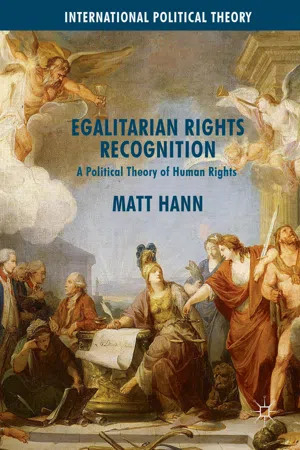
This book takes a distinctive and innovative approach to a relatively under-explored question, namely: Why do we have human rights? Much political discourse simply proceeds from the idea that humans have rights because they are human without seriously interrogating this notion. Egalitarian Rights Recognition offers an account of how human rights are created and how they may be seen to be legitimate: rights are created through social recognition. By combining readings of 19th Century English philosopher T.H. Green with 20th Century political theorist Hannah Arendt, the author constructs a new theory of the social recognition of rights. He challenges both the standard 'natural rights' approach and also the main accounts of the social recognition of rights which tend to portray social recognition as settled norms or established ways of acting. In contrast, Hann puts forward a 10-point account of the dynamic and contingent social recognition of human rights,which emphasises the importance of meaningful socio-economic equality.
- English
- ePUB (mobile friendly)
- Available on iOS & Android
eBook - ePub
About this book
Information
© The Author(s) 2016
Matt HannEgalitarian Rights RecognitionInternational Political Theory10.1057/978-1-137-59597-3_11. Introduction
Matt Hann1
(1)
Durham University, Durham, UK
This book sets out the theory of ‘egalitarian rights recognition’, building on a novel combination of aspects of the work of Thomas Hill Green and Hannah Arendt. The book makes three key arguments. First, human rights must be grounded in social recognition, rather than in the innate qualities of the human. Second, rights recognition requires a serious commitment to equality; egalitarian rights recognition provides a critical lens through which the problems of rights recognised in situations of inequality can be more clearly seen. Third, human rights, if grounded by egalitarian social recognition, are important for human freedom and flourishing.
The idea that human rights are a central and vital part of both the practice and the theory of politics today is an idea that hardly needs substantiating. In both domestic and international politics, debates are frequently framed in terms of human rights, rather than any other considerations. 1 Michael Ignatieff argues that ‘human rights has [sic] become the major article of faith of a secular culture that fears it believes in nothing else’ and that the Universal Declaration of Human Rights (UDHR) has become the ‘sacred text’ of this secular religion. 2 Indeed, former UN Secretary General Kofi Annan has gone so far to describe the Declaration as ‘the yardstick by which we measure human progress’. 3
Human rights are invoked in international relations to justify economic or even military interventions in the affairs of other sovereign states. 4 Domestically, within the UK there has been intense debate about the extent to which the abrogation of human rights may be justified by the threat of terrorism. 5 Human rights have been at the forefront of the Arab Spring revolutions. 6 This is reflected in the academic literature. New journals have been dedicated to human rights, monographs on human rights appear at an ever-increasing rate, new centres and research groups have opened up dedicated to the study of human rights. Human rights matter.
Yet at the same time there is a simple, yet profound, problem. While many people agree that human rights are a ‘Good Thing’, it is far from clear precisely what gives us these rights. The great human rights declarations are little help here. The United States Declaration of Independence holds ‘these truths to be self-evident, that all men are created equal, that they are endowed by their Creator with certain unalienable Rights, that among these are Life, Liberty and the pursuit of Happiness’. 7 The French Declaration of the Rights of Man and of the Citizen declares ‘the rights of man’ to be ‘natural, unalienable, and sacred’. 8 Rights are natural, something which humans (or at least men, in 1789) have simply qua humans. It is far from clear why the fact that we have rights should be self-evident. Furthermore, many people do not believe that there is a Creator, or any deity, in a position to grant such rights.
Such explanations of human rights rely, implicitly at least, on an understanding of natural law—an understanding that many no longer share. In the case of human rights, this understanding of natural law is a Christian one, in origin at least. Though there is some debate as to the precise origins of Natural Rights, 9 by the seventeenth century Hobbes could argue that ‘the RIGHT OF NATURE, which Writers commonly call Jus Naturale, is the Liberty each man hath, to use his own power, as he will himselfe, for the preservation of his own Nature; that is to say, of his own Life; and consequently, of doing any thing, which in his own Judgement and Reason, hee shall conceive to be the aptest means thereunto.’ 10
Some dispute the idea that our modern idea of human rights descends from, or is a continuation of, the idea of natural rights. 11 The post-war era is marked by both an increase in the attention paid to, and the importance ascribed to, human rights and, especially in the last quarter of a century, a growth in the literature that addresses the question of the foundations of human rights. 12 This book aims to contribute to this literature, but from a position that has been relatively neglected. 13 This position is that rights—including human rights—are created through social recognition. In contradistinction to this position are all those theories which see rights as natural, innate or pre-political. This, to be sure, is a disparate group of theoretical positions and perspectives, which disagree in many important and interesting ways. 14 In what follows I do not engage at any great length with the differences between theories of innate/pre-political/natural rights, and indeed I will run these three descriptors together with no distinction between them implied. This is not to say that important differences do not exist between such theories. Rather, my focus in this book is to develop a theory that offers an alternative to the one thing that all these theories do have in common, namely, the idea that humans have rights ‘simply in virtue of being human’. 15
The vast majority of this book is taken up with constructing the theory I call egalitarian rights recognition, rather than with engaging in a sustained critique of innate theories of rights. 16 However, before embarking on that construction project let me briefly sketch out the blueprints for a demolition, in the form of some potential objections to the idea of innate human rights. Of course one cannot ‘prove’ that human rights do not ‘exist’, 17 but I would like to suggest eight reasons (there are doubtless many more) for thinking twice before simply accepting the proposition that humans have rights ‘simply in virtue of being human’. This role of this section is not to produce novel arguments (these objections to rights have all been made before in various forms) but, rather, to introduce sufficient doubt regarding the idea of innate, or pre-social, human rights to effectively clear the ground for a theory of human rights based on recognition.
1.1 How Many Rights?
Throughout the history of innate, pre-political rights, there has been remarkably little agreement about which rights are human rights. The rights suggested include the right to life, the rights to liberty, property and happiness, and a whole further list, which seems to be continually expanding. If there are pre-social, natural rights then there is not a corresponding certainty about what those rights are. This could lead us to two conclusions: either there are not natural rights, and—as I suggest in this book—rights are continually created through processes of social recognition; or there are natural rights, but we can never know with any certainty what they are. In the second case, this brings into question what the point of innate rights is, if there is no agreement on what they are. In the end, both conclusions lead back to a process of recognition, where rights are recognised claims. In the first case, a right is a claim, which appeals to some sort of morality or ethics and which is recognised by society. In the second case a right is a claim, which appeals to the idea that there is a natural right to x, and which is recognised by society. In both cases, we would understand rights better if we understood them as the result of claim and recognition (as I will examine further throughout this work and particularly in Chap. 4).
1.2 History
If we hold rights to be innate or pre-political, then we hold that all humans, in whatever times and whatever places, had these rights (or at least, whichever rights we choose to include in our bundle of human rights—see above). The moment humans became human, to follow this logic, they were endowed by that fact with rights. Thus the cavewoman had rights to her life, liberty and property, perhaps to the pursuit of happiness, perhaps (UDHR article 22) the right to social security. Clearly this last example, at least, is absurd. But throughout history there has been a distinct lack of understanding that humans have innate rights as humans. Indeed, people have only thought in terms of rights in a way that we would understand today in the last few hundred years. If there had always been innate rights, it would be very odd indeed that no-one had commented or acted on this fact for many thousands of years. 18
The objection to my point here, clearly, is the argument that, like discoveries including DNA, electricity, nuclear fission and the like, we have in the last few hundred years ‘discovered’ innate rights, which were there all along. Perhaps. But the very processes of discovery in this regard have been processes of claim and recognition. If we have discovered innate rights, it is because someone has advanced a claim and society has recognised it. In this regard, it differs quite considerably from, say, certain scientific discoveries that can be proven. It can be proven that the Higgs Boson exists; one cannot prove (however desirable it would be) that there is a right to life. As we shall explore further, particularly with regard to Arendt in Chap. 3, when it comes to rights, one must rely on persuasion rather than proof.
1.3 The Role of God
Many writers in the natural law tradition were explicit that natural law (and thus natural rights) depended on God. Although Grotius argued that natur...
Table of contents
- Cover
- Frontmatter
- 1. Introduction
- 2. Thomas Hill Green and the Social Recognition of Rights
- 3. Hannah Arendt: The Rights of Man, the Political Community, Judgment and Recognition
- 4. Societies of Rights: What Does a Political Community Look Like?
- 5. Rights Recognition and Cosmopolitanism: Global Egalitarian Rights Recognition
- 6. Conclusion
- Backmatter
Trusted by 375,005 students
Access to over 1.5 million titles for a fair monthly price.
Study more efficiently using our study tools.
Frequently asked questions
Yes, you can cancel anytime from the Subscription tab in your account settings on the Perlego website. Your subscription will stay active until the end of your current billing period. Learn how to cancel your subscription
No, books cannot be downloaded as external files, such as PDFs, for use outside of Perlego. However, you can download books within the Perlego app for offline reading on mobile or tablet. Learn how to download books offline
Perlego offers two plans: Essential and Complete
- Essential is ideal for learners and professionals who enjoy exploring a wide range of subjects. Access the Essential Library with 800,000+ trusted titles and best-sellers across business, personal growth, and the humanities. Includes unlimited reading time and Standard Read Aloud voice.
- Complete: Perfect for advanced learners and researchers needing full, unrestricted access. Unlock 1.5M+ books across hundreds of subjects, including academic and specialized titles. The Complete Plan also includes advanced features like Premium Read Aloud and Research Assistant.
We are an online textbook subscription service, where you can get access to an entire online library for less than the price of a single book per month. With over 1.5 million books across 990+ topics, we’ve got you covered! Learn about our mission
Look out for the read-aloud symbol on your next book to see if you can listen to it. The read-aloud tool reads text aloud for you, highlighting the text as it is being read. You can pause it, speed it up and slow it down. Learn more about Read Aloud
Yes! You can use the Perlego app on both iOS and Android devices to read anytime, anywhere — even offline. Perfect for commutes or when you’re on the go.
Please note we cannot support devices running on iOS 13 and Android 7 or earlier. Learn more about using the app
Please note we cannot support devices running on iOS 13 and Android 7 or earlier. Learn more about using the app
Yes, you can access Egalitarian Rights Recognition by Matt Hann in PDF and/or ePUB format, as well as other popular books in Politics & International Relations & Civil Rights in Law. We have over 1.5 million books available in our catalogue for you to explore.