This book provides an assessment of the megatrends that are reshaping the emerging markets landscape. With developing countries already accounting for 40% of world GDP, emerging markets consumption growth will be an increasingly important growth engine for the world economy over the next two decades. However, emerging markets in many parts of Asia, Africa, the Middle East and Latin America are still facing tremendous economic challenges such as poverty, inequality, weak governance and inadequate infrastructure. The developed nations are no longer insulated from the economic shockwaves impacting developing countries, as globalisation and economic integration have also amplified the transmission effects to the West through immigration flows, cross-border crime and the proliferation of international terrorism.
Emerging Markets Megatrends is an essential read for government policymakers, corporate executives, international investors and analysts wishing to understand more about the economic drivers and long-term outlook for emerging markets.
The hard facts of demography will have a profoundly wrenching impact on the balance of world economic power.
(Alan Greenspan, “The Age of Turbulence—Adventures in a New World”, page 411, Penguin, 2007.)
Over the next three decades to 2050, global demographic trends will substantially alter the distribution of the world’s population. Among the advanced economies, many nations are facing demographic ageing and low fertility rates, with some nations such as Japan projected to experience declines in the total size of their populations.
This will create a witches’ brew of economic and social problems, including rising fiscal burdens of health care, pension and social security costs for the elderly. This will be accompanied by a rising elderly dependency ratio as a share of the total population and declining new cohorts of young workers joining the labor force.
However, among the developing countries, there are considerable contrasts in the demographic outlook over the period to 2050. Based on United Nations population projections (United Nations World Population Prospects, the 2017 Revision) using the medium variant of their projections, the total population of different developing regions of the world will show considerable variation in structural trends.
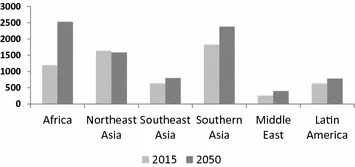
The most dramatic change in the total size and relative distribution of the global population will come from the projected growth in the total population of the African continent, which is expected to grow from 1194 million in 2015 to 2527 million by 2050. This indicates that the total population of Africa is expected to double by 2050, creating significant challenges for African governments to manage the social and economic impact of such rapid growth in the total size of the region’s population.
The UN’s very long term population projection to 2100 indicates that Africa’s population will increase to 4468 million by 2100. In 2017, Africa’s population was equivalent to around 28% that of Asia’s population and around 17% of the world’s population. By 2100, these relative shares change drastically according to the UN medium variant projections, with Africa’s population rising to almost become equal to Asia’s total population, equivalent to around 93% of Asia’s population and accounting for 40% of the world’s population.
The Middle East region, defined as “Western Asia” under the UN classification, will also see a large rise in population, from 258 million in 2015 to 397 million by 2050. A large increase in the population of Southern Asia is also projected, rising from 1823 million in 2015 to 2382 million by 2050.
However, other parts of Asia are projected to experience quite different demographic trends, with the population of China projected to decline slightly, from 1397 million in 2015 to 1364 million by 2050. In Southeast Asia, the total population is expected to show a more moderate increase compared with Africa and Southern Asia, rising from 634 million in 2015 to 798 million by 2050.
In Latin America and the Caribbean, the total population is projected to increase from 632 million in 2015 to 780 million by 2050, an increase of 148 million. This is remarkably similar to the population trends in Southeast Asia, where the total population will reach 798 million by 2050 and will increase by 164 million over the 2015–2050 period (Fig. 1.1).
Fig. 1.1
Population by region, 2015–2050 (population in millions)
(Source UN)
If the UN population projections are analyzed on the basis of per capita GDP levels, then one of the most challenging and troubling projections is that the global grouping of low income developing countries will experience a tremendous rise in total population from 642 million persons in 2015 to 1413 million persons by 2050. This represents a similar proportionate rise in population to the African continent as a whole, with the population more than doubling over the next three decades. To a significant extent this does reflect the overlap in composition of the grouping of low-income countries with African low-income countries. This serves to highlight the importance of global policy initiatives to boost the economic development of the African continent, particularly Sub-Saharan Africa.
Africa’s Demographic Time Bomb
In the coming three decades to 2050, more than half of the total increase in the world’s population is projected to be in Africa, according to the medium variant of the UN 2017 population projections. The total increase in Africa’s population between 2017 and 2050 is projected to be 1270 million persons. The rapid projected growth of the total population in the African continent is particularly attributable to the population growth in Sub-Saharan Africa, which is projected to increase from 969 million in 2015 to 2168 million in 2050. The longer range population projections by the UN for Sub-Saharan Africa give considerable cause for even greater alarm, as they project that Sub-Saharan Africa’s total population will increase to 4000 million by 2100. If these population projections are realized, the total population of Sub-Saharan Africa will be four times larger in around eight decades time.
The economic and social consequences of such rapid population growth are very troubling, particularly since the per capita income levels of many of the Sub-Saharan African countries are still classified as low income, with a significant share of the population of many of these countries still living in poverty or close to poverty thresholds.
Furthermore, the demographic profile of Africa’s population is extremely young, with youth aged 24 years or less accounting for 60% of the total population in 2017. An estimated 41% of Africa’s population is currently aged 15 years or less. With these UN demographic projections indicating that large cohorts of youth will join the working age population each year for many decades ahead, this will create considerable pressure on African governments to generate sufficient new employment opportunities each year in order to prevent the number of people who are either unemployed or underemployed from rising rapidly.
The implications of this long-term demographic outlook is that unless the Sub-Saharan African region can sustain rapid economic growth over many decades, the region could face significant social unrest and economic malaise due to high levels of unemployment and low or no improvement in the standard of living.
With the rapidly growing population putting increasing pressure on the rural sector to generate sufficient employment, there is likely to be a significant flow of rural population towards urban areas, resulting in rapidly growing urban populations with rising pressure on urban infrastructure such as health care, housing, public transport and sanitation.
A scenario of stagnant or slow improvement in living standards in Sub-Saharan Africa would also have considerable adverse consequences for advanced economies, particularly in the European Union, as it will imply a continuous exodus of migrants leaving Africa in search of a better standard of living elsewhere. The most obvious path of migration for African migrants will be towards Europe, since the route to most other developed economies faces much more difficult routes across large distances of ocean.
Clearly from the European Union’s perspective there is no realistic capability for the EU to provide a solution to Africa’s demographic problem by absorbing large numbers of refugees. However, there is likely to be a strong attraction for millions of economic refugees from Africa to try to find a new home in the EU over the next eight decades if Sub-Saharan Africa remains mired in a poverty trap with very low-income levels, combined with ongoing risks of conflict in some countries.
Politically the issue of such large-scale migrant inflows has already become one of the key concerns dominating the political debate in many EU countries. The issue of migration has generated considerable momentum for far right political parties in the EU who have galvanized support for their parties based on the migration issue.
However, even if the political, cultural and ethnic issues involved with such potentially large flows of immigrants are set aside, large-scale immigration of potentially millions of African refugees or migrants to the EU does not offer any kind of economic solution to the fundamental economic problems confronting Africa, and is also unlikely to be economically sustainable for the EU. If Africa’s population is indeed going to increase by an additional 1270 million people by 2050, the emigration of even tens of millions of Africans to other regions will not significantly alter the economic challenges confronting the African continent.
Therefore, if international policymakers wish to prevent such a scenario of substantial outflows of African migrants attempting to reach the EU and other countries each year for many decades ahead, large-scale international initiatives will be needed to try to accelerate the economic development of low income African countries and create sufficient economic growth momentum so that the push factors forcing emigration are significantly reduced.
Such a large-scale initiative would require co-ordinated economic policy measures by the world’s largest economic powers, including the EU and other European nations, as well as China and Japan, taking a joint approach over a number of years to try to help Africa’s low income nations to breakout of their poverty trap.
A key focus for such a global action plan would need to be on an economic and social development program for Nigeria, which is Africa’s most populous country although it is not classified by the UN as one of Africa’s least developed countries. However, with Nigeria’s total population forecast to rise from 181 million in 2015 to 410 million by 2050, addressing Nigeria’s economic challenges will be an important part of any overall co-ordinated international policy response to catalyze Africa’s economic development.
Nigeria is already struggling with a long-running insurgency by the Islamist Boko Haram rebels in the northeastern region of Nigeria. The insurgency has been quite protracted, having commenced in 2009 and so far having resulted in 20,000 persons being killed.
Nigeria has also been suffering from another militant uprising in the Niger Delta region, where rebel groups having also been attacking oil infrastructure as a response to the extreme poverty of communities in the region.
Nigeria is therefore already being impacted by several insurgencies, some of which are linked to extreme poverty in some areas. The risks of further political unrest if the numbers of unemployed rise significantly in future decades is a major potential future challenge.
Another major focal point for long-term international development support will be East Africa, notably Ethiopia, which is Africa’s second most populous nation. Ethiopia’s population is projected by the UN to rise from 100 million in 2015 to 191 million by 2050, representing an increase of 91 million persons.
Three other populous East African countries are also projected to experience significant increases in population. Tanzania’s population is projected by the UN to rise from 54 million in 2015 to 138 million by 2050, rising by 84 million over this timeframe. Kenya’s population is projected to rise from 47 million in 2015 to 95 million by 2050, while Uganda’s population is projected to increase from 40 million in 2015 to 106 million by 2050.
Therefore, for these four East African nations, total population is projected to increase from 240 million in 2015 to 530 million by 2050, an increase of 290 million persons. Three of these four nations, Ethiopia, Tanzania and Uganda, are currently classified by the UN as least developed countries, highlighting the importance of international development assistance for these countries in order to accelerate economic development.
Another populous Sub-Saharan African country that will experience rapid population growth is the Democratic Republic of Congo (DRC), whose population is projected to increase from 76 million in 2015 to 197 million by 2050, which amounts to a population increase of 121 million persons.
In Southern Africa, South Africa is the most populous nation and also the second-largest economy in Sub-Saharan Africa, with a much higher level of per capita GDP than many other Sub-Saharan African nations. Due to its economic size and large population, the accelerated economic development of South Africa would also contribute significantly to the region’s economic stability, although South Africa’s demographic outlook is not as severe a policy challenge as for some of the other populous Sub-Saharan nations. South Africa’s population is projected to rise from 55 million in 2015 to 73 million by 2050, an increase of 18 million persons.
Due to the demographic importance of these seven nations for Sub-Saharan Africa’s overall demographic trends to 2100, international initiatives to boost economic growth in these African countries would, if successful, have potentially significant implications for absorbing a large proportion of the new cohorts of young people of working age entering the Sub-Saharan working age population each year. Sustained rapid growth in these countries could therefore be an important mitigating factor that could help to contain risks of rising regional unemployment and potential social unrest.
Another important implication of creating rapid growth in these countries which have significant population sizes is that a sustained period of strong economic growth will drive consumer expenditure growth rates, creating new growth markets for exports from other African countries.
Therefore, focused economic development initiatives by the international community to accelerate the economic development of some of the most populous Sub-Saharan African countries could play an important role in stabilizing the region’s economic and social outlook and lifting much of the region’s population of poverty.
How international policymakers in the global economic powers address Sub-Saharan Africa’s demographic change will therefore have far-reaching implications for Sub-Saharan Africa’s future and the human development of the...
Table of contents
Cover
Front Matter
1. Demographic Trends in Emerging Markets
2. The Emerging Markets Consumer Boom
3. Emerging Markets Megacities
4. Reshaping the Global Financial Architecture
5. Financing Infrastructure for Developing Countries
6. China’s Belt and Road Initiative
7. Emerging Manufacturing Hubs
8. Disruptive Change from Robotics, Industrial Automation and the Digital Economy
9. The New Global Technology Wars
10. The Least Developed Countries: Opportunities and Challenges
11. Crisis Prevention and Resolution in Emerging Markets
12. The Impact of Climate Change
13. Combating Terrorism and Organized Crime: Cryptocurrencies and Cybercrime
14. Conclusion: The Future Emerging Markets Landscape
Back Matter
Trusted by 375,005 students
Access to over 1.5 million titles for a fair monthly price.
Study more efficiently using our study tools.
Frequently asked questions
Yes, you can cancel anytime from the Subscription tab in your account settings on the Perlego website. Your subscription will stay active until the end of your current billing period. Learn how to cancel your subscription
No, books cannot be downloaded as external files, such as PDFs, for use outside of Perlego. However, you can download books within the Perlego app for offline reading on mobile or tablet. Learn how to download books offline
Perlego offers two plans: Essential and Complete
Essential is ideal for learners and professionals who enjoy exploring a wide range of subjects. Access the Essential Library with 800,000+ trusted titles and best-sellers across business, personal growth, and the humanities. Includes unlimited reading time and Standard Read Aloud voice.
Complete: Perfect for advanced learners and researchers needing full, unrestricted access. Unlock 1.5M+ books across hundreds of subjects, including academic and specialized titles. The Complete Plan also includes advanced features like Premium Read Aloud and Research Assistant.
Both plans are available with monthly, semester, or annual billing cycles.
We are an online textbook subscription service, where you can get access to an entire online library for less than the price of a single book per month. With over 1.5 million books across 990+ topics, we’ve got you covered! Learn about our mission
Look out for the read-aloud symbol on your next book to see if you can listen to it. The read-aloud tool reads text aloud for you, highlighting the text as it is being read. You can pause it, speed it up and slow it down. Learn more about Read Aloud
Yes! You can use the Perlego app on both iOS and Android devices to read anytime, anywhere — even offline. Perfect for commutes or when you’re on the go. Please note we cannot support devices running on iOS 13 and Android 7 or earlier. Learn more about using the app
Yes, you can access Emerging Markets Megatrends by Rajiv Biswas in PDF and/or ePUB format, as well as other popular books in Business & International Business. We have over 1.5 million books available in our catalogue for you to explore.