The Gender of Money in Middle English Literature: Value and Economy in Late Medieval England explores the vital and under-examined role that gender plays in the conceptualization of money and value in a period that precedes and shapes what we now recognize as the discipline of political economy. Through readings of a range of late Middle English texts, this book demonstrates the ways in which gender ideology provided a vocabulary for articulating fears and fantasies about money and value in the late Middle Ages. These ideas inform beliefs about money and value in the West, particularly in realms that are often seen as outside the sphere of economy, such as friendship, love and poetry. Exploring the gender of money helps us to better understand late medieval notions of economy, and to recognize the ways in which gender ideology continues to haunt our understanding of money and value, albeit often in occluded ways.
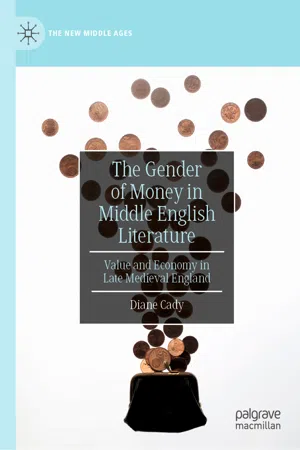
eBook - ePub
The Gender of Money in Middle English Literature
Value and Economy in Late Medieval England
- English
- ePUB (mobile friendly)
- Available on iOS & Android
eBook - ePub
The Gender of Money in Middle English Literature
Value and Economy in Late Medieval England
About this book
Information
© The Author(s) 2019
D. CadyThe Gender of Money in Middle English LiteratureThe New Middle Ageshttps://doi.org/10.1007/978-3-030-26261-7_11. Introduction: Anxious Interests
In a speech before the National Republican Convention in 2004, then-California Governor Arnold Schwarzenegger famously aligned fiscal worry with a lack of manly fortitude: “to those who are pessimistic about the American economy, I say, don’t be economic girlie men.”1 The phrase “girlie men” originated not with Schwarzenegger but with the comedians Dana Carvey and Kevin Nealon, who, in a series of Saturday Night Live skits, played Austrian bodybuilders who labeled as “girlie” any men whose muscles were smaller than their own. In what we might read as a campy appropriation, Schwarzenegger capitalized on the phrase, adding the economic element to serve his political purposes.
Schwarzenegger’s use of “economic girlie men” in a nationally televised speech catapulted the phrase into the cultural imaginary.2 Many Republicans embraced the term, accusing Democrats in general, and the then-Democratic nominee John Kerry in particular, of being “economic girlie men .” Democrats responded: Some fiercely rejected the label, while others secretly worried that their nominee was “girlie” when it came to fiscal matters. Still others concluded that if concern about the salubriousness of the nation’s economy made them “girlie,” they would gladly accept the label. Absent in the wake of Schwarzenegger’s remark was a discussion of what, exactly, an “economic girlie man” was. What did masculinity or femininity have to do with the economic questions and concerns of the moment? And why did so many people seem to understand what Schwarzenegger meant by the phrase? That is, what made this trope immediately legible to so many Americans?
The answers reside in gender ideology’s constitutive function in the construction of economy in the West. Here, I am referring neither to the very real effects of gender identity (among other factors) on one’s personal economy, nor on gender ideology’s impact on economic policy and practices on a national stage. Rather, the focus of this book is on how dominant Western theories about the intrinsic nature of money and value are intimately tied to its beliefs about gender and gender difference. Put another way, gender ideology does not simply inform notions of money and value , it actually forms them. The roots of this isomorphic relationship can be traced to the late Middle Ages. In a time before the invention of political economy as a discipline we might recognize today, gender ideology provided medieval writers and thinkers with a ready vocabulary for understanding money and value during a period of rapid economic and social change. Although often occluded, this legacy still lingers in the ways in which the West continues to conceptualize money and value .
The late Middle Ages have been described as “an age of anxiety ,” and no small part of that anxiety had to do with the rapidly shifting meaning and importance of money.3 It is perhaps hard for us to imagine a time when money did not enjoy its fetishized position. However, for much of the Middle Ages, money served primarily as a supplementary form of value, rather than as the general equivalent of all commodities. As Jim Bolton has noted, England did not begin to develop a monetized economy until the middle of the twelfth century, a process that would take another two centuries to fully materialize.4 Several events contributed to the change in money’s importance, including the growth of international trade, the increase of urban markets, a rise in population, and the discovery of new silver mines. By 1381, there were some 800 tons of silver circulating as coins, which represented almost a 24-fold increase from the number of coins circulating in the mid-twelfth century.5
Alongside this increase in money’s influence and importance emerged new financial practices and instruments that not only facilitated the growth of the monetized economy, but also brought to light new questions about the nature of money and its uses. Much like today, medieval international trade required banking techniques that enabled the flow of money across nations, techniques that, in many ways, required a leap of faith analogous to religious belief. One must believe that money that began, for example, in Florence, would eventually make its way to Lavenham in Suffolk. Chevisance, foreign exchange agreements, and bills of exchange served as creative ways to circumvent prohibitions against usury , all while underscoring how bookkeeping and receipts can say one thing and mean something very different. Even the materiality of money came under scrutiny during this period in the debate over the debasement of coinage, a practice by which precious metal was extracted from a coin and replaced with alloy. Debasement was a popular way of raising funds by some European rulers, and the ability to manipulate money so easily spurred new questions and concerns about the stability of money and its value . This concern about the instability and manipulability of money also found its way to venality satire , a genre that virtually exploded in the fourteenth century in the wake of the burgeoning monetary economy. Venality satire is concerned both with the corrosive effects of money on important social institutions, such as the Church and the legal system, and with money’s destabilizing effects on traditional social hierarchies.6
Although the Middle Ages lack a discrete discipline for attending to questions of economy, literary texts provide rich insight into medieval attitudes about money and the rapid economic changes taking place. Over the past ten years in particular, scholars have probed the links between medieval literature and money.7 My contribution to this lively critical conversation is to place gender at the center of our understanding of money and value . Gender ideology ’s constitutive role manifests in a number of ways, from the isomorphic links made between the supposedly unstable natures of women and money to the equation of wealth with masculinity and sexual possession of a woman and of poverty with emasculation and cuckoldry. At stake in these instantiations is a form of analogical logic that relies on naturalistic claims about one realm to buttress naturalistic claims about another. For example, the case for the debased nature of both women and money is strengthened through these instantiations, helping to support arguments that both need to be tightly controlled by men, a need that is reinforced by the implication that a lack of money (and a lack of sexual loyalty) results in a loss of manhood. As we will see, seemingly gender-neutral discussions of money have much to tell us about medieval gender ideology , and in turn, medieval discussions of gender help to elucidate medieval ideas about money and value .
Although gender is at the center of this study, this book does not center on the economic lives of medieval women. In recent years, both historians and literary scholars have done excellent work to excavate the economic lives of English medieval women, adding complexity and richness to our understanding of the history of economy, a history that often is read and analyzed through the experiences of men of privilege.8 The contribution of this study is to consider how the very notion of economy and value is gendered, how that gendering is tied to a particular economic history, how this conceptualization of economy and value impacts how women are viewed and treated, and how this conceptualization still lingers in our understanding of value and economy today. This focus exposes how gender serves as a malleable intellectual category that organizes not only the body, but also other social and cultural systems.
The reader is likely to notice, too, that I do not extensively treat texts written by women. In addition, although I briefly discuss William Langland’s portrayal of Lady Meed in Piers Plowman , I do not extensively treat other female characters who might seem obvious vehicles for exploring the links between gender and economy, such as Chaucer’s Wife of Bath . My aim is to excavate the gendered economy in texts where its presence may seem less pronounced—or even where it seems that the text is taking a decidedly noneconomic, disinterested stance. The texts that I have selected allow me to make two overarching points that are central to this volume: (1) Gender ideology plays a foundational role in the medieval construction of money, and (2) gender ideology plays a foundational role in the medieval construction of value, particularly in areas that post-Enlightenment epistemology would have us believe are free from the taint of economy, such as friendship , love, and poetry.
Exploring the gender of money not only enriches our understanding of medieval ideas of economy, but also invites us to reevaluate some of the structural assumptions of political economy, especially in relationship to literature. In recent years, new economic critics have explored the isomorphic connections between money and language , as well as the effects of political economy on particular authors and on the production, circulation, and transmission of writing during particular historical moments. While the work of a number of medievalists has made clear that these issues are germane to premodern literature, the vast majority of new economic criticism has focused on literature written during or after the eighteenth century. Nor has gender played a prominent role in these studies.9
I see these two critical lacunae as linked, a linkage that stems from the invention of political economy itself. Like the Middle Ages, the eighteenth century was a time of rapid social and economic change, and new financial instruments and banking practices catalyzed questions about the nature of money and fueled fantasies and anxieties about its transformative possibilities. Political economy was invented during this period in large part to answer these emerging questions about money and value . What’s more, political economy becomes the only place to address these questions. That is because the Enlightenment had a penchant f...
Table of contents
- Cover
- Front Matter
- 1. Introduction: Anxious Interests
- 2. Money Walks
- 3. Necrophilia, Necropolitics, and the Economy of Desire in the Squire of Low Degree
- 4. The Kindness of Strangers: The Perils of Generosity in John Lydgate’s Fabula Duorum Mercatorum
- 5. Midas’s Touch: Common Property and Erotic Economies in Book 5 of the Confessio Amantis
- 6. Damaged Goods: Merchandise, Stories, and Gender in Chaucer’s the Man of Law’s Tale
- 7. Coda: Make America Great Again—The Gender of Money
- Back Matter
Trusted by 375,005 students
Access to over 1.5 million titles for a fair monthly price.
Study more efficiently using our study tools.
Frequently asked questions
Yes, you can cancel anytime from the Subscription tab in your account settings on the Perlego website. Your subscription will stay active until the end of your current billing period. Learn how to cancel your subscription
No, books cannot be downloaded as external files, such as PDFs, for use outside of Perlego. However, you can download books within the Perlego app for offline reading on mobile or tablet. Learn how to download books offline
Perlego offers two plans: Essential and Complete
- Essential is ideal for learners and professionals who enjoy exploring a wide range of subjects. Access the Essential Library with 800,000+ trusted titles and best-sellers across business, personal growth, and the humanities. Includes unlimited reading time and Standard Read Aloud voice.
- Complete: Perfect for advanced learners and researchers needing full, unrestricted access. Unlock 1.5M+ books across hundreds of subjects, including academic and specialized titles. The Complete Plan also includes advanced features like Premium Read Aloud and Research Assistant.
We are an online textbook subscription service, where you can get access to an entire online library for less than the price of a single book per month. With over 1.5 million books across 990+ topics, we’ve got you covered! Learn about our mission
Look out for the read-aloud symbol on your next book to see if you can listen to it. The read-aloud tool reads text aloud for you, highlighting the text as it is being read. You can pause it, speed it up and slow it down. Learn more about Read Aloud
Yes! You can use the Perlego app on both iOS and Android devices to read anytime, anywhere — even offline. Perfect for commutes or when you’re on the go.
Please note we cannot support devices running on iOS 13 and Android 7 or earlier. Learn more about using the app
Please note we cannot support devices running on iOS 13 and Android 7 or earlier. Learn more about using the app
Yes, you can access The Gender of Money in Middle English Literature by Diane Cady in PDF and/or ePUB format, as well as other popular books in Literature & European Medieval History. We have over 1.5 million books available in our catalogue for you to explore.