In order to be developed, inter-organizational relationships, as well as organizational cultures, rely on communication, learning, trust, commitment, and shared meanings and symbols. This book discusses the emergence and development of an inter-organizational culture, in which meanings, beliefs, and values of people from different companies interact. It proposes that inter-organizational culture can be seen as a culture of intersection, because of the association of cultural perspectives between suppliers and intermediaries. The more the parties are motivated to maintain the relationship, the more willing they are to invest in that relationship, which minimizes the risk of dissolution, promotes interaction, and contributes to cultural changes.
The authors consider organizational culture through a three-perspective framework involving integration, differentiation, and fragmentation, at the intersection of which inter-organizational culture develops. This book will provide scholars with a better understanding of the connection between relationship marketing and organizational behavior, through the emergence of a specific culture.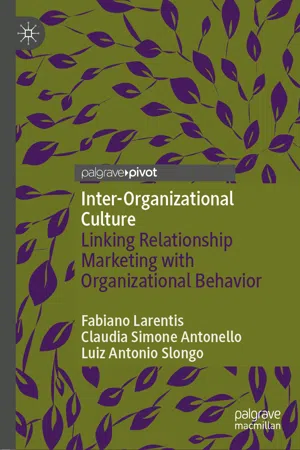
eBook - ePub
Inter-Organizational Culture
Linking Relationship Marketing with Organizational Behavior
- English
- ePUB (mobile friendly)
- Available on iOS & Android
eBook - ePub
Inter-Organizational Culture
Linking Relationship Marketing with Organizational Behavior
About this book
Information
© The Author(s) 2019
Fabiano Larentis, Claudia Simone Antonello and Luiz Antonio SlongoInter-Organizational Culturehttps://doi.org/10.1007/978-3-030-00392-0_11. Introduction: Relationship Marketing and Organizational Culture—An Inter-organizational Perspective
Fabiano Larentis1, 2 , Claudia Simone Antonello3 and Luiz Antonio Slongo4, 5, 6
(1)
Universidade Federal do Rio Grande do Sul, Porto Alegre, Brazil
(2)
Management Graduate Program, Universidade de Caxias do Sul, Caxias do Sul, Brazil
(3)
Universidade Federal do Rio Grande do Sul, Porto Alegre, Brazil
(4)
Universidade de São Paulo, São Paulo, Brazil
(5)
Marquette University, Milwaukee, USA
(6)
Management Graduate Program, Universidade Federal do Rio Grande do Sul, Porto Alegre, Brazil
Abstract
Organizations engaged in relationship marketing practices deal with market needs jointly, searching for value, cocreation and mutual benefits. However, is it possible that a culture that arises in an intersection of organizational cultures is dependent on relationships? Stemming from a study that investigated with a qualitative approach the emergence and development of an inter-organizational culture in a Brazilian context, in this chapter, we present some underlying concepts related to relationship marketing and organizational culture, along with some findings from our research. We conclude by discussing the definition of inter-organizational culture, in which symbols and meanings, beliefs and values of people from different companies interact.
Keywords
Relationship marketingOrganizational cultureInter-organizational relationshipsInter-organizational culture Imagine two organizations engaged in a relationship, which together develop offers and deal with market needs jointly, searching for value co-creation and mutual benefits. They also present a great level of interdependency and realize the importance of trust, commitment and cooperation. People from both organizations interact with one another, solve problems jointly, learn from one another. This interaction allows them to know more and keep in touch with the organization’s paths, about their values, beliefs, meanings and symbols, that is, their organizational cultures. However, does this relationship lead to a common culture to both organizations? In what way? With whom?
The idea for this book originated from a doctoral dissertation, whose main findings are published as a paper (Organizational culture and relationship marketing: an inter-organizational perspective, Review of Business Management), in which two Brazilian cases (furniture and financial services industries) were studied in a qualitative research. The dissertation presents and discusses the emergence and development of an inter-organizational culture, in which symbols and meanings, beliefs and values of people from different companies interact. That study indicates that inter-organizational culture can be seen as a culture of intersection, because of the association of cultural perspectives between suppliers and intermediaries.
These companies are located in the south of Brazil, from different industrial groups. Evviva Bertolini, the furniture company (www.evviva.com.br), was founded in the mid 1990s and belongs to Bertolini Group (http://www.bertolini.com.br/?idioma=en). The company manufactures customized furniture and deals with exclusive furniture stores as intermediaries, with an exclusive contract by region, similar to a franchising system. Racon Consórcios (https://www.racon.com.br) was founded in mid 1980s and belongs to Randon Companies (http://www.empresasrandon.com.br/EN). They provide financial services for real estate and vehicles purchase, through a franchising system. Evviva and Racon have been chosen to take part of the research because of the close relationship with their sales intermediaries (large number of interactions and the existence of trust, commitment and cooperation). The research (interviews and observation) was carried out in the dyads in four stages, with the participation of individuals from supplier companies and sales intermediaries involved in the relationships.
This book contributes to a deeper understanding of a culture that arises in an intersection of organizational cultures, dependent on relationships. Despite consensus about the importance of role of organizational culture in relationship marketing, this subject is often neglected and under-researched by relationship marketing and organizational behavior literature (Iglesias, Sauquet, & Montaña, 2011), mainly when we consider organizational culture in three perspectives (integration, differentiation and fragmentation) and the existence and development of an inter-organizational culture.
Furthermore, current studies on organizational culture interface, in an inter-organizational context, generally emphasize more organizational culture differences rather than organizational culture compatibilities (Lu, Plewa, & Ho, 2016). In addition, research should consider how an organizational culture is constituted from the development of marketing activities over time, and how dissonant cultures and structures are aligned (Moorman & Day, 2016).
Thus, we present some underlying concepts related to relationship marketing and organizational culture, along with some findings from our research. We conclude by presenting and exploring the definition of inter-organizational culture.
1.1 Relationship Marketing and Organizational Culture: Key Aspects and Findings
Relationship marketing can be defined as a process of engagement and interaction which develops, establishes and maintains long-term cooperative and profitable relationships between partners, with benefits among them as a result (Hakansson & Snehota, 1995; Larentis, Antonello, & Slongo, 2018; Morgan & Hunt, 1994; Palmatier, 2008). In this sense, the more both parties are encouraged to sustain the relationship, the lower the chance of relationship dissolution and the more willing they are to invest in that relationship, especially in nonrecoverable investments (Scheer, Miao, & Palmatier, 2015). Furthermore, relationship marketing increases the efficiency through cost reductions, qualifies market orientation and helps to manage dependency and uncertainty (Cannon & Perreault, 1999).
We highlight trust, commitment and cooperation as relationships key elements (Agariya & Singh, 2011; Gummesson, 2017; Palmatier, Dant, Grewal, & Evans, 2006). Trust increases information sharing and the feeling of stability, and it also reduces opportunism between partners (Palmatier et al., 2006), but it decreases in unstable environments (Kang & Jindal, 2015). Commitment reinforces the will to keep a relationship (Palmatier et al., 2006). Cooperation, influenced positively by trust and cooperation (Morgan & Hunt, 1994; Palmatier et al., 2006), expands when partners favorably perceive past interactions and believe future actions to be constructive (Morgan, 2000).
The activities performed by Evviva and Racon along with their channel partners demand more closeness. Although there are binding agreements, we have identified that they do not seem to narrow the social benefits related to the relationship. Moreover, Evviva deals with furniture projects and assemblies, which mobilize consumers’ lives. They also deal with other professionals, such as interior designers and architects. Racon deals with several financial procedures and rules, which influence sales arguments.
The relationships nurtured by Evviva and Racon rely on practices, on outcomes and on the concern to deliver what has been promised, through constant information sharing, team’s integration, reliability on what is being done, through the willingness to solve problems and to learn. Hence, we recognize the presence of trust, commitment and cooperation.
Nevertheless, relationship development depends on time. Also, some customers do not want to maintain a close relationship with their suppliers and vice versa. For these reasons, relationships need to be stable enough to last, but dynamic enough to assure capability development (Batt...
Table of contents
- Cover
- Front Matter
- 1. Introduction: Relationship Marketing and Organizational Culture—An Inter-organizational Perspective
- 2. Inter-organizational Culture and the Cultural Perspectives
- 3. Development of Inter-organizational Culture: The Elements
- 4. Promoting an Inter-organizational Culture
- 5. Conclusion
- Back Matter
Trusted by 375,005 students
Access to over 1.5 million titles for a fair monthly price.
Study more efficiently using our study tools.
Frequently asked questions
Yes, you can cancel anytime from the Subscription tab in your account settings on the Perlego website. Your subscription will stay active until the end of your current billing period. Learn how to cancel your subscription
No, books cannot be downloaded as external files, such as PDFs, for use outside of Perlego. However, you can download books within the Perlego app for offline reading on mobile or tablet. Learn how to download books offline
Perlego offers two plans: Essential and Complete
- Essential is ideal for learners and professionals who enjoy exploring a wide range of subjects. Access the Essential Library with 800,000+ trusted titles and best-sellers across business, personal growth, and the humanities. Includes unlimited reading time and Standard Read Aloud voice.
- Complete: Perfect for advanced learners and researchers needing full, unrestricted access. Unlock 1.5M+ books across hundreds of subjects, including academic and specialized titles. The Complete Plan also includes advanced features like Premium Read Aloud and Research Assistant.
We are an online textbook subscription service, where you can get access to an entire online library for less than the price of a single book per month. With over 1.5 million books across 990+ topics, we’ve got you covered! Learn about our mission
Look out for the read-aloud symbol on your next book to see if you can listen to it. The read-aloud tool reads text aloud for you, highlighting the text as it is being read. You can pause it, speed it up and slow it down. Learn more about Read Aloud
Yes! You can use the Perlego app on both iOS and Android devices to read anytime, anywhere — even offline. Perfect for commutes or when you’re on the go.
Please note we cannot support devices running on iOS 13 and Android 7 or earlier. Learn more about using the app
Please note we cannot support devices running on iOS 13 and Android 7 or earlier. Learn more about using the app
Yes, you can access Inter-Organizational Culture by Fabiano Larentis,Claudia Simone Antonello,Luiz Antonio Slongo in PDF and/or ePUB format, as well as other popular books in Business & Business Strategy. We have over 1.5 million books available in our catalogue for you to explore.