eBook - ePub
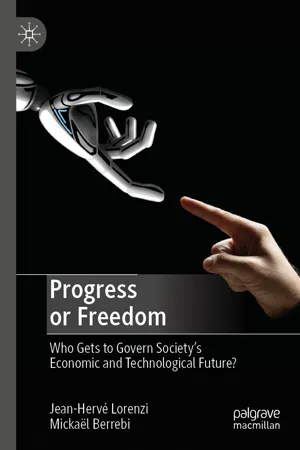
Progress or Freedom
Who Gets to Govern Society’s Economic and Technological Future?
- English
- ePUB (mobile friendly)
- Available on iOS & Android
eBook - ePub
Progress or Freedom
Who Gets to Govern Society’s Economic and Technological Future?
About this book
Technological dominance is shifting the balance of global economic stability. This is the central premise behind the latest book from Lorenzi and Berrebi who view the rise of artificial intelligence, robotics, use of private data, and genetic transformation, among other developments, culminating in new economic conditions that require a fresh sense of governance in order for society to sustain order. Whilst progress in technology provides numerous opportunities and hope, is the desire to pursue these ambitions in innovation putting our society at risk of being undermined and, ultimately, governed by technology firms? How will these changes affect economic outlooks in an age of growing inequality and aging populations? What role do politicians serve in facilitating these changes? The decline of a labour force, the use of Big Data and increased speeds of communication are but three examples that the authors address in their quest to understand where the limits should lie between progressand disruption for the future of society.
Information
© The Author(s) 2019
J.-H. Lorenzi, M. BerrebiProgress or Freedomhttps://doi.org/10.1007/978-3-030-19594-6_11. Introduction: The New Human Condition
Jean-Hervé Lorenzi1 and Mickaël Berrebi2
(1)
Paris Dauphine University, Paris, France
(2)
Paris, France
The world is perplexed: a little lost, even. It is waking up to the fact that our emergence from the crisis does not in any way imply a return to the extraordinary growth of the early 2000s. It is finally realising that the ageing population, the demographic time bomb, the slowdown in productivity gains, the explosion in inequalities and unregulated finance are all creating entirely new economic conditions and, in fact, a slowdown in the world economy. Accommodative monetary policies are coming to an end, interest rates are set to rise again and fiscal policies, with the possible exception of Trump-style, temporary measures, are limited by the weight of public debts. We have reached a point today where the rational world is retreating and extremism and populism are rising, where the technological dream appears to be the only dream of a better world. This is what this book will discuss: the risks our societies are taking, with their naïve and simplistic view of a technological Eden: an Eden where politicians make way for the new prophets of technology, who are designing our world to suit themselves.
1.1 The Eternal Prophecy of a Better World
The technological illusion has a prophet: Jeremy Rifkin. He is a spokesman for great entrepreneurs who, despite their current promises, believe they can shape the world based on their innovations. Rifkin is far from the only one, of course. But he remains the most iconic figure, because he lends an air of scientific and cultural credibility to his views.
Why pick on this unfortunate propagandist for a world which is finally rid of all the hindrances we have endured for millennia: work, ignorance, wars and widespread change, beginning with the climate? Very simply, because he epitomises, on his own, the naïve world view whose keyword is “progress”: a world where a sated and appeased consumer defines the new human condition. Rifkin conflates, under the general term “progress”, science’s remarkable developments and their technological applications for the majority of the population. But what precisely do we mean by “technological”? It can be defined as the sum total of individual processes designed for production, and therefore as the result of a concrete application of science, science being our tool for understanding the world. All scientific processes indicate an expertise which claims to be perfect, rigorous, increasingly concerned with regulation, which bases that claim on a heightened use of previously unknown computational tools. Technologies, and subsequent innovations, are nothing more than applications of these great advances in knowledge. And it is from this confusion that the problem is born.
Let’s go back to Rifkin. His work, The Zero Marginal Cost Society (Rifkin 2014), pulls off the coup of making the entire Internet the answer to the crisis in the capitalist system and the threats it poses to humans and the environment. How better to resolve mass unemployment, or even “the end of work”, as Rifkin has long described it, than by imagining “prosumers”, capable of producing everything they need? How better to do away with our obsession with the hypothetical notion of growth, and to resolve the now central problem of inequality, than by envisaging a peer-to-peer, sharing, collaborative society, where profit no longer has any meaning? A society which can spread through the poorest regions of the world, as is the case in certain rural communities in India? How better to recreate a common good than by imagining a new model of governance, “collaborative commons”, with a nod to the “commons” of feudal times, where production for use predominates over production for exchange? Finally, entering the realm of false assumptions, how better to reduce humanity’s carbon footprint that by promoting renewable energy and a lifestyle which reconciles “free everything” abundance with sustainability?
Rifkin contends that the world is heading towards a third industrial revolution, based on the Internet of Things. But can we safely state this is an industrial revolution, in the sense of a new balance between production and consumption, creating a new cycle of economic growth and resulting from a series of innovations related to the boom in, and distribution of, new technologies? The conclusion is risky, because the development of the Internet of Things and of renewables remains embryonic and uncertain.
But most importantly, there is no consensus on this misused concept of industrial revolution. Once again, it is Schumpeter who puts us back on the right track: “if we survey the course of economic history, we do not find any sudden ruptures, only a slow and continual evolution” (Schumpeter 1946). Economists and historians have always been in a constant dialogue over the dynamics of technological change. Some, like Braudel, see it as a linear process, whereas others favour the disruptive approach. The idea of the industrial revolution, which is the result of the second approach, must be handled with care.
The uncertainty around the theory of a third industrial revolution is not just technical, moreover. The development of an Internet of renewable energy presupposes a collaborative economic approach which supersedes the traditional mode of production based on market exchange. Whether it is a question of advances in technology, or in the mode of production and consumption that these technological developments presuppose, it is questionable whether the conditions for an industrial revolution have been met.
Despite such a debatable approach, Rifkin, the prophet, a kind of heir to Charles Fourier and his Phalansteries, is right on target in a world full of nightmare scenarios. His offering of such naïve optimism has seduced quite a few people.
But if he was the only one, the world would be simple and criticism easy. In fact, he is joined by other prophets: those who, not content with conference speakers’ fees, share their vision of the world from their position at the heart of the current economic establishment. Listen to them: Eric Schmidt 1 (Seigler 2010) explains: “Your car should drive itself. It’s amazing to me that we let humans drive cars…”. Similarly, Jeff Bezos (Quinn 2015) 2 reckons that the task of delivering parcels will be done by drones, so that: “One day, (such)… deliveries will be as common as seeing a mail truck”. And what about Sundar Pichai (Tung 2016), 3 the man said to play Moses to Larry Page 4 ’s God, by deciphering abstract projects from a mind too brilliant to be understood by everyone? He says: “the very concept of the ‘device’ will fade away. Over time, the computer itself, in whatever form, will be an intelligent assistant helping you through your day”. As for the fascinating Elon Musk (Musk 2017), 5 he is quite determined to create entirely self-sufficient cities on Mars, because: “if we stay on Earth forever, there will be some eventual extinction event”.
These are exceptional men: remarkable innovators and industrialists. But for all that, should they be the ones pointing the way forward for humanity? A humanity fascinated by new tools, overcome with gratitude towards those who provide them for us; a humanity fascinated by extraordinary means of communication, yet distraught when faced with an unfathomable world? Deep down, it can all be summed up by the simple idea that progress is never-ending, that it applies to everyone everywhere, that it transforms and improves our lot and that it is appropriate that those who design it should also set the rules.
Thus, artificial intelligence and gene technology would be tools in the hands of all-powerful demiurges. Based on their current economic power, they would naturally qualify as the sole architects of a recreated world. This would spell the end of thinkers on the nature of human progress, such as John Rawls on fairness and Amartya Sen’s capabilities approach, on development for all; an end to the women and men who could alert the world to climate risks; an end to the Mandelas and others who could pave the way to peace in a violent world. From now on, only Mark Zuckerberg, 6 Larry Page and others like Sergey Brin 7 will have a voice. But, as ever, how much of this is new?
Are the misuse of technology and the pronouncements of these prophets unique in human history?
1.2 The Recurring Conflict Between Progress and Society
This debate is not really new. In fact, the dominant schools of thought have been confronting each other for centuries: those who control disruptive technologies in order to shape tomorrow’s society, and those who think the power to make society progress belongs to those who conceive it in human terms. We need only consider the strong reluctance of the great thinkers in relation to the concept of progress: Paul Valéry said: “Modern man is the slave of modernity; there is no progress which does not turn into his complete servitude” (Valéry 1948). Technology against humanities: it is an eternal conflict, because power’s only real prize is to make the rules which govern the lives of those who follow us.
In the past, economists perceived technological progress as an exogenous variable and declared they were not competent to analyse it. In fact, Lionel Robbins wrote that “Economists are not interested in technique as such” (Robbins 1932). Even Pareto excludes technological development from economic logic and considers it as external, gratuitous data in his model.
But economists did not remain absent from this arena. Innovation gradually becomes one of the principal levers of growth, and the cycles of innovation and economic growth are brought closer together, in the manner of Kuznets, for whom: “several periods of economic growth in the modern age can be identified with major innovations and the relative growth of the industries concerned” (Kuznets 1973). It is well known that this development in economic thought finds its most complete expression in Schumpeter, for whom technological progress is the engine of history and innovation the engine of growth. In fact, the influence of technological progress on economic growth and development appears to be firmly established, although perhaps not entirely so. Let’s remind ourselves of Jacques Ellul, the undisputed technological thinker par excellence, little known because he was undoubtedly ahead of his time. According to Ellul, in every aspect of technology, it is really a human drive which is at work: the drive of power. “Technology is power, made up of instruments of power, hence producing phenomena and structures of power, i.e. of domination” (Ellul 2018). This impulse has found very different applications throughout the ages, which we should bear in mind, because it gives us hope that the future has not yet been decided.
Let’s go back ten centuries. In the year one thousand, Europe is lagging behind, widely outpaced by the Chinese and Islamic societies and civilisations. The former has already seen the emergence of gunpowder, the compass, paper pulp and printing. The latter produced algebra and new advancements in medicine. But those technological innovations, produced by an educated elite, remain within the social circles of the powerful dynasties as they rise and fall. Take for example th...
Table of contents
- Cover
- Front Matter
- 1. Introduction: The New Human Condition
- 2. A Major Stagnation, But Not a Secular One
- 3. The High Tech Eden
- 4. A Shattered Labour Market
- 5. Human Genius at the Controls
- 6. A Disengaged Society?
- 7. Who Governs: Politicians, or Technology Prophets?
- 8. Two Possible Paths: The Great Parting of Ways
- 9. Re-humanising the World
- Back Matter
Trusted by 375,005 students
Access to over 1.5 million titles for a fair monthly price.
Study more efficiently using our study tools.
Frequently asked questions
Yes, you can cancel anytime from the Subscription tab in your account settings on the Perlego website. Your subscription will stay active until the end of your current billing period. Learn how to cancel your subscription
No, books cannot be downloaded as external files, such as PDFs, for use outside of Perlego. However, you can download books within the Perlego app for offline reading on mobile or tablet. Learn how to download books offline
Perlego offers two plans: Essential and Complete
- Essential is ideal for learners and professionals who enjoy exploring a wide range of subjects. Access the Essential Library with 800,000+ trusted titles and best-sellers across business, personal growth, and the humanities. Includes unlimited reading time and Standard Read Aloud voice.
- Complete: Perfect for advanced learners and researchers needing full, unrestricted access. Unlock 1.5M+ books across hundreds of subjects, including academic and specialized titles. The Complete Plan also includes advanced features like Premium Read Aloud and Research Assistant.
We are an online textbook subscription service, where you can get access to an entire online library for less than the price of a single book per month. With over 1.5 million books across 990+ topics, we’ve got you covered! Learn about our mission
Look out for the read-aloud symbol on your next book to see if you can listen to it. The read-aloud tool reads text aloud for you, highlighting the text as it is being read. You can pause it, speed it up and slow it down. Learn more about Read Aloud
Yes! You can use the Perlego app on both iOS and Android devices to read anytime, anywhere — even offline. Perfect for commutes or when you’re on the go.
Please note we cannot support devices running on iOS 13 and Android 7 or earlier. Learn more about using the app
Please note we cannot support devices running on iOS 13 and Android 7 or earlier. Learn more about using the app
Yes, you can access Progress or Freedom by Jean-Hervé Lorenzi,Mickaël Berrebi, Dina Leifer in PDF and/or ePUB format, as well as other popular books in Economics & Development Economics. We have over 1.5 million books available in our catalogue for you to explore.