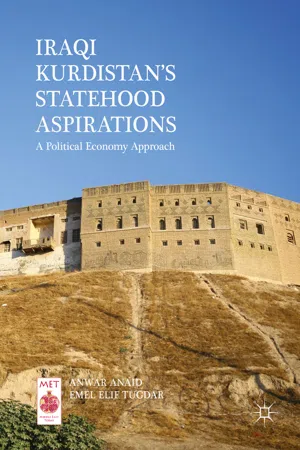
eBook - ePub
Iraqi Kurdistan’s Statehood Aspirations
A Political Economy Approach
- English
- ePUB (mobile friendly)
- Available on iOS & Android
eBook - ePub
Iraqi Kurdistan’s Statehood Aspirations
A Political Economy Approach
About this book
This edited volume addresses the issues of Iraqi Kurdistan's political economy with historically grounded, theoretically informed, and conceptually relevant scholarship that prioritizes comparative politics over international relations. The book seeks to explore the dynamics of Iraqi Kurdistan at the stage of referendum for independence from a political economy perspective within its own debates, conflicts, and interests. Overall, the authors contribute to these debates by exploring key questions in novel ways, focusing on comparative methodology that serve to expand the scope of scientific inquiry and place it into more solid understanding.
Information
© The Author(s) 2019
Anwar Anaid and Emel Elif Tugdar (eds.)Iraqi Kurdistan’s Statehood AspirationsMiddle East Todayhttps://doi.org/10.1007/978-3-319-93420-4_11. Introduction
Anwar Anaid1 and Emel Elif Tugdar2
(1)
Department of Politics and International Relations, University of Kurdistan Hewler, Erbil, Iraq
(2)
Department of Politics and International Relations, University of Kurdistan Hewler, Erbil, Iraq
Anwar Anaid (Corresponding author)
Emel Elif Tugdar
Two significant events helped the Kurds in Iraq to place themselves at the center of international public and scholarly attention. Initially, the Gulf War in the early 1990s made Iraqi Kurds strong coalition partners against the Saddam regime. This coalition also caused Kurds to take an official federal status known as the Kurdistan Region represented by the Kurdistan Regional Government (KRG) after the Saddam regime was removed in 2003. After more than a decade, Kurds have been again in the headlines of international community due to their fight against Islamic State of Iraq and Syria (ISIS) as part of the major partners of the international coalition. This increasing attention on the Kurds can be easily seen through the increase in academic and media publications on their role in regional affairs and international relations. Thus, questions such as the statehood aspirations of Kurds, independence, and state building attract more scholarly attention now.
The long-term state building aspirations of the Iraqi Kurdistan Region entered a new phase with the independent referendum in September 2017. In this edited volume, we aim to address the questions about statehood aspirations of Kurds in Iraq from a political economy perspective. We ask several questions, i.e. how far the Iraqi Kurdistan Region is ready for state building from political economy perspective? How do different sectors of economy , i.e. oil, agriculture and tourism affect political aspirations? How do external relations, specifically with neighboring states with Kurdish population take part in statehood aspirations from political economy perspective? Which macro and micro arguments of political economy are applicable to the region? In a nutshell, this proposed book seeks to explore the internal dynamics of Kurdistan Region of Iraq (KRI ) from a political economy perspective within its own debates, conflicts, and interests.
The theme of Part 1 is ‘Theoretical Framework of Political Economy in the Iraqi Kurdistan’. In Chapter 2, Anwar Anaid discusses “The Nature of Political Economy Challenges of the Kurdistan Region of Iraq”. According to Anaid in addressing the financial and economic crisis that the KRI has faced since 2014 the focus has been either economic, social or political, not the interrelation between them which is the focal point of political economy . In this chapter, Anaid attempts to approach the crisis from a political economy perspective or the relationship between state, economy , and society in the Kurdistan region. By approaching the crisis from such a perspective, the aim of the chapter is to provide a theoretical framework that informs the other chapters. It is argued that the primary cause of the Kurdistan Region’s current economic challenges is the KRG’s failure to base its initial developmental policies on a comprehensive and binding political economy model that could define and promote a healthy relationship between government, market, and society in the region. The chapter purposes adopting a model of political economy that is economically sound, politically responsible and socio-culturally informed.
Within the context of the theme “Theoretical Framework of Political Economy in Iraqi Kurdistan ”. Fahrettin Sümer and Jay Joseph evaluate whether the KRI ’s political and economic institutions are conducive for economic development in the region in Chapter 3 titled “Compatibility of the Kurdistan Region of Iraq ’s Institutions and Economic Development Within Iraq ”. There have been growing economic development literatures that point at the importance of having inclusive institutions for sustained economic growth. Inclusive economic institutions create a level playing field for entrepreneurship and businesses, provide secure property rights, and enforce contracts. Inclusive political institutions create a democratic society where various groups and interests are represented and their demands are expressed through political mechanisms; which articulates, reconciles and turns such demands into policies. In positioning the need for inclusive institutions, we also explore how various public sector inefficiencies can occur due to shortcomings of bureaucracy, interest groups, and political behaviors within political and economic institutional structures. Public Choice economic literatures show that key actors of political processes may engage in economically damaging behaviors such as: rent-seeking activities by well-organized interest groups, short-term political decision making, corruption around personal electoral gains or rent-extraction from private groups or public sources, self-interest based income, and prestige and career decision making from bureaucrats. Thus, society’s resources could be wasted unless well-designed institutional constraints are established, and incentives for economically damaging political behavior are eliminated or reduced. Therefore, a country or region’s institutions, starting from the constitution, need to be designed in a way that will bring checks and balances, enhance accountability of bureaucrats and politicians, and bring transparency in public revenues and expenditure for the public’s scrutiny.
The theme of Part II is ‘Sectorial and External Approaches to Political Economy in Kurdistan Region’. In Chapter 4 titled “Perspectives of an Independent Energy Export Policy of Iraqi Kurdistan ”, Gülistan Gürbey and Caner Yildirim explore the prospects for an independent energy export policy of the KRI and, therefore, deals with the question of how sustained profitability, legitimacy and stability can be ensured after making an inventory of the current situation and portraying the oil dispute between Erbil and Baghdad, energy policy goals, strategies, and cooperation are presented, as well as challenges and opportunities are critically examined. In the context of the referendum for independence and substantial dependence on revenues from oil exports, this article investigates the economic, legal, political, and security challenges such as the resistance from the central government in Iraq , the freeze of budget payments to KRG and the fall in oil prices, the inflated state apparatus and attacks on the pipeline infrastructure. The long-term profitability and stability of the Kurdish strategy will depend, among other things, on production and capacity increases on the one hand and building good governance structures and strengthening internal democratic development on the other hand. A successful energy export policy would have important effects on the political economy of the Kurdistan Region in Iraq and the de facto and aspired de jure independence, respectively.
In Chapter 5, titled “Technology Management and Policy of Kurdistan Region of Iraq” . Nabaz Khayyat discusses the importance of upgrading Kurdistan Region industrial structure to be able to generate more value-added products for maintaining the process of economic development . Khayyat claims that this process requires advancement in technological capabilities to employ and engross more urbane technologies. Thus, this advancement in technological capabilities needed to build a national innovation system, its activities should include but not limited to hardware and software purchases, industrial design and engineering activities, employing up to date machinery, equipment and other capital goods, in-house software development , and finally the ability to conduct reverse engineering. In addition to this, Nabaz Khayyat shows the importance of investing in human development in terms of training and tertiary education, which should be applied in Kurdistan Region for state building process.
In Chapter 6 titled “Kurdistan’s Democratic Developments Amid a Rentier Oil Economy ”, Ari Mamshae discusses about oil economy . It is a common understanding that democracy is hard to flourish in oil-rich countries and in fact, majority of these countries are either authoritarian or dictatorial. The KRI, whether relying on Baghdad or independently selling oil to generate revenue, could be all standards called a rentier. However, unlike other examples of rentier states, there are some democratic features in the KRI . Although far from perfect, elections are largely fair and free, freedom of expression and association is high, pluralism and diversity exists, among others—there has been no coverage of KRI by the democracy indexes. For that purpose, this chapter will be using the Economic Intelligence’s Democracy Index methodology to measure it. It will thereafter look into the reasonable reasons behind the democratic developments and provide explanation to this outstanding example. This is the first time in academic publications that both measuring democracy and studying the democratic developments in Iraqi Kurdistan Region are done.
In Chapter 7 Joseph and Sümer argue as an oil-rich developing region, the Kurdistan Region of Iraq has characteristically fallen into the resource curse affecting many oil-rich nations. One such symptom of this curse is an overinflated and inefficient public sector, which now employs over half of all adult workers in the region, growing over time for both political purposes and out of fiscal mismanagement. The public sector of the KRI now stands as a fiscal burden on the KRG’s central budget, undermining the region’s ability to build a sustainable employment market for the future.
Overall, this edited volume introduces the dynamics and complexities of the political economy perspective on the statehood aspirations of Iraqi Kurds. As the Kurdish state building aspirations are conducive to many factors, i.e. actors, rivalries, alliances, ideologies, interests, this edited volume seeks to unpack this complex political economy dynamics. In the end, the book has three major objectives: (1) to introduce scholars of Comparative Politics, Political Economy and...
Table of contents
- Cover
- Front Matter
- 1. Introduction
- Part I. Theoretical Framework of Political Economy in Iraqi Kurdistan
- Part II. Sectorial and External Approaches to Political Economy in Kurdistan Region
- Back Matter
Trusted by 375,005 students
Access to over 1.5 million titles for a fair monthly price.
Study more efficiently using our study tools.
Frequently asked questions
Yes, you can cancel anytime from the Subscription tab in your account settings on the Perlego website. Your subscription will stay active until the end of your current billing period. Learn how to cancel your subscription
No, books cannot be downloaded as external files, such as PDFs, for use outside of Perlego. However, you can download books within the Perlego app for offline reading on mobile or tablet. Learn how to download books offline
Perlego offers two plans: Essential and Complete
- Essential is ideal for learners and professionals who enjoy exploring a wide range of subjects. Access the Essential Library with 800,000+ trusted titles and best-sellers across business, personal growth, and the humanities. Includes unlimited reading time and Standard Read Aloud voice.
- Complete: Perfect for advanced learners and researchers needing full, unrestricted access. Unlock 1.5M+ books across hundreds of subjects, including academic and specialized titles. The Complete Plan also includes advanced features like Premium Read Aloud and Research Assistant.
We are an online textbook subscription service, where you can get access to an entire online library for less than the price of a single book per month. With over 1.5 million books across 990+ topics, we’ve got you covered! Learn about our mission
Look out for the read-aloud symbol on your next book to see if you can listen to it. The read-aloud tool reads text aloud for you, highlighting the text as it is being read. You can pause it, speed it up and slow it down. Learn more about Read Aloud
Yes! You can use the Perlego app on both iOS and Android devices to read anytime, anywhere — even offline. Perfect for commutes or when you’re on the go.
Please note we cannot support devices running on iOS 13 and Android 7 or earlier. Learn more about using the app
Please note we cannot support devices running on iOS 13 and Android 7 or earlier. Learn more about using the app
Yes, you can access Iraqi Kurdistan’s Statehood Aspirations by Anwar Anaid, Emel Elif Tugdar, Anwar Anaid,Emel Elif Tugdar in PDF and/or ePUB format, as well as other popular books in Política y relaciones internacionales & Relaciones internacionales. We have over 1.5 million books available in our catalogue for you to explore.