This book critically engages with how the conservation of tropical rainforests is financed. Beginning with the context of tropical deforestation, alongside an overview of tropical ecology, global environmental policy and finance, the book reviews several conservation financing instruments. These include ecotourism and private reserves, debt-for-nature swaps and government domestic budgetary expenditures for state and national parks. Tropical deforestation and forest degradation are serious global environmental issues, contributing to global climate change, species extinction, and threatening the livelihoods of forest-dependent communities. Yet, many leading companies, individuals and governments are making a positive impact on tropical forest conservation to mitigate greenhouse gas emissions through the use of conservation finance. Conservation of Tropical Rainforests tells the history of international conservation finance and provides a variety of options for individuals, businesses, and governments to support conservation financing projects.
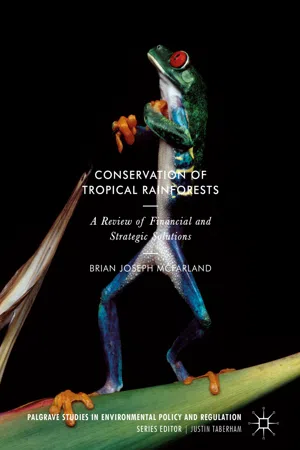
eBook - ePub
Conservation of Tropical Rainforests
A Review of Financial and Strategic Solutions
- English
- ePUB (mobile friendly)
- Available on iOS & Android
eBook - ePub
Conservation of Tropical Rainforests
A Review of Financial and Strategic Solutions
About this book
Information
© The Author(s) 2018
Brian Joseph McFarlandConservation of Tropical RainforestsPalgrave Studies in Environmental Policy and Regulation https://doi.org/10.1007/978-3-319-63236-0_11. Executive Summary
Brian Joseph McFarland1
(1)
Windham, NH, USA
Rainforests are the most biologically diverse terrestrial ecosystem on Earth and provide a wide range of critical ecosystem services from regulating water cycles to recycling nutrients, to the storage of carbon. According to research by Dr. Claude Martin:
The area covered by tropical rainforests at that time {Humboldt and Bonpland’s expedition in 1799–1804} was still close to the 1.6 billion hectares believed to be the original maximum distribution areas {…}. Today less than half this area remains as undisturbed forest {less than 800 million hectares}—nobody knows exactly how much—and about another quarter survives as fragmented and degraded forest.1
This said, significant financial resources from both the private and public sectors need to be mobilized to reverse this trend of tropical rainforest deforestation, while at the same time to restore degraded areas. As of January 2016, it is estimated that approximately “$52 billion per year flows to conservation projects {i.e., not just rainforest conservation}, the bulk of it is public and philanthropic funds.”2 In addition, approximately USD$8.2 billion was invested by the private sector from 2004 to 2015 in the following “three groups of conservation-oriented investments:
- Sustainable food and fiber production (e.g., forestry, agriculture, and fisheries);
- Habitat conservation (e.g., mitigation banking and forest carbon trading); and
- Water quality and quantity protection (e.g., watershed protection and water rights trading).”3
However, going forward, “{…} to finance the preservation of the world’s precious ecosystems {including tropical rainforests} will require $200 billion to $300 billion in additional capital, and private investment capital may be the main source of additional capital. Attracting such a level of private capital will require attractive risk-adjusted rates of return, in addition to clear and measurable conservation impacts.”4 As stated by the former Commission on Climate and Tropical Forests, approximately USD$30 billion a year “will be required to reduce emissions from tropical deforestation by half in 2020.”5
The history of conservation finance arguably dates back to 1634, when the Boston Commons was established and likewise, it is considered “the oldest public open space in the United States. Indeed, it is very likely the oldest public open space in the English-speaking world.”6 The Bogd Khan Uul National Park in Mongolia was established “by the Mongolian government in 1778, {however} it was originally chartered by Ming Dynasty officials in the 1500s as an area to be kept off limits to extractive uses, protected for its beauty and sacred nature.”7
The first documented protected area, according to the World Database on Protected Areas, appears to be a nature park in Russia known as the Donskoj rybny zapovednik (Donskoe zapretnoe rybnoe prostranstvo) which was established in 1819.8
The first state park appears to be Yosemite National Park in California, United States, which was first designated a state park in 1864,9 while the first national park—aside from Bogd Khan Uul National Park—appears to be Yellowstone National Park in the current US states of Wyoming, Montana, and Idaho in 1872.10
In 1891, the Trustees of Public Reservations (now the Trustees of Reservations, or TTOR) became the world’s first regional land trust,11 which established the world’s first conservation easement in Boston, Massachusetts.12
It is difficult to discern when the first government international budgetary expenditures for conservation were allocated. However, it is likely this mechanism was first established in the late nineteenth century or early twentieth century, when the world’s first international conservation organizations were established. This includes the Society for the Preservation of the Wild Fauna of the Empire (now known as Fauna and Flora International or FFI), which was founded in 1903,13 and the International Council for Bird Preservation (ICBP; the ICBP would rebrand as BirdLife International in 1993) was established in 1922.14 Similarly, Waterton Glacier International Peace Park was established in 1932 between the United States of America and Canada and marked the world’s first international peace park.15
Modern-day impact investing is comparable to socially responsible investing, which took “{…} off in the 1970s as part of grassroots campaigns to boycott firms in South Africa {as a result of Apartheid} as well as the nuclear weapons and tobacco industries.”16
In the late 1970s, the concept of payments for ecosystem services (PES, referred to earlier as payments for environmental services) begins to appear.17
Low-impact tourism likely began earlier, but in 1983, the term “ecotourism” is first coined by Mexican architect Héctor Ceballos-Lascuráin.18
Debt-for-nature swaps came along shortly thereafter with the first such debt-for-nature swaps conducted in 1987 in both Bolivia and Ecuador .19
Then in 1991, the world’s first major bioprospecting deal was struck between Merck & Co. and Costa Rica’s Instituto Nacional de Biodiversidad (INBio).20
The sustainable, green procurement of locally produced commodities—particularly by Indigenous Peoples and forest-dependent communities—has existed for thousands of years. However, the origin of commercial, green procurement with independent certification standards likely started with the creation of the Forest Stewardship Council (FSC)21 and the Sustainable Forestry Initiative (SFI) in 1994.22
The first widely recognized green bonds were issued in 2007 and 2008 by the World Bank23 and European Investment Bank.24
With this historical overview in mind, it appears as though the two most promising conservation financing instruments are the payments for ecosystem ...
Table of contents
- Cover
- Front Matter
- 1. Executive Summary
- 2. The Context of Tropical Rainforest Deforestation and Degradation
- 3. Tropical Rainforest Ecology
- 4. Global Environmental Policy
- 5. International Finance
- 6. The Origins and History of Conservation Finance
- 7. Government Domestic Budgetary Expenditures
- 8. Tax Deductions and Conservation Easements
- 9. Government International Budgetary Allocations
- 10. Impact Investing
- 11. Payments for Ecosystem Services
- 12. Ecotourism and Private Reserves
- 13. Debt-for-Nature Swaps
- 14. Bioprospecting
- 15. Green Procurement Models
- 16. Green Bonds, Landscape Bonds, and Rainforest Bonds
- 17. Additional Considerations for Tropical Forest Conservation Finance
- 18. The Future of Tropical Forest Conservation Finance
- Back Matter
Trusted by 375,005 students
Access to over 1.5 million titles for a fair monthly price.
Study more efficiently using our study tools.
Frequently asked questions
Yes, you can cancel anytime from the Subscription tab in your account settings on the Perlego website. Your subscription will stay active until the end of your current billing period. Learn how to cancel your subscription
No, books cannot be downloaded as external files, such as PDFs, for use outside of Perlego. However, you can download books within the Perlego app for offline reading on mobile or tablet. Learn how to download books offline
Perlego offers two plans: Essential and Complete
- Essential is ideal for learners and professionals who enjoy exploring a wide range of subjects. Access the Essential Library with 800,000+ trusted titles and best-sellers across business, personal growth, and the humanities. Includes unlimited reading time and Standard Read Aloud voice.
- Complete: Perfect for advanced learners and researchers needing full, unrestricted access. Unlock 1.5M+ books across hundreds of subjects, including academic and specialized titles. The Complete Plan also includes advanced features like Premium Read Aloud and Research Assistant.
We are an online textbook subscription service, where you can get access to an entire online library for less than the price of a single book per month. With over 1.5 million books across 990+ topics, we’ve got you covered! Learn about our mission
Look out for the read-aloud symbol on your next book to see if you can listen to it. The read-aloud tool reads text aloud for you, highlighting the text as it is being read. You can pause it, speed it up and slow it down. Learn more about Read Aloud
Yes! You can use the Perlego app on both iOS and Android devices to read anytime, anywhere — even offline. Perfect for commutes or when you’re on the go.
Please note we cannot support devices running on iOS 13 and Android 7 or earlier. Learn more about using the app
Please note we cannot support devices running on iOS 13 and Android 7 or earlier. Learn more about using the app
Yes, you can access Conservation of Tropical Rainforests by Brian Joseph McFarland in PDF and/or ePUB format, as well as other popular books in Biological Sciences & Business General. We have over 1.5 million books available in our catalogue for you to explore.