This title brings together seven presidential politics scholars to address the Trump presidency and the current functioning of American democracy based on recent provocative research. These studies focus on several important topics, including presidential leadership theory and the Trump presidency, examining its mistruths, analyzing its record in the lower federal courts, probing its use of the pardon power, debating whether it requires an entirely new United States constitution to prevent future authoritarian threats, and assessing Trump's contribution to presidential power research. Taken together, these chapters represent a snapshot view of the early Trump presidency and its implications for US politics moving forward.
eBook - ePub
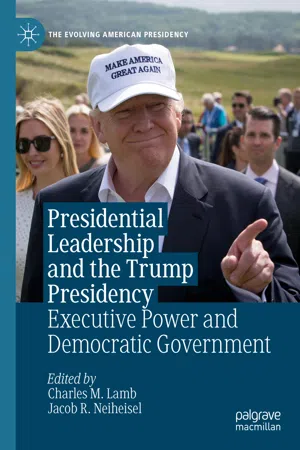
Presidential Leadership and the Trump Presidency
Executive Power and Democratic Government
- English
- ePUB (mobile friendly)
- Available on iOS & Android
eBook - ePub
Presidential Leadership and the Trump Presidency
Executive Power and Democratic Government
About this book
Information
© The Author(s) 2020
Charles M. Lamb and Jacob R. Neiheisel (eds.)Presidential Leadership and the Trump PresidencyThe Evolving American Presidencyhttps://doi.org/10.1007/978-3-030-18979-2_11. On Studying the Trump Presidency
Charles M. Lamb1 and Jacob R. Neiheisel1
(1)
Department of Political Science, University at Buffalo, State University of New York, Buffalo, NY, USA
We thank Joshua Boston for his past research assistance.
End AbstractA survey of members of the American Political Science Association’s Presidents and Executive Politics section conducted roughly a year after President Trump took office ranked him as the worst president in the nation’s history (Nussbaum 2018). Notably, this ranking placed Trump behind even James Buchanan—the chief executive whose quiescence in the face of significant controversy and lack of presidential leadership on the issue of slavery are often thought to have led directly to the outbreak of the American Civil War (Kwong 2018). Although the survey also asked respondents to grade presidents on several different dimensions (Guild 2018) in addition to providing a summary evaluation of each man (dimensions on which Trump also fared poorly according to the experts), ranking presidents has long been an endeavor fraught with difficulties (Nice 1984; Nichols 2012; Pfiffner 2003), not the least of which concerns the set of criteria upon which each chief administrator is to be judged (Pfiffner 2003) and the problems associated with making comparisons across vastly different time periods (Nice 1984). Nevertheless, such exercises can aid students of presidential leadership in identifying the criteria by which presidents ought to be judged (Pfiffner 2003).
Much the same might very well be said for early appraisals of presidents and their leadership undertaken while they still occupy the White House. And even though most would agree with Hilliard, Lansford and Watson’s (2004) judgment—leveled in their own inquiry into George W. Bush early in his administration—that “evaluating presidents is a compelling and an important exercise,” there is still significant disagreement within the scholarly community regarding not only how presidents should be evaluated but also when. Hindsight is often 20/20, and events that appeared to be of little import early in a particular presidency would later go on to define an entire administration. Greenstein (1983) notes that Truman’s Fair Deal and Johnson’s involvement in Vietnam would later characterize their respective periods in office, even as their import was not apparent while they were still serving as the nation’s chief executive. To this list one might add Clinton’s intimate involvement with a White House intern; although it was clear to all at the time that the scandal and resulting impeachment would almost certainly color later evaluations of his presidency, the public, for its part, seemed reluctant at the time to incorporate Clinton’s personal failings into their evaluation of his overall job performance (Zaller 1998). But Clinton’s ratings have declined in recent years—a drop that corresponds with the arrival of the “#MeToo” movement (Andelic 2018). Similarly, decisions or actions that were praised at one point in time might very well be decried at a later date with the benefit of greater historical perspective (Nice 1984).
Why, then, embark upon such an early appraisal of a man who, at the time of this writing, is little over halfway through the term to which he was elected to serve? Political scientists and public administration scholars have engaged in such efforts since at least the Carter administration (Sundquist 1979; see also Burke 2009; Campbell and Rockman 1991, 1996; Greenstein 2003; Hilliard et al. 2004; Jacobson 2007; King and Riddlesperger 1996; Newland 1983).1 Few, however, have provided a rationale for assessing a president while he (or she) is still in office.
Greenstein’s (1983) early examination of President Reagan stands out as a notable exception to this general observation and is applicable to the inquiries detailed in the following pages. According to Greenstein, Reagan’s presidency was worthy of scholarly study “while under way” because it was both “unique” and “extraordinary” (4). As scholars writing for this volume will attest, the very same reasoning applies to President Trump. If Reagan’s presidency was notable for its ideological undertones, however, Trump’s is remarkable for his populist streak and what can only be described as a type of ideological flexibility, not to mention his willingness to break with convention and precedent on a host of other dimensions. Trump’s presidency thus far has defied explanation, and theoretical work on presidential leadership would appear at first blush to offer little in the way of a guide for understanding his approach to the office. This fact alone recommends an early appraisal of the Trump presidency.
Moreover, if Greenstein (1983) is correct in his evaluation that the modern (postwar) presidents face an institutional environment that is qualitatively different from the administrations that came before the midpoint of the twentieth century (an assumption that Skowronek [1997] challenges), then the narrow database available to scholars of presidential politics almost certainly requires the academic community to learn about the presidency as history is unfolding in front of them. According to Greenstein, “Scholars also need to produce ‘instant history’ of each modern presidency because many questions central to analysis of the presidency and of public policy are not addressed in normal media coverage” (1983, 4). What Greenstein said of the Reagan administration over thirty years ago rings true to this day, in spite of the proliferation of media outlets covering national politics and the arrival of the twenty-four-hour news cycle. And even though there is currently no shortage of popular-press books covering the Trump presidency from every conceivable angle, from insider looks at Trump’s administration from respected journalists (e.g., Woodward 2018), to polemics penned by political adversaries, including those within his own party (Wilson 2018), the present volume promises to number among the first scholarly assessments of the Trump presidency (see also Genovese 2017; Nelson 2018).
What political scientists and other academic observers of politics lack in speed, though, they often make up for in terms of perspective. The contributors to this volume, like those who have offered comment on previous presidents while they were still in office (see Campbell and Rockman 1991, 1996; Greenstein 1983, 2003; Hilliard et al. 2004), excel at connecting the goings-on in a particular administration with “historical and disciplinary perspectives” (Greenstein 1983, 3) in such a way so as to inform the general public and add depth to journalistic accounts that often frame contemporary events in episodic rather than thematic terms (Iyengar 1991). Students of presidential politics are well situated in this regard and “bring distinctive assets to bear, including analytic clarity, rigorous reasoning, sensitivity to complexity, and the ability to place new developments in a historical context” (Greenstein 2003, x).
That is not to say that journalists do not cover important elements of presidential politics; indeed, each of the chapters in this volume addresses an aspect of the Trump presidency that was touched upon in the media as they went about covering the events of the day. For instance, in Chap. 2 James Pfiffner puts Trump’s “peculiar relationship with the truth” (Ghitis 2017) in context, while in Chap. 4 Jeffrey Crouch engages in some depth with the president’s clemency power, owing at least in part to recent speculation regarding whether Trump might pardon his personal lawyer and fixer Michael Cohen or former campaign chairman Paul Manafort in an effort to buy their silence (Sheth and Haltiwanger 2019). In this chapter’s final section, we go into greater detail about the ground each chapter covers.
Early assessments of presidents, like this one, also help in starting conversations within the scholarly community about how administrations should be evaluated and provide a basis for future comparisons between presidents (see Hilliard et al. 2004). For, in spite of criticisms to the effect that research on the presidency is deficient from a theoretical standpoint (Hilliard et al. 2004, 2), there is a robust literature on presidential leadership that might serve as a guide to situate the Trump administration within a broader framework. We describe much of this work in the following section.
Presidential Leadership in Theory
American presidents are the nation’s leaders in foreign, military, and domestic policy. It is not surprising, then, that numerous scholars have sought to analyze and develop theories regarding presidential leadership, with varying degrees of success (also see, e.g., Cohen 2009; Kernell 2007). Neustadt’s famous theory of presidential leadership highlights the importance of the chief executive’s ...
Table of contents
- Cover
- Front Matter
- 1. On Studying the Trump Presidency
- 2. The Lies of Donald Trump: A Taxonomy
- 3. Legal Challenges to Trump Administration Policies: The Risks of Executive Branch Lawmaking That Fails to “Take Care”
- 4. President Donald J. Trump and the Clemency Power: Is Claiming “Unfair” Treatment for Pardon Recipients the New “Fake News”?
- 5. How to Keep the Republic (Before It’s Too Late): Why a New Constitution Is Necessary to Strengthen Liberal Democracy in the United States
- 6. Conclusion: The Five Rules of Trump
- 7. Epilogue: Donald Trump’s Contribution to Research on Presidential Power
- Back Matter
Trusted by 375,005 students
Access to over 1.5 million titles for a fair monthly price.
Study more efficiently using our study tools.
Frequently asked questions
Yes, you can cancel anytime from the Subscription tab in your account settings on the Perlego website. Your subscription will stay active until the end of your current billing period. Learn how to cancel your subscription
No, books cannot be downloaded as external files, such as PDFs, for use outside of Perlego. However, you can download books within the Perlego app for offline reading on mobile or tablet. Learn how to download books offline
Perlego offers two plans: Essential and Complete
- Essential is ideal for learners and professionals who enjoy exploring a wide range of subjects. Access the Essential Library with 800,000+ trusted titles and best-sellers across business, personal growth, and the humanities. Includes unlimited reading time and Standard Read Aloud voice.
- Complete: Perfect for advanced learners and researchers needing full, unrestricted access. Unlock 1.5M+ books across hundreds of subjects, including academic and specialized titles. The Complete Plan also includes advanced features like Premium Read Aloud and Research Assistant.
We are an online textbook subscription service, where you can get access to an entire online library for less than the price of a single book per month. With over 1.5 million books across 990+ topics, we’ve got you covered! Learn about our mission
Look out for the read-aloud symbol on your next book to see if you can listen to it. The read-aloud tool reads text aloud for you, highlighting the text as it is being read. You can pause it, speed it up and slow it down. Learn more about Read Aloud
Yes! You can use the Perlego app on both iOS and Android devices to read anytime, anywhere — even offline. Perfect for commutes or when you’re on the go.
Please note we cannot support devices running on iOS 13 and Android 7 or earlier. Learn more about using the app
Please note we cannot support devices running on iOS 13 and Android 7 or earlier. Learn more about using the app
Yes, you can access Presidential Leadership and the Trump Presidency by Charles M. Lamb, Jacob R. Neiheisel, Charles M. Lamb,Jacob R. Neiheisel in PDF and/or ePUB format, as well as other popular books in Politik & Internationale Beziehungen & Öffentliches Recht. We have over 1.5 million books available in our catalogue for you to explore.