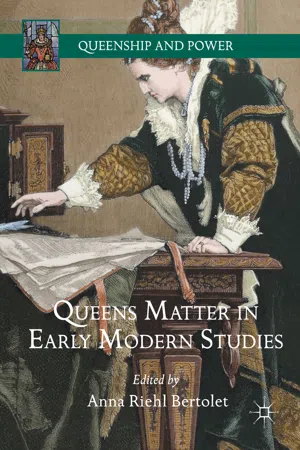
The essays in this book traverse two centuries of queens and their afterlives—historical, mythological, and literary. They speak of the significant and subtle ways that queens leave their mark on the culture they inhabit, focusing on gender, marriage, national identity, diplomacy, and representations of queens in literature. Elizabeth I looms large in this volume, but the interrogation of queenship extends from Elizabeth's historical counterparts, such as Anne Boleyn and Catherine de Medici, to her fictional echoes in the pages of John Lyly, Edmund Spenser, William Shakespeare, Mary Wroth, John Milton, and Margaret Cavendish. Celebrating and building on the renowned scholarship of Carole Levin, Queens Matter in Early Modern Studies exemplifies a range of innovative approaches to examining women and power in the early modern period.
Anna Riehl Bertolet (ed.)Queens Matter in Early Modern StudiesQueenship and Powerhttps://doi.org/10.1007/978-3-319-64048-8_1
Begin Abstract
1. Introduction: Studies of Queens in Honor of Carole Levin
Anna R. Bertolet1
(1)
Auburn University, Auburn, USA
End Abstract
This collection of scholarship on early modern queens is an offering to honor Carole Levin, Willa Cather Professor of History, University of Nebraska at Lincoln, on her seventieth birthday. The scope of this book spans two centuries of queens and their afterlives, from the historical Elizabeth of York to the fantastical Empress of Cavendish’s Blazing World. We study these queens from so many angles and do so by freely crossing the boundaries of our various disciplines partly because of Carole’s fearless interdisciplinary scholarship, mentoring, and editing. The essays in this volume are grouped in the categories that mark some of Carole’s deepest research interests and the hallmarks of her methodology. Gender, marriage, religion, national identity , and diplomacy and, above all, the interplay between the historical and the literary have been at the center of Carole’s research projects as well as the studies of numerous scholars whom Carole mentored and encouraged or collaborated with. This volume brings all of these facets of Carole’s interests to bear on her greatest love: queenship (Fig. 1.1).
Fig. 1.1
Carole Levin. Photo by Anna Riehl Bertolet
Carole’s research, teaching, mentorship, and friendship have touched and inspired countless people around the globe. An analysis of the extent, abundance, and diversity of Carole’s work and influence would fill a book-length study on its own in a volume that could serve as a counterpart to Carole’s groundbreaking cultural biography of Elizabeth I, The Heart and Stomach of a King: Elizabeth I and the Politics of Sex and Power. The current volume is an opportunity to show rather than tell how influential, appreciated, and loved Carole is. To include all scholars whose contributions are rooted in Carole’s studies and whose research has been nourished by her enthusiastic support, this collection would have to span several volumes. It could easily accommodate a book series of its own.
Queens Matter contains the work of seventeen scholars who serve as the deputies of hundreds more, equally grateful researchers, as representatives of hundreds and hundreds of audience members who have been inspired by Carole’s unforgettable talks, and thousands and thousands of readers around the world who have enjoyed Carole’s books inside and outside the classroom. This book is but a synecdoche, a glimpse of the vast scholarly expanse of Carole’s impact in the fields of late medieval and early modern history and culture.
Carole Levin has written five monographs to date: Shakespeare’s Foreign Worlds: National and Transnational Identities in the Elizabethan Age (co-authored with John Watkins, 2009), Dreaming the English Renaissance: Politics and Desire in Court and Culture (2008), The Reign of Elizabeth I (2002), The Heart and Stomach of a King: Elizabeth I and the Politics of Sex and Power (1994), and Propaganda in the English Reformation: Heroic and Villainous Images of King John (1988). Carole has co-edited thirteen essay collections and encyclopedias; she has also edited and co-edited two special issues of Explorations in Renaissance Culture (2004 and 2011) and either authored or co-authored over five dozen book chapters, introductions, and journal articles. Her most frequently referenced work is the pioneering study of Queen Elizabeth I: The Heart and Stomach of a King, which, now in its second edition, was named one of the top ten academic books of the 1990s by the readers of Lingua Franca in September 2000. On the creative end of scholarship, Carole authored some dramatic works, most recently a mesmerizing one-hour show where Elizabeth I narrates her own story: Elizabeth I—In Her Own Words.1
Carole has received numerous awards for her scholarship and teaching, published poems and short plays, given numerous interviews, appeared on radio and television, and held a number of prestigious fellowships, most recently Fulbright Scholar at the University of York (2015). She is currently involved in two book series: the “Early Modern Cultural Studies” series at the University of Nebraska Press, successor of the Susquehanna University Press series, and the “Queenship and Power” series at Palgrave Macmillan. Carole excels equally at working in the archives and giving a public talk, lecturing to non-majors, and mentoring undergraduate majors, graduate students, and scholars in their early career and beyond. In the essays offered here, Carole’s significance as a scholar is eminent, but also, now and then, one may glimpse her personal warmth and contagious dedication to the subject. Indeed, Carole’s influence in the scholarly field is but one part of the story. Perhaps even more prominent are the imprints Carole leaves on the minds and hearts of the non-academic audiences as a public intellectual.
Carole has been instrumental in fostering the study of queens, hence the title of this collection, Queens Matter. Carole co-founded, with Donald Stump, the Queen Elizabeth I Society, and she initiated and is co-editing, with Charles Beem, the “Queenship and Power” series at Palgrave Macmillan. The book series and Society quickly turned into complementary venues for the study of queens. The rich and lively annual meetings of the Queen Elizabeth I Society constitute, in effect, mini-conferences in their own right within the larger South-Central Renaissance Conference. These meetings continue to offer an opportunity to share the cutting-edge scholarship on Elizabeth I and other queens, envision new collaborations, and enjoy the festivities the Queen’s Revels that sometimes featured playful dramatic entertainment written by Carole, such as “The King Dreams of Marriage” and “The Heart and Stomach of a Queen”.2 Likewise, the “Queenship and Power” series ensures that the innovative studies of queens have a venue for publication. Charles Beem’s insider account of the birth and development of this series is an apt prelude to this volume celebrating Carole’s role in the rising scholarship of queenship.
The first group of essays in Queens Matter is dedicated to the recurring issues of gender in the study of queens. To be sure, all the essays in this volume touch on gender by default, so these first essays prepare the ground for the explorations of various aspects of queenship in conjunction with gender. Susan Doran’s essay, “Did Elizabeth’s gender really matter?” delineates the gendered underpinnings of some strategies and practices of Elizabeth’s queenship and brings to light the lack of such gendered specificity in others. At first glance, Doran’s stance may seem like a challenge to one of Carole’s most important convictions that attention to gender is key to studying Elizabeth. However, this argument about the prevalence of gender-neutral practices of queenship does not negate the studies that attend to Elizabeth’s gender, but rather historicizes some practices and reminds us to broaden our perspective in order to discern the elements of Elizabeth’s queenship that are truly gendered.
In “A Great Reckoning in a Little Room: Elizabeth, Essex, and Royal Interruptions”, Catherine Loomis takes a close look at a disturbing episode: the Earl of Essex bursting into the queen’s bedchamber and catching her off-guard. Loomis analyzes the discourse surrounding this event, pointing out the unsettling metamorphosis of the rhetoric of courtly love into the suggestions of rape . William Barlow’s sermon preached soon thereafter refers to Elizabeth as “Lady Queene”, once again reminding us of the gender-determined vulnerabilities of queenship.
Kirilka Stavreva’s chapter, “‘We are such stuff’: Re-Mythologizing the Absolute Queen in Julie Taymor’s Tempest (2010)” zeroes in on the ways gender is foregrounded in Taymor’s recasting of Shakespeare’s Prospero as Prospera. Tracing the web of mythological archetypes in Prospera’s cinematic representation, Stavreva unfolds the contradictions in film’s re-imagining of Shakespeare’s character and points to the fragility of female power as the ultimate takeaway.
The second group of essays exemplifies a triad of approaches to the issues of marriage, each approach aligned with Carole Levin’s scholarly methodology and interests. Jane Donawerth, in “Elizabeth I and the Marriage Crisis , John Lyly’s Campaspe, and the Politics of Court Drama”, reveals how literary work is embedded in the surrounding historical discourse. Donawerth juxtaposes the contemporary debate about the possibilities of Elizabeth I’s marriage, on one hand, and, on the other, the way Lyly repurposes these arguments, thus joining the debate and obliquely voicing his own position.
Retha Warnicke’s study, “Tudor Consorts: The Politics of Royal Matchmaking, 1483–1543”, moves away from the concerns of courtship and into the territory of practical choices made by Henry VII and Henry VIII while selecting and securing their future queens. In looking into the ways the queens are made through marriage rather than born as full or potential heirs to the crown, Warnicke surveys the factors, from the male perspective, that contribute to the creation of Tudor queen-consorts. This investigation of match-making practices complements Jane Donawerth’s analysis of the marriage discourse carried on in Elizabeth’s reign.
While Warnicke explores the beginnings of royal marital unions, Jo Eldridge Carney extends the inquiry to the other side of marriage: the point when the dying queen uses her authority for the last time to preserve the dynasty. In “The Queen’s Deathbed Wish in Early Modern Fairy Tales: Securing the Dynasty”, it is the fairy tale queens who leave their kings with some strict rules for choosing their next spouse, and these rules oddly point to the king’s own daughter. Carney’s piece is a fascinating study of the confluences between fairy tale motifs and historical realities. Thus, “The Queens and Marriage” section of the book comes full circle from the debates about, to preparations for marriage, and finally, to making provisions for the next marriage as a means to secure the succession.
The third section of the book, “Queens and Religion”, focuses on Queen Elizabeth I, moving from exploring the process of settling the Protestant course in the early months of her reign to delineating the ways in which religious iconography and rituals allow Elizabeth to confirm or create familial bonds and political alliances. In his essay, “Spenser’s Dragon Fight and the English Queen: The Struggle over the Elizabethan Settlement”, Donald Stump elucidates the allegorical meaning of the dragon fight at the end of Book I of Edmund Spenser’s TheFaerie Queene. The three phases of setbacks, recovery, and eventual triumph of Redcrosse over the dragon correspond to the complicated tactics employed by Elizabeth and her Parliament in the campaign for the religious settlement. While making clear that Elizabeth played a crucial part in the campaign, Stump examines the question of the queen’s agency in Spenser’s allegory since the poet relegates Una, Elizabeth’s avatar, to the sidelines of the battle.
Helen Hackett continues the inquiry into the literary and artistic renditions of Elizabeth’s religious policies in “Anne Boleyn’s legacy to Elizabeth I: Neoclassicism and the Iconography of Protestant Queenship”. Hackett reminds us that the allusions to the Muses , the Three Graces , and the Judgment of Paris in the last two decades of Elizabeth’s reign are shared with the neoclassical iconography of Anne Boleyn’s coronation pageants . To account for these continuities, Hackett uncovers the missing links in the intervening years and explores the humanist, cultural, and religious purposes of the neoclassical allusions in the iconography of both queens.
This iconographic continuity with her mother’s pageants allowed Elizabeth to affirm the familial relationship she seldom discussed. Elaine Kruse argues in “‘A Network of Honor and Obligation’: Elizabeth as Godmother” that Elizabeth used the religious ceremony of christening as a means to forge and fortify relationships that resembled familial bonds. Kruse offers an enlightening survey of over one hundred cases of Elizabeth’s agreeing to be godmother in an age of religious conflict. Kruse delineates the trends and examines the reasons for establishing the mutual connections between Elizabeth and her godchildren’s families.
Part five of this book, “Queens, National Identity, and Diplomacy ”, gathers the essays that cross geographical and cultural boundaries. The essays in this section interrogate the transformations that occur when boundaries are crossed, paying special attention to the negotiations and interpretive strategies involved in making sense of the crossing and blurring of the borders. These explorations open with John Watkins’s essay, “Lesbianism in Early Modern Vernacular Romance: The Question of Historicity”. Tracing and historicizing the transformation of the motif of female same-sex desire in the romance-epics from Italy to England, this study continues the work started in Shakespeare’s Foreign Worlds: National and Transnational Identities in the Elizabethan Age, the book Carole Levin and John Watkins co-authored. While not addressing Elizabeth I overtly, this essay focuses on the literary pre-history and later transformation of the episode of a sexual encounter of Britomart, one of Elizabeth’s avatars in Spenser’s TheFaerie Queene. As the episode is reshaped from one romance-epic to the next, the filtering out of lesbian sexuality in Spenser and Milton becomes symptomatic of their authors’ adherence to the national identity and the attitudes promoted by England’s official religion. Along with the issues of the generic transformation in Ludovico Ariosto , Torquato Tasso , Edmund Spenser, and John Milton , Watkins raises the methodological question central to interdisciplinary scholarship: to what extent does literature respond to social historical process and where does it override the reflection of historical reality in favor of a longue durée literary heritage. To put it differently, to what extent are the boundaries permeable?
Anna Riehl Bertolet continues the interrogation of boundaries in her chapter, “Doppelgänger Queens: Elizabeth Tudor and Mary Stuart”. While the queenly status of Elizabeth I and Mary Queen of Scots makes their names almost synonymous with the national identity of their kingdoms, this essay invites questions about the construction of their personal identities that have been perennially considered to be polar opposites. By looking at the moments when the two queens become almost interchangeable, Bertolet argues that the contrast between Elizabeth and Mary is sustained—and sometimes defeated—by their essential likeness.
In “Elizabeth I and the Politics of Invoking Russia in Shakespeare’s Love’s Labor’s Lost”, Linda Shenk uses one of Carole’s favorite methodologies to illuminate the historical underpinnings of the Muscovite scene in Shakespeare’s play. Shenk’s survey of the Anglo-Russian discourse comprised of Elizabeth’s correspondence with Tsar Theodor and Boris Godunov , travel narratives, and court-attended entertainments establishes a nuanced international context that would be legibl...
Table of contents
Cover
Frontmatter
1. Introduction: Studies of Queens in Honor of Carole Levin
1. Prelude: Studying Queens
2. Queens and Matters of Gender
3. Queens and Marriage
4. Queens and Religion
5. Queens, National Identity, and Diplomacy
6. Inspired by the Queen: Queens in Literature
Backmatter
Trusted by 375,005 students
Access to over 1.5 million titles for a fair monthly price.
Study more efficiently using our study tools.
Frequently asked questions
Yes, you can cancel anytime from the Subscription tab in your account settings on the Perlego website. Your subscription will stay active until the end of your current billing period. Learn how to cancel your subscription
No, books cannot be downloaded as external files, such as PDFs, for use outside of Perlego. However, you can download books within the Perlego app for offline reading on mobile or tablet. Learn how to download books offline
Perlego offers two plans: Essential and Complete
Essential is ideal for learners and professionals who enjoy exploring a wide range of subjects. Access the Essential Library with 800,000+ trusted titles and best-sellers across business, personal growth, and the humanities. Includes unlimited reading time and Standard Read Aloud voice.
Complete: Perfect for advanced learners and researchers needing full, unrestricted access. Unlock 1.5M+ books across hundreds of subjects, including academic and specialized titles. The Complete Plan also includes advanced features like Premium Read Aloud and Research Assistant.
Both plans are available with monthly, semester, or annual billing cycles.
We are an online textbook subscription service, where you can get access to an entire online library for less than the price of a single book per month. With over 1.5 million books across 990+ topics, we’ve got you covered! Learn about our mission
Look out for the read-aloud symbol on your next book to see if you can listen to it. The read-aloud tool reads text aloud for you, highlighting the text as it is being read. You can pause it, speed it up and slow it down. Learn more about Read Aloud
Yes! You can use the Perlego app on both iOS and Android devices to read anytime, anywhere — even offline. Perfect for commutes or when you’re on the go. Please note we cannot support devices running on iOS 13 and Android 7 or earlier. Learn more about using the app
Yes, you can access Queens Matter in Early Modern Studies by Anna Riehl Bertolet in PDF and/or ePUB format, as well as other popular books in History & British History. We have over 1.5 million books available in our catalogue for you to explore.