In spite of the robust development of venture capital that has occurred over the last three decades, returns from venture capital have been declining. This book focuses on a simple question: why? The answer lies in the context of multiple deformations that have occurred throughout the venture capital process. The book critically assesses the ways in which interactions between different stakeholders in the venture capital ecosystem change (or "deform") venture capital, decreasing its value. Klonowski also reveals that venture capital actually has few benefits—and some outright disadvantages—for entrepreneurs, and it can create a self-perpetuating cycle of investment and loss for the entire venture capital industry. This is especially true as corporate governance and compensation structures may create significant misalignments, incongruities, and conflicts of interest between general and limited partners.
eBook - ePub
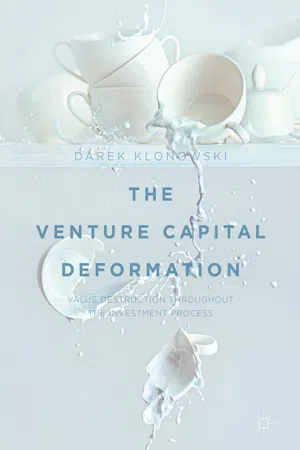
The Venture Capital Deformation
Value Destruction throughout the Investment Process
- English
- ePUB (mobile friendly)
- Available on iOS & Android
eBook - ePub
About this book
Information
Introduction to Venture Capital
© The Author(s) 2018
Darek KlonowskiThe Venture Capital Deformationhttps://doi.org/10.1007/978-3-319-70323-7_11. Venture Capital: A Closer Look Behind the Curtain
Darek Klonowski1
(1)
Brandon University, Brandon, Manitoba, Canada
Venture Capital: Definitions, Characteristics, and Forms
Although the definition of venture capital has evolved over time, it can be broadly defined as the provision of capital and know-how by institutional investors to entrepreneurial firms. English language dictionaries describe venture capital as a business endeavor involving chance, risk, or even danger, and outline venture capital as money invested or earmarked for acquisition of shares, especially those of new and speculative entrepreneurial firms. Webster’s dictionary, for example, predominantly defines venture capital as a very risky investment. The Collins English Dictionary characterizes venture capital as financing directed toward potentially high-return investment opportunities, which may be totally lost. On the other hand, business dictionaries (such as the Cambridge Business English Dictionary, or A Dictionary of Business and Management) categorize venture capital as a search for significantly above-average and long-term investment returns achieved through equity ownership with risky start-ups and emerging or expanding firms.
It is important to differentiate between the various financial terminologies used to describe the act of investing into private firms. Let’s present the key variations among definitions used in Europe and the United States (the US)—the major venture capital markets. The National Venture Capital Association (NVCA) in the United States defines venture capital as a method of financing early-stage entrepreneurial firms within the fastest growing sectors of the economy. The term “venture capitalist” normally describes a financial institution focused on investing into early-stage and expanding entrepreneurial firms. The phrase “private equity” defines larger expansion transactions and buyout deals. Private equity may also refer to investment cases related to infrastructure, real estate, distressed situations (such as debt restructuring), explicit sectors of the economy (natural resources, infrastructure, energy, military, and health services), or government-owned firms. US institutional investors have historically preferred to invest in early-stage entrepreneurial firms; hence, their investments have been regarded as venture capital. In contrast, Invest Europe (IE), formerly known as the European Private Equity and Venture Capital Association (EVCA) , defines private equity as equity provided to entrepreneurial firms not quoted on a public stock exchange. Consistent with IE’s definitions, the terms venture capital and private equity mean financing used to develop new and innovative products and services, support working capital needs, make acquisitions, or strengthen the firm’s balance sheet. Financing from private equity can be utilized to address ownership and management issues through the implementation of leveraged buyout transactions. Venture capital, on the other hand, is broadly defined by IE as capital co-invested alongside the entrepreneur for the purpose of providing capital and know-how to firms in the early stages of development (including seed, start-up, and first-stage expansion). IE defines venture capital as a subset of private equity where investments are made during the early stages of new venture development. European investors have historically pursued later-stage expansion deals and therefore prefer using the term private equity to signify investments in private firms. To simplify matters, this book uses the term venture capital as the primary description of investing into private firms. This means that we include private equity in our considerations.
Venture capital can be differentiated from other types of financing in numerous ways. For one, venture capital focuses on investing into the equity of entrepreneurial firms (funds are normally provided through a capital increase and, from time to time, through debt-like financial instruments including convertible debt). The most common security held by venture capitalists is a convertible preferred share (though this is not true for all the international markets), a hybrid financial instrument that entails the preferential protection of capital provided to the entrepreneurial firm by venture capitalists combined with the upside potential enshrined in a common share. Venture capital financing is often subordinate to other forms of financing (i.e., it has lower priority of repayment in the event of bankruptcy , liquidation , winding-up, or other forms of business closure). Venture capitalists are highly selective in their choice of investment projects, investing in one or two out of every one hundred business plans they review; this means that the vast majority of entrepreneurial firms will not receive venture capital financing. For example, statistics from the US market indicate that only one in 1541 firms receive financing (Table 1.1 provides data from other markets as well). Venture capital is also illiquid. Venture capitalists make medium- to long-term investments in entrepreneurial firms. The average duration of these investments is usually between three and five years, although it can be longer if the entrepreneurial firm requires significant development or simply underperforms. This long period of illiquidity is the chief reason why venture capitalists expect to generate a rate of return that exceeds the rate available from public markets; simply put, venture capitalists should be expected to produce for their investors a premium above the rate of return available from a stock exchange. Subsequently, venture capitalists promise to generate this extra premium for limited partners (LPs). This premium is expected to compensate venture capitalists for their inability to dispose of shares in a timely manner and for other risks inherent in investing into entrepreneurial firms. Another characteristic of venture capital is that returns are expected from growth in the value of an entrepreneurial firm rather than from collecting any ongoing payments, dividends, coupons, or other charges. Venture capitalists are involved in their investee firms and are typically appointed as the firm’s board of directors. Lastly, venture capitalists seek to dispose of their ownership stake in the venture. The exit is a “must have” for venture capitalists.
Table 1.1
The contribution of venture capital to financing entrepreneurial firms in selected countries
Selected countries | Number of SMEs | Number of VC deals | Adjusted number of VC deals | One in × SMEs financed by VC | Percentage of SMEs financed by VC |
|---|---|---|---|---|---|
Belgium | 565,136 | 242 | 218 | 2595 | 0.039 |
Czech Republic | 1,006,019 | 10 | 9 | 111,780 | 0.001 |
France | 2,800,172 | 989 | 890 | 3146 | 0.032 |
Germany | 2,179,098 | 1505 | 1355 | 1609 | 0.062 |
Hungary | 523,631 | 70 | 63 | 8312 | 0.012 |
Holland | 861,203 | 407 | 366 | 2351 | 0.043 |
Italy | 3,773,244 | 101 | 91 | 41,510 | 0.002 |
Poland | 1,516,886 | 76 | 68 | 22,177 | 0.005 |
Spain | 2,382,328 | 149 | 134 | 17,765 | 0.006 |
The United Kingdom | 1,697,653 | 796 | 716 | 2370 | 0.042 |
European average | 25,095,120 | 5484 | 4936 | 5085 | 0.020 |
The United States | 6,049,655 | 4361 | 3925 | 1541 | 0.065 |
Canada | 1,181,333 | 292 | 263 | 4495 | 0.022 |
Israel | 369,981 | 48 | 43 | 8564 | 0.012 |
Venture capital can flow into entrepreneurial firms at different stages of development (the provision of venture capital financing is often referred to as stages of financing). Venture capitalists can broadly provide two forms of capital: “new venture” financing or expansion financing. New venture financing is provided to young entrepreneurial firms and is utilized to cover the cost of market research, product feasibility studies, or the development of a complete business plan. This is called seed financing . Early-stage financing may also be provided to more established entrepreneurial firms that have been working on prototypes and are ready to test their products or services in the marketplace. If the market trial proves successful, the process of developing a management team commences. Capital provided at this stage of development is often referred to as start-up financing. First-stage financing is provided to entrepreneurial firms that have successfully passed the market test and are ready to commence production on a larger scale. At this stage, the entrepreneurial firm needs to develop all of the functional components of the business, including production, management and staff, a distribution structure, back-office operations, marketing and promotional activities, customer service, and so on. The second category of financing (i.e., expansion financing) is directed toward entrepreneurial firms beyond their inaugural years of development. Later-stage or expansion financing is provided to firms that are already fully operational and have proven the viability of their products or services in the marketplace. Second-stage financing is directed toward entrepreneurial firms operating at more advanced stages of development. Such firms typically already enjoy strong growth in revenue, but may not yet be profitable. Capital is normally directed toward working capital (rapid growth in revenue often requires investment into working capital), product development, expansion, additional product development, the balance sheet (i.e., improving debt-to-equity ratios), and so on. Other types of financing include mezzanine financing , bridge financing, and buyouts. Mezzanine financing comes in the form of debt or equity and is provided to finance expansion. This form of financing is provided on short notice (with limited due diligence), but it is aggressively priced and can require interest or coupon payments (similar to debt instruments). Bridge financing is temporary financing directed toward firms looking to go public. Buyout financing is provided to management to purchase the business (management buyouts ) or to allow independent managers from outside of the firm to purchase shares in the business (management buy-ins ). Leveraged buyouts refer to deals where a substantial amount of debt is used to acquire a part of or the entire business. Debt raised for the purpose of leveraged buyouts often directly or indirectly encumbers the balance sheet of the entrepreneurial firm being purchased.
Before considering the advantages and disadvantages of venture capital , it is important to understand the basic venture capital ecosystem (we describe this ecosystem in more detail in Chaps. 2 and 3; see Figs. 2.3 and 3.1). The underlying venture capital environment consists of four main components: entrepreneurs, investors (called limited partners or LPs ), venture capitalists (known as general partners, or GPs), and the general public. Entrepreneurs form the most critical component of the ecosystem because they generate ideas, contribute the initial capital and “sweat equity ,” assemble management teams, test product, or service ideas in the marketplace, generate clients, and take disproportion...
Table of contents
- Cover
- Frontmatter
- 1. Introduction to Venture Capital
- 2. Venture Capital Deformations Throughout the Investment Process
- 3. Conclusions: The Venture Capital Industry at the Crossroads
- Backmatter
Trusted by 375,005 students
Access to over 1.5 million titles for a fair monthly price.
Study more efficiently using our study tools.
Frequently asked questions
Yes, you can cancel anytime from the Subscription tab in your account settings on the Perlego website. Your subscription will stay active until the end of your current billing period. Learn how to cancel your subscription
No, books cannot be downloaded as external files, such as PDFs, for use outside of Perlego. However, you can download books within the Perlego app for offline reading on mobile or tablet. Learn how to download books offline
Perlego offers two plans: Essential and Complete
- Essential is ideal for learners and professionals who enjoy exploring a wide range of subjects. Access the Essential Library with 800,000+ trusted titles and best-sellers across business, personal growth, and the humanities. Includes unlimited reading time and Standard Read Aloud voice.
- Complete: Perfect for advanced learners and researchers needing full, unrestricted access. Unlock 1.5M+ books across hundreds of subjects, including academic and specialized titles. The Complete Plan also includes advanced features like Premium Read Aloud and Research Assistant.
We are an online textbook subscription service, where you can get access to an entire online library for less than the price of a single book per month. With over 1.5 million books across 990+ topics, we’ve got you covered! Learn about our mission
Look out for the read-aloud symbol on your next book to see if you can listen to it. The read-aloud tool reads text aloud for you, highlighting the text as it is being read. You can pause it, speed it up and slow it down. Learn more about Read Aloud
Yes! You can use the Perlego app on both iOS and Android devices to read anytime, anywhere — even offline. Perfect for commutes or when you’re on the go.
Please note we cannot support devices running on iOS 13 and Android 7 or earlier. Learn more about using the app
Please note we cannot support devices running on iOS 13 and Android 7 or earlier. Learn more about using the app
Yes, you can access The Venture Capital Deformation by Darek Klonowski in PDF and/or ePUB format, as well as other popular books in Business & Corporate Finance. We have over 1.5 million books available in our catalogue for you to explore.