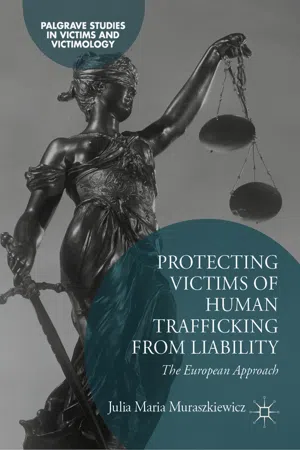
This books demonstrates the difficulty of protecting victims of human trafficking from being held liable for crimes they were compelled to commit in the course, or as a consequence, of being trafficked, under current European law. The legislation remains vague and potentially inadequate to recognise victimhood, safeguard the human rights of victims, and avoid further victimisation. Muraszkiewicz explains how the non-liability principle is rooted in criminal and human rights law, and proposes a more efficient provision and framework which would protect trafficked persons, and do better to encourage victims to act as witnesses in criminal proceedings against the perpetrators. In doing so the book will provide relevant stakeholders,including policy makers and law enforcement authorities, with a better understanding of the non-liability principle and how it ought to be used in practice.
eBook - ePub
Protecting Victims of Human Trafficking From Liability
The European Approach
- English
- ePUB (mobile friendly)
- Available on iOS & Android
eBook - ePub
Protecting Victims of Human Trafficking From Liability
The European Approach
About this book
Information
© The Author(s) 2019
Julia Maria MuraszkiewiczProtecting Victims of Human Trafficking From LiabilityPalgrave Studies in Victims and Victimologyhttps://doi.org/10.1007/978-3-030-02659-2_11. Introduction
Julia Maria Muraszkiewicz1
(1)
Trilateral Research & Consulting, London, UK
Julia Maria Muraszkiewicz
Crime and punishment do not always go together. Sometimes, we must excuse those who break the law.
When victims of human trafficking escape their trafficking situation, they can be at serious risk of criminal or civil proceeding for violations they committed in connection with their human trafficking circumstances. Thus, one of the areas in which victims’ rights need to be protected regards holding them not liable for those wrongdoings. European regional law has sought to do just that. However, perceiving a person who engaged in a criminal act as a victim is still counter-intuitive to the criminal justice system and there is “difficulty for a law enforcement officer to simultaneously view a trafficked person as both a criminal committing an offence and a victim compelled by a human-trafficking situation to commit that offence” (Cross 2013: 401). Nonetheless, these persons deserve protection for they were acting under control and broke law because of the unique circumstances they found themselves in. Their culpability was either significantly reduced or destroyed. That is to say, there was a lack of the foundation for criminal responsibility . Holding trafficked persons liable can lead to institutional victimisation and is far from the victim centred approach that is championed in anti-human trafficking discourse.
This book is a reaction to the regrettable truth that many of the victims who break the law are looked at in terms of their breaches and their irregular migration status. Meanwhile, the serious crime which has been committed against them gets lost. For these persons, the amplified rhetoric that victims deserve support and human trafficking is a heinous crime seems to have drifted away. Instead, their fate is one of arrests, prosecutions, trials and punishment . It is one of secondary victimisation . The book is also born out of the belief that a proper application of protective measures requires understanding the law. However, there are significant uncertainties about the scope of the principle of non-punishment and non-prosecution of trafficked persons who have been compelled to commit crimes, or as this book calls it the principle of non-liability . It is not just the principle that poses difficulties, i.e. the idea of excusing someone for breaching the law. Societies’ perception of who is a victim of human trafficking also thwarts the application of the non-liability principle. Indeed, an accurate political and social construction of victimhood is central to the successful protection of trafficked persons, but it is missing. This book shows that it remains difficult to, in theory and practice, protect victims of human trafficking from being held liable for crimes they were compelled to commit in the course or as a consequence of being trafficked. European laws, from the Council of Europe and the European Union , and in turn their transposition , remain vague and potentially inadequate to achieve the aim of safeguarding the human rights of victims and avoiding further victimisation.
This book also explains how the non-liability principle is justified through the ethos of criminal and human rights law and critically analyses the existing law and its transposition . This is done in order to test the efficiency of the non-liability principles as contained in European legal frameworks. Towards the end, this book concludes with a concrete recommendation on how European law, or any other law (be it domestic or regional), can enhance protection for trafficked persons against unjust liability . In turn, in doing so the book provides relevant stakeholders, e.g. policy makers, civil society and law enforcement authorities, with a better understanding of the non-liability principle. Moreover, national policy makers and future regional policy makers can use the proposed alternative provision if they are serious about protecting the rights of the victims.
How Trafficked Persons Commit Crimes
The purposes for which victims of human trafficking are exploited include forced criminality . In France , for example, child victims have been compelled to commit theft (French Commission Nationale Consultative des Droits de l’Homme 2016). Other crimes that victims are forced to commit include, albeit are not limited to, drug trafficking and cultivation, benefit fraud, pickpocketing, robbery and burglary. The Recital to the 2011 EU Human Trafficking Directive at para. 14 explicates that the exploitation of criminal activities should be understood as “the exploitation of a person to commit, inter alia pick-pocketing, shoplifting, drug trafficking and other similar activities which are subject to penalties and imply a financial gain…” According to UK statistics , in 2011 thirty victims were identified as exploited for the purposes of cannabis cultivation, whilst by 2012 this number increased to sixty-nine (SOCA 2013: 17). A UK police operation, Operation Golf, found over one thousand children from a single Romanian Village who were trafficked “to Western Europe for forced labour and sexual exploitation . The exploitation of the children in the UK was largely connected to ‘street crime’ offences such as pickpocketing, bag snatching, shoplifting and ATM and distraction thefts, as well as through forced begging” (Anti-slavery 2014: 21).
In addition, trafficked persons may commit crimes that are not part of the exploitation element but are related to their migration status. Stoyanova writes that “this is very likely since countries of destination have introduced a panoply of criminal offences related to breaches of immigration laws” (2015: 224). Masika (2007: 14) concludes: “trafficked women and children often have an illegal immigration status in destination countries. Since legal frameworks relating to trafficking and prostitution vary, victims of trafficking are commonly deported, without adequate support, or imprisoned. Law enforcement may trap the victim of trafficking rather the trafficker .” We can also consider the work of Campbell (2016), a British Anthropology and Sociology scholar, who raises attention of the numerous immigration offences used to criminalise irregular migrants. Moving away from immigration offences, Stoyanova (2015: 224) highlights that “involvement in prostitution, soliciting for the purpose of prostitution, or other prosecution-related activities could be qualified as criminal offences in some national jurisdiction.” Indeed, in Croatia persons engaging in prostitution breach the national law. Furthermore, as highlighted by Schloenhardt and Markey-Towler (2016: 13) “victims of trafficking may commit criminal offences in an attempt to escape the trafficking situation, especially by using force or threats against traffickers and those associated with them.”
Although forcing a person to commit crimes is a recognised form of exploitation , research and case law show that many victims are prosecuted (Anti-slavery 2014). Hales and Gelsthorpe (2012) from the Institute of Criminology at the University of Cambridge confirm this. Between May 2010 and November 2011, they studied migrant women in prison and immigration holding estates in the South-East of England and found that fifty-eight women (out of one hundred and thirteen studied) had strong indicators of being victims of human trafficking . They were predominantly charged with offences related to false identification possession or the production of cannabis. The civil society organisation Fair Work (2011) also shows with respect to the Netherlands that trafficked persons who were forced to commit criminal activities are incarcerated in prisons. It thus follows that authorities sometimes look at trafficked persons in terms of their immigration status or the crimes which they have committed, rather than the violations that they have endured. This could be a result of a number of reasons including: lack of identification of a person as a victim , lack of clarity as to relevant law that protects these persons or a need to meet government quotas and policies such as the war on drugs. Consequently, as stated by the organisation Anti-slavery (2014) “states are failing to implement the non-punishment and non-prosecution provisions enshrined in international legislation. By doing so, miscarriages of justice are being committed against victims whilst their traffickers go unpunished.” In turn, for the traffickers the punishment of victims is to a great advantage. It gives them further control over the victim ; they can threaten victims with state punishment . Moreover, “it ensures that their victims are the ones to bear the criminal penalties while the real offenders can operate with impunity” (OSCE: 10).
Aims of the Book Through the Prism of Multiple Looking Glasses
The following legal provisions aim to protect trafficked persons against being held liable:
Article 26 of the 2005 Council of Europe Convention on Action Against Trafficking in Human Beings states:
Each Party shall, in accordance with the basic principles of its legal system, provide for the possibility of not imposing penalties on victims for their involvement in unlawful activities, to the extent that they have been compelled to do so.
Article 8 of Directive 2011/36 on preventing and combating trafficking in human beings and protecting its victims states:
Member States shall, in accordance with the basic principles of their legal systems, take the necessary measures to ensure that competent national authorities are entitled not to prosecute or impose penalties on victims of trafficking in human beings for their involvement in criminal activities which they have been compelled to commit as a direct consequence of being subjected to any of the acts referred to in Article 2.
The provision is supported by the Recital, which at para. 14 states that:
Victims of trafficking in human beings should, in accordance with the basic prin...
Table of contents
- Cover
- Front Matter
- 1. Introduction
- 2. Human Trafficking
- 3. Rationale for the Non-liability Principle
- 4. Non-liability in European and International Law
- 5. Dissecting Article 26 of the 2005 Council of Europe Convention
- 6. Dissecting Article 8 of the 2011 EU Human Trafficking Directive
- 7. How States Have Implemented the Non-liability Provision
- 8. What Thwarts the Use of the Non-liability Provision?
- 9. An Alternative Provision
- Back Matter
Trusted by 375,005 students
Access to over 1.5 million titles for a fair monthly price.
Study more efficiently using our study tools.
Frequently asked questions
Yes, you can cancel anytime from the Subscription tab in your account settings on the Perlego website. Your subscription will stay active until the end of your current billing period. Learn how to cancel your subscription
No, books cannot be downloaded as external files, such as PDFs, for use outside of Perlego. However, you can download books within the Perlego app for offline reading on mobile or tablet. Learn how to download books offline
Perlego offers two plans: Essential and Complete
- Essential is ideal for learners and professionals who enjoy exploring a wide range of subjects. Access the Essential Library with 800,000+ trusted titles and best-sellers across business, personal growth, and the humanities. Includes unlimited reading time and Standard Read Aloud voice.
- Complete: Perfect for advanced learners and researchers needing full, unrestricted access. Unlock 1.5M+ books across hundreds of subjects, including academic and specialized titles. The Complete Plan also includes advanced features like Premium Read Aloud and Research Assistant.
We are an online textbook subscription service, where you can get access to an entire online library for less than the price of a single book per month. With over 1.5 million books across 990+ topics, we’ve got you covered! Learn about our mission
Look out for the read-aloud symbol on your next book to see if you can listen to it. The read-aloud tool reads text aloud for you, highlighting the text as it is being read. You can pause it, speed it up and slow it down. Learn more about Read Aloud
Yes! You can use the Perlego app on both iOS and Android devices to read anytime, anywhere — even offline. Perfect for commutes or when you’re on the go.
Please note we cannot support devices running on iOS 13 and Android 7 or earlier. Learn more about using the app
Please note we cannot support devices running on iOS 13 and Android 7 or earlier. Learn more about using the app
Yes, you can access Protecting Victims of Human Trafficking From Liability by Julia Maria Muraszkiewicz in PDF and/or ePUB format, as well as other popular books in Social Sciences & Civil Rights in Law. We have over 1.5 million books available in our catalogue for you to explore.