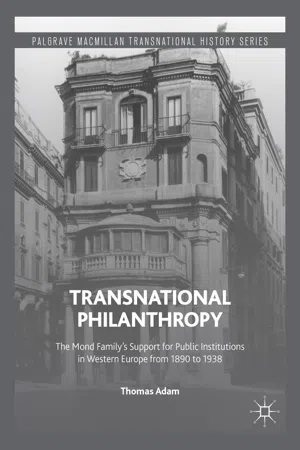
This book provides a collective biography of the Mond family and explores the philanthropic activities of Ludwig Mond and of his two sons Alfred and Robert in the field of art collecting, the fight against early childhood mortality, the advancement of research and of higher education, archaeological excavations in Egypt and Palestine, and for the founding of the State of Israel from the 1890s to the late 1930s. These activities resulted in the creation of the Bibliotheca Hertziana in Rome, the donation of Ludwig Mond's art collection to the National Gallery in London, the funding of the excavation of the sacred Buchis Bulls at Armant in Egypt, the establishment of the Children's Hospital in London, and the support of many natural science institutes and associations in England, France, Germany, and Italy.
eBook - ePub
Transnational Philanthropy
The Mond Family’s Support for Public Institutions in Western Europe from 1890 to 1938
- English
- ePUB (mobile friendly)
- Available on iOS & Android
eBook - ePub
Transnational Philanthropy
The Mond Family’s Support for Public Institutions in Western Europe from 1890 to 1938
About this book
Information
© The Editor(s) (if applicable) and The Author(s) 2016
Thomas AdamTransnational PhilanthropyPalgrave Macmillan Transnational History Series10.1007/978-3-319-29127-7_11. Introduction: Transnational Spaces in History
Thomas Adam1
(1)
University of Texas at Arlington, Arlington, Texas, USA
To most historians, the spatial dimension of the nation appears to be the seemingly natural skin to the body of history. Since the modern craft of history served as midwife at the birth of the modern nation-state and provided modern nation-states with national narratives that allowed each state to claim particular national spaces, historians have continued to tell history in its national variants. 1 History has been, foremost, national history. Even younger forms of history with a focus on smaller units and dimensions, and which include a wide theoretical and methodological range from cultural history and everyday life history to regional and urban history, accepted in the end the nation as their framework. Students of history early on in their careers are still forced by tradition and the structures of history departments to choose national fields of study, they continue on to teach courses in a national specialization, they publish books for series in national fields, and they enjoy mingling with historians of their national specialization at exclusive annual meetings of national history associations such as the German Studies Association or the Organization of American Historians.
The advent of world and global history approaches has certainly broadened our understanding of history and caused us to reevaluate the place of nations and nation-states in the history of humankind. Given the novelty of nations since their introduction into the historical record at the end of the eighteenth century, and given world history’s scope of 5000 years of history, nation-states have lost some of their hold over history. However, world history and global history have remained separate streams of research and teaching, with their own infrastructure of organizations, jobs, and journals. World history and global history have, furthermore, evolved side by side with established national history without challenging the legitimacy of national history accounts. Even truly path-breaking syntheses of global phenomena such as migration, as in the case of Dirk Hoerder’s Cultures in Contact, have had a fairly limited impact on entrenched ideas about migration and assimilation in cases such as American history. 2
The approach of transnational history differs markedly from the approach of both world history and global history because of its time frame. While the time frame of world history and of global history stretches back 5000 and 500 years, respectively, and thus extends beyond the last 200 years of national history, transnational history’s temporal space is identical with that of national history. That makes the paradigm of transnational history a rival of national history. In contrast to world history and global history, transnational history has also not yet reached a level of institutionalization. There is no professional association, no journal, and very few jobs. It has, however, with the Palgrave Dictionary of Transnational History, a founding document. 3 Transnational history is very much, as its proponents readily admit, still a project and a research perspective.
While world and global history approaches tackle historical phenomena from migration to climate change and thereby provide interpretations that should impact national history accounts, it is transnational history that truly challenges national history, because it provides a counternarrative that highlights the interconnected nature of the human experience that crosses and ignores artificial political borders. Transnational history is not about adding another stream of historical interpretation that can coexist with national history; it is an attempt to develop a historical narrative “with nations that is not a history of nations.” 4 As such, transnational history, which is steeped in cultural and social history, is the attempt to provide new ways in which we teach, research, and write history that turns history from a parochial national variant into a universal category. 5
This universal history needs its own space. The prospect of taking out from history the national space as the dominating framework seems, even in the face of the decline of nation-states, to frighten historians. Pierre-Yves Saunier aptly but all too politely summarized the fears of traditional (national) historians when he wrote in his textbook on transnational history:
Historians may fear that an emphasis on what lies in-between and through polities and communities will lead to some kind of offshore and footloose history that would follow restless objects, ideas and people without paying attention to the fact that these movements are impulsed, resisted and managed by specific individuals or organizations rooted in specific contexts. If so, transnational history would give up on an elementary duty of historians: the contextualization of events, facts, people, groups, processes and institutions. 6
Transnational history is certainly not a history without space. But in contrast to traditional assumptions about the appropriate (national) space, transnational historians focus on spaces created by intercultural transfers and networks. 7 Traditional historians seem to have succumbed to the misconception that all people lived their lives within the confines of nation-states and that these nation-states provided their exclusive mental and identity-creating frameworks. Only minorities, in the words of Jürgen Osterhammel, developed transnational identities. 8 Yet, people living in regions such as the Balkans or the region of Alsace-Lorraine would hardly be expected to be loyal to imposed and frequently changing national allegiances. And research on migration has shown that in the nineteenth century—the time of the construction of nation-states—moving across continents and oceans was part of the life trajectory of many Europeans. From 1815 to 1939, about 50–55 million Europeans—which represents about one-fifth of Europe’s population as of 1800—left their homes, according to Dirk Hoerder, in hopes of finding a better life in the Americas, Asia, and Australia. 9
Those remaining behind were not sedentary, either. Europeans moved across the continent from East to West and from West to East. German-speakers from central Europe, on the one hand, relocated to regions as far away as the Transylvanian region in the Austrian-controlled Balkans and to Bessarabia and Volhynia in the Russian Empire. 10 Germans from the German states in central Europe and Jews from across Eastern and Central Europe, on the other hand, relocated to Great Britain. 11 And industrialization caused a massive movement from rural areas to industrialized towns and cities which shaped modern society. 12 Nineteenth-century populations were certainly not characterized by a sedentary lifestyle. In an expanding economy, hungry for labor supply, laborers moved around in search of better-paid jobs, and entrepreneurs such as Ludwig Mond followed the path of opportunity from Cassel to Cologne, from Orsova to Utrecht, and finally to Manchester, and London.
In February of 1869, Ludwig Mond wrote to his parents from a business trip to Paris: “To-day one no longer marries one’s self to one place, but to the world. One lives on the railway, and young people, especially, are unable to speak of a definite domicile.” 13 Mond’s statement reflects an attitude among many people in the second half of the nineteenth century who looked for opportunities far beyond the limits of their village or their city. They felt no attachment to national communities and moved easily across the English Channel and the Atlantic Ocean in search of a better life and better career opportunities. The people on the move were certainly not a minority, and most of them (although not all of them) were not chased out because of religious or political persecution. In the process of migration, transnational family networks that spanned the Atlantic and the Pacific emerged. 14 The stories of German families began to include the figure of a long lost aunt or uncle in South or North America. Told at family gatherings, and in the twentieth century made into the theme of iconic movies such as Das Haus in Montevideo (1951), such stories reflected a transnational space in which individuals from continental Europe felt an emotional connection to relatives thousands of miles away. The long-lost aunt or uncle in the USA or Canada became a staple for millions of British and German families given the high number of migrants who left both countries for North America before World War I. 15 Networks created by migration, the exchange of letters, and visits created and sustained transnational spaces, which allowed for movements of relatives back and forth within this space. There was not just one transatlantic space; the ocean was the background for a myriad of transnational spaces created and shaped by individual families and communities.
The experience of non-national spaces created by letters, newspapers, travel, labor migration, and novels such as Karl May’s Winnetou affected more people than historians are willing to admit. And these movements created transnational spaces even for those who did not travel. The novels about Winnetou published by Karl May in three volumes from 1876 to 1893 were read by virtually everyone in continental Europe and produced in the Europeans’ minds an imagined space in which the readers encountered the American frontier. 16 There is no doubt that in the process of moving around, people encountered nation-states through restrictions on travel, policies about the things one could carry in one’s luggage, and so on, but these were perceived as obstacles and not internalized as protective national borders and identities. Ludwig Mond saw Western Europe as his space for chemical research, industrial activities, collecting of art work, and leisurely travel. Any attempt to force him into just one (national) identity being German or being English or being Italian would distort his experience and force the historian to neglect one part of his personality in order to focus on another part. Ludwig Mond was none of the above and at the same time he was all of them. Biographers such as Jean Goodman had noted that he “certainly had no wish to ape the English. He declined a peerage when it was unofficially offered to him, ignored the current symbols of material success in his adopted country, such as a fashionable London address, a country estate, a yacht or a racing stable. He even forbade his sons to ride to hounds because he saw the sport as a pastime exclusive to the English aristocracy.” 17 Some contemporaries and scholars, and this probably included even his son Sir Alfred, might have considered such attitudes as a failure at assimilation since it prevented Ludwig Mond’s acceptance into British High Society. Such traditional interpretations that focus on the nation and employ explanatory tools such as assimilation and acculturation are unable to make sense of individuals who considered spaces larger than the nation in which they lived as their backyard. Ludwig Mond felt at home in London for his industrial interests. He also felt at home in Rome because of his interest in Renaissance paintings. For him, it was not a choice of either England or Italy. It was the combination of both spaces into one space that allowed his money made in England and Canada to flow into the Italian art market. His two sons, and Sir Robert in particular, continued the transnationalism of their father albeit with different motivations and outcomes, and created a transnational space of their own that was even larger than the space created by their father since their space included not only Western Europe but also Canada, Egypt, and Palestine.
The story of the Mond family and their philanthropic engagements in particular can simply not be told in meaningful ways within the traditional framework of national history. And it is the Monds’ philanthropic activities that gave structure to the transnational space in which the members of this family moved around. This space is as constructed and artificial as any national space. However, it provides context and space to the historical account of the Mond family’s activities in philanthropy. The fear of traditional (national) historians that transnational history robs them of the dimension of space, thus, is simply unfounded. There is no doubt that we need both dimensions—time and space—to ...
Table of contents
- Cover
- Frontmatter
- 1. Introduction: Transnational Spaces in History
- 2. The Monds: A Transnational Family
- 3. Gifts to the Nations: Ludwig Mond’s Art Collections in London and Rome
- 4. Transnational Giving in the Age of National Confrontation: Ludwig Mond’s Bequests for the University of Heidelberg, the Academy of Fine Arts in Munich, and the City of Cassel
- 5. Why Some Wealthy Give: Sir Alfred and Sir Robert Mond’s Attitudes Toward Philanthropy
- 6. The Transnational Excavation of Ancient Egypt and Palestine
- 7. Conclusion: Constructing Transnational Spaces
- Backmatter
Trusted by 375,005 students
Access to over 1.5 million titles for a fair monthly price.
Study more efficiently using our study tools.
Frequently asked questions
Yes, you can cancel anytime from the Subscription tab in your account settings on the Perlego website. Your subscription will stay active until the end of your current billing period. Learn how to cancel your subscription
No, books cannot be downloaded as external files, such as PDFs, for use outside of Perlego. However, you can download books within the Perlego app for offline reading on mobile or tablet. Learn how to download books offline
Perlego offers two plans: Essential and Complete
- Essential is ideal for learners and professionals who enjoy exploring a wide range of subjects. Access the Essential Library with 800,000+ trusted titles and best-sellers across business, personal growth, and the humanities. Includes unlimited reading time and Standard Read Aloud voice.
- Complete: Perfect for advanced learners and researchers needing full, unrestricted access. Unlock 1.5M+ books across hundreds of subjects, including academic and specialized titles. The Complete Plan also includes advanced features like Premium Read Aloud and Research Assistant.
We are an online textbook subscription service, where you can get access to an entire online library for less than the price of a single book per month. With over 1.5 million books across 990+ topics, we’ve got you covered! Learn about our mission
Look out for the read-aloud symbol on your next book to see if you can listen to it. The read-aloud tool reads text aloud for you, highlighting the text as it is being read. You can pause it, speed it up and slow it down. Learn more about Read Aloud
Yes! You can use the Perlego app on both iOS and Android devices to read anytime, anywhere — even offline. Perfect for commutes or when you’re on the go.
Please note we cannot support devices running on iOS 13 and Android 7 or earlier. Learn more about using the app
Please note we cannot support devices running on iOS 13 and Android 7 or earlier. Learn more about using the app
Yes, you can access Transnational Philanthropy by Thomas Adam in PDF and/or ePUB format, as well as other popular books in History & European History. We have over 1.5 million books available in our catalogue for you to explore.