- English
- ePUB (mobile friendly)
- Available on iOS & Android
eBook - ePub
About this book
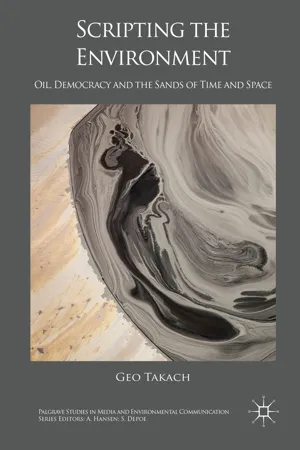
This volume explores how to engage audiences both beyond and within the academy more deeply in environmental research through arts-based forms. It builds on a multi-pronged case study of scripts for documentary film, audio-visual and stage formats, focusing on how the identity of a place is constructed and contested in the face of environmental concerns around fossil-fuel extraction in a globalized, visual society--and specifically on the rising, international public-relations war over Alberta's stewardship of the tar sands. Each script is followed by discussion of the author's choices of initiating idea, research sources, format, voices, world of the story, structure and visual style, and other notes on the convergence of synthesis, analysis and (re)presentation in the script. Included are lively analysis and commentary on screenwriting and playwriting theory, the creation and dissemination of the scripts, and reflections to ground a proposed framework for writing eco-themed scripts for screen, audio-visual and stage formats.
Information
© The Author(s) 2016
Geo TakachScripting the EnvironmentPalgrave Studies in Media and Environmental Communication10.1007/978-3-319-40433-2_11. Environment, Communication and Arts-Based Research
Geo Takach1
(1)
Royal Roads University, Victoria, BC, Canada
Keywords
Environmental communicationEnvironmentArts-based researchArtSciencePublic engagementArtistic and Scientific Inquiry
With its preoccupation with scientific issues such as global warming, the acidification of oceans and the concentration of greenhouse gases, the field of environmental studies in general, and environmental communication in particular, has quite naturally drawn on theories and methods characterizing scientific research and adopting a positivist, quantitative orientation. However, reflecting its diverse connections as both a subfield of a highly interdisciplinary area of inquiry, communication studies, and a metafield transcending other disciplines (Milstein 2009), environmental communication has also adopted more interpretivist theories and methods in the qualitative tradition. Yet this sub/metafield has been slower to explore the rich opportunities and challenges of adopting artistic practices as a means of scholarly inquiry.
It is easy to see why, given the deeply entrenched binaries in Western society around notions of left and right brains, numbers and pictures, and objectivity and subjectivity. Although popular culture and the academy alike persist in separating artistic and scientific explorations, the two were considered a common form of inquiry until the Enlightenment (Barone and Eisner 2012). After all, ‘Both art and science represent the pursuit of truth, changing the way in which we view ourselves, and bringing new understanding to the world at large’; both express intellectual and emotional experience; and at their most pivotal, both require courage to confront the status quo and compel us to reexamine how we relate to the world (Hayden and Hayden 2008, 50). The French multidisciplinary artist, Jean Cocteau, tells us, ‘Art is science made clear’; putting that relationship another way, a contemporary scholar adds, ‘Science explains art technically’, but ‘Art, by the strong emotional context that it arouses, clarifies and gives meaning in the moment’ (Huret 2014, 71).
Comparing science and poetry, the Nobel Laureate in literature, St.-John Perse, notes that they ‘are exploring the same abyss and it is only in their modes of investigation that they differ’ (1971, 7). Science is ‘the process of thought that is guided by quantification, is analytical, deductive, conditional on problem definition, is “true” in that it is repeatable, is expressive of nature in its simplicity, a basis of technology and industry’ (Edwards 2008, 8). For its part, art can be defined as:
Their approaches to finding new knowledge may be different to the extent that one commentator called each the ‘methodological Antichrist’ of the other, and yet, amazingly enough, ‘the human brain can absorb and believe in replicable, numerical, objective expressions of reality, as well as figurative, non-numerical, subjective expressions of the same world, all without losing consciousness or going briefly mad’ (Strauss 2008, 86). Both artistic and scientific inquiry involve thinking conceptually, symbolically and metaphorically in demonstrating innovation, intuition and flexibility in exploring, discovering and illuminating (Leavy 2011). The subjectivity of art does not reduce its significance (Carey 2005); the same might be said for science, which also relies on individual and collective observations, judgments and standards.‘an aesthetic method, a process of thought that is guided by images, is sensual and intuitive, often thrives in uncertainty, is “true” in that it seems to reflect or elucidate or interpret what we experience in our lives, and is expressive of nature in its complexity, a basis of entertainment and culture’ (Edwards 2008, 8).
Of course, both human art and science embody not only processes, but also results of those processes, whether found in a public exhibition or a private notebook. And communication is central in science as well as in art: few consider that scientists must also use clear and compelling language and visuals well to move others to thought and action, and that expressions of their findings ‘are not there to be picked off the lab shelf but must also be created’ (Hayden and Hayden 2008, 53).
Although both avenues of inquiry have been well-established for millennia and have long been staples of the academy, only relatively recently has art been considered a form of scholarly research in its own right. This chapter explores why and how environmental research can and should also be presented through arts-based forms. I introduce arts-based research and situate the nexus between environment and art. I outline advantages, challenges and approaches to arts-based research in environmental scholarship, and conclude by highlighting the theory and research methodology grounding the case study which will form the spine of this work.
Foundations of Arts-Based Research
‘Could we ever know each other in the slightest without the arts?’ asks the celebrated Canadian writer, Gabrielle Roy, a question once cited on the back of the nation’s $20 bill (Bank of Canada 2004). Premised on the idea that ‘many of the greatest contributions to human understanding have been generated by the arts’ (McNiff 2008, 38), arts-based research is defined as:
This hybrid methodology transcends art and science (Finley 2003; Eisner 2006; Leavy 2015), and thus in a sense, also their historical bifurcation into distinct modes of inquiry. The methodology emerged over the last few decades because traditional academic vocabulary ‘fell short in its ability to capture and communicate the complexity of human experience in all its diversity’ and because ‘even challenging conventions of positivism and following qualitative research methodologies resulted in research representations wrung dry of life’, making little impact on participants or their communities (Knowles and Cole 2008, 57).the systematic use of the artistic process, the actual making of artistic expressions in all of the different forms of the arts, as a primary way of understanding and examining experience by both researchers and the people that they involve in their studies (McNiff 2008, 29).
Although the arts were implicitly tied to initial research in education, anthropology and linguistics, there is a paucity of references to the arts in research before 1980, and the arts were valued neither in nor as scholarship (Cahnmann-Taylor 2008). An early, if oblique, reference to arts-based methodology is Guba’s (1967) foreseeing a reformist movement that would bring ‘art’ to inquiry, although he did not define that term. Arts-enabled research has been situated as part of a movement towards participatory critical action research in social science (Finley 2011a). It has been linked to a developing activist dynamic among both artists and social researchers, just as postmodern artists sought a stronger voice in politics and greater popular influence in the construction of societal values (Lincoln 1995; Finley 2011a). It has also been traced partly to curative and empowering arts-based therapies adopted by researchers in health care and special education, psychologists and others, beginning in the 1970s and emerging as an alternative methodological genre or paradigm, echoing the disruption of the challenge to positivism posed by qualitative inquiry (Leavy 2015).
The term ‘arts based research’ was first coined at a conference on educational research in 1993 (Barone and Eisner 2012). The literature has used different terms to define this methodology, such as ‘arts-based research’ (Leavy 2015), ‘art-based research’ (McNiff 2008), ‘arts-informed research’ (Knowles and Cole 2008), ‘practice-led research’ (Gray 1996), ‘performative research’ (Haserman 2006), ‘performative social science’ (Gergen and Gergen 2011), and ‘critical arts-based inquiry’, ‘aesthetic research practice’, ‘scholartistry’ and others (Chilton and Leavy 2014).
Transcending positivistic statements and numbers, arts-based research seeks to make scholarship more accessible, engaging and relevant to more people (Barone and Eisner 2012). It brings the languages, processes and forms of literary, visual and performing arts to scholarly inquiry, creating ‘a way of redefining research form and representation and creating new understandings of process, spirit, purpose, subjectivities, emotion, responsiveness and the ethical dimensions of enquiry’ (Knowles and Cole 2008, 59). It recognizes art as a source of truth and awareness (of others as well as oneself), and values preverbal ways of learning as well as multiple ways of knowing, such as sensory, kinaesthetic and imaginal (Gerber et al. 2012).
As one of its pioneers, Eisner (1997), explains, arts-based research is motivated both epistemologically and politically. First, it raises questions going to the foundations of research—our study of the world and the creation of ways to share our learning. Second, it aims to supplement traditional means of conducting and sharing scholarly research within the academy and beyond. The latter is particularly significant, for ‘starkly political is the effort to claim that art is equal to—indeed, sometimes even profoundly more appropriate than—science as a way of understanding’ (Finley 2005, 685–686). Yet in a broader sense, arts-based methods are hardly radical, as all research is constructed narratives (Richardson 1990). Cultures around the world have long used artistic processes to ‘discover, transform and celebrate life’, and the term artistic inquiry has been traced back to at least 1859, in a reference in a British catal...
Table of contents
- Cover
- Frontmatter
- 1. Environment, Communication and Arts-Based Research
- 2. A Line in the Bit-Sands
- 3. Tarred and Feathered
- 4. Voices from the Visual Volley
- 5. War of the Wild Roses
- 6. Scripting Environmental Research
- Backmatter
Trusted by 375,005 students
Access to over 1.5 million titles for a fair monthly price.
Study more efficiently using our study tools.
Frequently asked questions
Yes, you can cancel anytime from the Subscription tab in your account settings on the Perlego website. Your subscription will stay active until the end of your current billing period. Learn how to cancel your subscription
No, books cannot be downloaded as external files, such as PDFs, for use outside of Perlego. However, you can download books within the Perlego app for offline reading on mobile or tablet. Learn how to download books offline
Perlego offers two plans: Essential and Complete
- Essential is ideal for learners and professionals who enjoy exploring a wide range of subjects. Access the Essential Library with 800,000+ trusted titles and best-sellers across business, personal growth, and the humanities. Includes unlimited reading time and Standard Read Aloud voice.
- Complete: Perfect for advanced learners and researchers needing full, unrestricted access. Unlock 1.5M+ books across hundreds of subjects, including academic and specialized titles. The Complete Plan also includes advanced features like Premium Read Aloud and Research Assistant.
We are an online textbook subscription service, where you can get access to an entire online library for less than the price of a single book per month. With over 1.5 million books across 990+ topics, we’ve got you covered! Learn about our mission
Look out for the read-aloud symbol on your next book to see if you can listen to it. The read-aloud tool reads text aloud for you, highlighting the text as it is being read. You can pause it, speed it up and slow it down. Learn more about Read Aloud
Yes! You can use the Perlego app on both iOS and Android devices to read anytime, anywhere — even offline. Perfect for commutes or when you’re on the go.
Please note we cannot support devices running on iOS 13 and Android 7 or earlier. Learn more about using the app
Please note we cannot support devices running on iOS 13 and Android 7 or earlier. Learn more about using the app
Yes, you can access Scripting the Environment by Geo Takach in PDF and/or ePUB format, as well as other popular books in Social Sciences & Art General. We have over 1.5 million books available in our catalogue for you to explore.