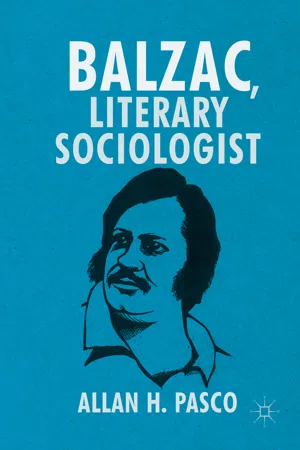
Melding the fields of literature, sociology, and history, this book develops analyses of the ten novels in Balzac's Scènes de la vie de province. Following the order of the novels projected in La Comédie humaine, Allan H. Pasco investigates how Balzac used art as a tool of social inquiry to obtain startlingly accurate insights into the relationships that defined his turbulent society. His repeated claim to be an "historian of manners" was more than an empty boast. Though Balzac was first and foremost a great novelist, he was also a trailblazing sociologist, joining Henri de Saint-Simon and the subsequent Auguste Comte in considering the relationships that represent society as an interacting, interlocking web. Using a methodology that combines close analysis with a broad cultural context, Pasco demonstrates that Balzac's sociological vision was extraordinarily pertinent to both his and our days.
- English
- ePUB (mobile friendly)
- Available on iOS & Android
eBook - ePub
Balzac, Literary Sociologist
About this book
Information
© The Author(s) 2016
Allan H. PascoBalzac, Literary Sociologist10.1007/978-3-319-39333-9_11. Introduction
Allan H. Pasco1
(1)
University of Kansas, McLouth, Kansas, USA
[Flaubert] then outlined a theory that I already knew about, since I’d heard it from Ernest Feydeau. “The novel is an outstanding historical document. In the future, no one will be able to write the history of Louis-Philippe’s reign without consulting Balzac. The novel, a work of the imagination inspired by reality must contain indisputably true details that give it the value of a record book. It dismantles Paris, so as to describe the way it works. It is doing the work of a mechanic, taking Paris apart to transpose its mathematical movement into a novel. It is doing the work of a writer, hesitating is to do wrong, choosing badly is a crime.” I confessed that I had decided to be both a criminal and a mechanic.[Flaubert] did not fail to make fun of me. Repeating one of his favorite comments, he said, “Look out! You have already quit using quill pens […] which is the indication of a weak mind. In your preface to the Chants modernes, you reeled off a bunch of fairly dishonorable nonsense. You celebrated industry and sang of steam, which is idiotic and far too much like Saint-Simon.”—Maxime Du Camp 1
The late eighteenth and early nineteenth centuries in France were fraught with turmoil, and the populace was riven with insecurity, anguish, and fear. Diderot was reflecting the central agony of his society when he had one of his fictional characters remark “the instability of everything!” 2 The philosophe’s Tahitian responds to the cultural comment by wondering what would happen in the midst of a changing world if “there were neither true nor false, neither good nor evil, neither beautiful nor ugly”? Who would decide on one or the other? Priests? Judges? If one or the other or both, what would happen if “from one moment to the next, you were obliged to change your ideas and conduct”? Was anything stable? Was there no base in society that could stand strong without the support of either the Church, which had weakened, or the aristocracy, which had fallen into disrepute?
Looking for convincing answers to these widely voiced questions surely made people even more aware of the fractured social landscape. By the mid-eighteenth century, it was common to wonder whether there might be a basic idea that depended on neither church, nor the aristocracy and the monarchy, nor the law that differed depending upon jurisdiction, politics, and influence. The quest for a generative, foundational, and predictive idea that would explain the basis for rational order is one of the most significant characteristics of the late eighteenth and early nineteenth centuries. This desire is the source of such widely repeated catchwords as “science” and “progress.” Both of these concepts were well rooted in eighteenth-century thought and writings, and were undeniably important to the attitudes of nineteenth-century French people as they looked to the future. They were, however, insufficient to satisfy such thinkers as Vicq-d’Azyr, Cabanis, Bichat, Condorcet, Henri de Saint-Simon, and Balzac, all of whom sought the seminal idea, what the novelist called the “seminal or generative idea [l’idée mère],” 3 that is, the concept or principle or, even, network that would explain both the causes of the contemporary topsy-turvy world and the future that was in progress.
Although I have found the term “idée mere” only twice in Balzac’s writings, it is an extremely useful image for understanding a motivational force behind Balzac’s theoretical thought. I translate it as either “seminal” or “generative idea.” The sense of Balzac’s term was very similar to catallaxy, a word invented by Ludwig von Mises and popularized by his student and colleague Friedrich Hayek. For these economists, it referred to a spontaneous order created within an economic system by exchange and specialization. 4 It occurs when people act for the simplest and perhaps most durable of motives: that is, enlightened or rational self-interest. While people might interact, and working together could be mutually beneficial, it need not be for the same reasons. As relationships formed and reformed within the shifting social landscape, whether because of regression or development and whether reciprocal or not, so too the catallaxy. Balzac found self-interest everywhere he looked, and his work makes it clear that the desire for money was, with a few exceptions in such marvelous, sacrificial people as Pauline Salomon de Villenoix, the guide and goal for human activity in the Restoration and July Monarchy. As Gobseck understood, whether gold or currency, money was easily transferrable into power, pleasure, fantasies, comfort, peace, luxury, or whatever (2.976). 5 The widespread, driving self-centered need for money could be summarized with the image of gold, and was a causative factor, the desired end point, and the basis for intervening relationships. Society was the result of the individual goals of a community, however diverse and different they might be, at least superficially. For Balzac, the egotistical desire for “gold” was the foundation of the entire society.
Investigations of the nature of human beings, their social constructs, and the consequent desire to predict where the world was going show up in many aspects of the events and writings of the late eighteenth and early nineteenth centuries. It is perhaps most obvious in the widespread, intense interest ignited by the discoveries of explorers of far-flung lands like Cook and Bougainville. Exotic places and people were in vogue. The numerous novels dealing with South Sea Islands and distant continents, while to some degree growing from missionary accounts, constructed imaginary worlds that reflected the hopes and needs of the French. By searching out isolated peoples who had not been “corrupted” by society, they hoped to discover the qualities that they believed resided at the core of human beings. Then, perhaps, they would be able to orient their own lives appropriately, in order to escape present problems and future uncertainties. Social philosophers like Thomas Hobbes, John Locke, and Jean-Jacques Rousseau constructed theoretical notions of a “state of nature.” They felt that the whole of civilization required refashioning on the basis of this rediscovered Nature.
Many Frenchmen and women desperately dreamed of escaping the dismal reality of France. They wanted to try something different, something “other.” Considering what that “other” meant to ordinary individuals of the late eighteenth and early nineteenth centuries often reveals through opposition to the novelist’s constructs what it was like to live within both the overriding and the day-to-day conditions of society. The very fact that the French felt an impelling need to flee suggests fundamental weaknesses within the system. Whether the evasion was successful or not on the way to what Baudelaire would eventually call “Anywhere Out of the World” was left an open question. There were many possibilities for both goals and means—for example, Diderot’s imaginative creation of exotic lands; popular utopian or sentimental literature; excessive use of alcohol, absinthe, opium, sex, or gambling—each of these escapes reveals social failures of daily life and, in addition, a significant fear, desire, or, more pointedly, a problem in French society. 6
Our knowledge of how individuals felt about the tumultuous, societal changes that were taking place is quite limited. Historians tell us a lot about the major events, the roads, the coal production, the wars, and the leaders’ speeches and activities, but very little about how the general population was actually living and what they thought and felt about the revolutions, riots, famines, and festivals. To some degree, the police and court records allow us to see into families with problems of inheritance, adultery, physical abuse, divorce, separation, abandonment, deaths, bankruptcy, and events that required official involvement. 7 Such insights gained from studying the legal records leave significant gaps about individual lives of the time, however. Indications of social turmoil are nonetheless many. I think, for example, of the particularly troublesome reality of suicide, which from the 1770s grew in frequency and appears to reflect the personal problems growing from severe weather, failed crops, hunger, disease, and general disruption. 8 Although reliable records of families’ intimacy are not common, scholars have discovered several archives, including letters, a few diaries, and miscellaneous family accounts, in short documents that give us a peek at these lives, whether high- or low-born, whether rural or urban, in the streets, in houses, apartments, rooms, or miserable shacks originally made for animals.
Nonetheless, with all these, we remain virtually ignorant about the ordinary citizen who did not attract the attention of the police or people like the engraver Jean-George Willes who took no part in the Revolutionary uproar, but rather worked on the sidelines to improve his business and increase his wealth. On one occasion, he describes what must have been his customary behavior: “I did not see this march, not having wished to expose myself in any crowd, almost always dangerous.” 9 For many, as for Benjamin Constant, the solution was even simpler: “As for me, I hide.” 10 More thorough knowledge is, however, available. As I have argued before in Revolutionary Love, by looking to literature like Balzac’s Comédie humaine, we may find useful commentary on a major period of France’s history. Literature and art provide infrequently exploited historical archives and follow in the footsteps of the Annales School. Comparative study of such widely available texts can also result in significant new insights into France’s political, economic, and social systems as the country morphed painfully from an agricultural to a capitalistic society. Many of these same systems can be seen in our current world.
The following pages pursue a more adequate vision of what has been called the “private life” of Balzac’s culture by considering his Scènes de la vie de province [Scenes from Provincial Life], a major section of what Davin called a “gallery” of La Comédie humaine. Readers are invited into a series of the galleries’ “rooms each of which has its purpose” (10.1204, 1207). Balzac investigates the relationship of Paris to the provinces as the capital city’s values slowly infiltrated country life during the Industrial Revolution, and he provides important insights into the whole of society. The author’s sophisticated literary devices used within the pages of his artfully composed masterpiece deserve close attention. Otherwise it is easy to go astray and miss the point or, even, to misinterpret his individual or corporate texts. It is also useful to note the careful arrangement of the novels within the cycle, demonstrating once again that he ordered his books so as to more fully develop his thesis and vision of the whole of society. The repeated claims that he made about the unity of his work were by no means idle. He meant exactly what he said.
His use of the reappearing character has been widely recognized. Reappearing themes followed, for they work together in a textual complex that includes character and plot “types.” Such devices as the mock heroic have importance, as well. Certainly, he came to La Comédie humaine with an extensive knowledge of classical, literary, legendary, biblical, and historical material, which he exploited extensively in his allusions. Balzac was far more than a mere storyteller. He was rather determined to understand and portray his society. Indeed, La Comédie humaine gives the reader the opportunity to go to school with a great sociologist and join him in examining the interplay of competing individuals and groups within the French culture of his turbulent era. The portrayal he left us of Restoration and July Monarchy society is not only remarkably accurate; it predicts a future that continues to unroll in this aborning twenty-first century.
Discontent, even hostility toward established authority, was rife. 11 Public executions and torture were no longer successful at repressing or even diverting frustrations. Individual anger flowered in domestic and street violence and open revolt. The causes were many. Scholars have pointed to widespread crop failures, very cold weather, malnutrition, a weak economy exacerbated by an unbridled, profligate aristocracy, harsh taxation, institutionalized violence, an increasingly politicized clergy, the rise of the middle class, the costly wars against England and Prussia (1756–63, 1778), and the numerous failures and misjudgments of Kings Louis XIV, XV, and XVI. 12 All of these considerations made up a part of the nation’s moral and physical bankruptcy. From the beginning to the end of the eighteenth century, there was an undercurrent of dissatisfaction that eventually brought France to its knees. Tocqueville, for example, describes a central administration staffed by a bureaucracy that was busily undermining the nobility, 13 and nobles themselves applauded the inflammatory remarks of Beaumarchais’s wildly successful theatrical character, Figaro. 14 A man who lived through the period wrote, “People played, they danced, they made themselves dizzy, but this gnawing anxiety that resembles the quivering of the wind, the rustling of plants a few minutes before a big storm already reigned” (La Maisonfort 79). Later, in 1813, the social theorist Henri de Saint-Simon pointed out that Diderot’s Encyclopédie (1751–...
Table of contents
- Cover
- Frontmatter
- 1. Introduction
- 2. Through the Glass Darkly: Ursule Mirouët
- 3. A “Divine” Comedy: Eugénie Grandet
- 4. The Gerontocracy and Youth: Pierrette
- 5. The Tangible and the Intangible: Le Curé de Tours
- 6. The Dying Patriarchy: La Rabouilleuse
- 7. Nascent Capitalism: “L’Illustre Gaudissart”
- 8. A Provincial Muse: La Muse du département
- 9. Empty Wombs: La Vieille Fille
- 10. Restoration Boneyard: Le Cabinet des Antiques
- 11. Aeries and Muck: Illusions perdues
- 12. Conclusion
- Backmatter
Trusted by 375,005 students
Access to over 1.5 million titles for a fair monthly price.
Study more efficiently using our study tools.
Frequently asked questions
Yes, you can cancel anytime from the Subscription tab in your account settings on the Perlego website. Your subscription will stay active until the end of your current billing period. Learn how to cancel your subscription
No, books cannot be downloaded as external files, such as PDFs, for use outside of Perlego. However, you can download books within the Perlego app for offline reading on mobile or tablet. Learn how to download books offline
Perlego offers two plans: Essential and Complete
- Essential is ideal for learners and professionals who enjoy exploring a wide range of subjects. Access the Essential Library with 800,000+ trusted titles and best-sellers across business, personal growth, and the humanities. Includes unlimited reading time and Standard Read Aloud voice.
- Complete: Perfect for advanced learners and researchers needing full, unrestricted access. Unlock 1.5M+ books across hundreds of subjects, including academic and specialized titles. The Complete Plan also includes advanced features like Premium Read Aloud and Research Assistant.
We are an online textbook subscription service, where you can get access to an entire online library for less than the price of a single book per month. With over 1.5 million books across 990+ topics, we’ve got you covered! Learn about our mission
Look out for the read-aloud symbol on your next book to see if you can listen to it. The read-aloud tool reads text aloud for you, highlighting the text as it is being read. You can pause it, speed it up and slow it down. Learn more about Read Aloud
Yes! You can use the Perlego app on both iOS and Android devices to read anytime, anywhere — even offline. Perfect for commutes or when you’re on the go.
Please note we cannot support devices running on iOS 13 and Android 7 or earlier. Learn more about using the app
Please note we cannot support devices running on iOS 13 and Android 7 or earlier. Learn more about using the app
Yes, you can access Balzac, Literary Sociologist by Allan H. Pasco in PDF and/or ePUB format, as well as other popular books in Literature & European Literary Criticism. We have over 1.5 million books available in our catalogue for you to explore.