This book examines research using anti-oppressive, arts-based methods to promote social change in oppressed and marginalized communities. The contributors discuss literary techniques, performance, visual art, and new media in relation to the co-construction of knowledge and positionality, reflexivity, data representation, community building and engagement, and pedagogy. The contributors to this volume hail from a wide array of disciplines, including sociology, social work, community psychology, anthropology, performing arts, education, medicine, and public health.
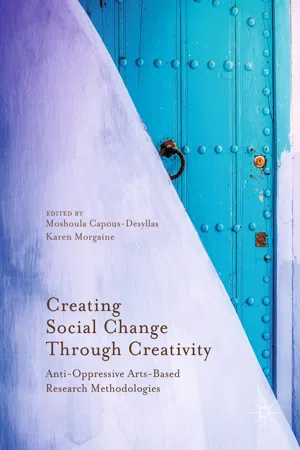
eBook - ePub
Creating Social Change Through Creativity
Anti-Oppressive Arts-Based Research Methodologies
- English
- ePUB (mobile friendly)
- Available on iOS & Android
eBook - ePub
Creating Social Change Through Creativity
Anti-Oppressive Arts-Based Research Methodologies
About this book
Information
Topic
Scienze socialiSubtopic
Politica socialeCo-construction of Knowledge & Positionality
Anti-oppressive research is grounded in attention to the various ways that power circulates within and around the researchers and the research process itself. Navigating complex identities of both the researchers and the community members who are participating in the research can pose challenges and opportunities. While both anti-oppressive research and arts-based research have the potential to disrupt entrenched power relations, actualizing this potential requires critical self-reflection, self-awareness, and a willingness to deeply examine how and why we do the research that we do. In this Part, the authors examine how their intersecting identities influence, how they approach research through a decolonizing lens, a framework of solidarity, and lessons learned.
In “To Speak in Our Own Ways About the World, Without Shame”: Reflections on Indigenous Resurgence in Anti-Oppressive Research, Jeffrey Ansloos focuses on how Indigenous perspectives shape anti-oppressive research, specifically through reflections on identity, voice, decolonization, and indigenous resurgence. Situated within a sociopolitical struggle for decolonization, the author explores how arts-based anti-oppressive research promotes Indigenous resurgence and highlights how Indigenous resurgence as a co-constructive voice can promote the active healing of Indigenous peoples and embody anti-colonial resistance. Ansloos reflects upon the possibilities of Indigenous resurgence in anti-oppressive research through the use of a layered approach to auto-ethnography, drawing on memories, reflections, and stories. Notions of Indigenous resurgence and active anti-hegemonic resistance are highlighted, and Ansloos models the use of an arts-based method as a means of Indigenous knowledge production.
In Listening Through Performance: Identity, Embodiment, and Arts-Based Research, Hilary Cooperman addresses identity construction from the perspective of a researcher from the global North studying participants of the global South. The author draws attention to the inherent difficulties of listening to subalterns while rethinking one’s own positionality and deeply held memories and meanings. Cooperman leads us through three examples of performance ethnography in which her own identity was called into question through embodied and participatory research among Palestinians in Israel and the West Bank. She demonstrates the way her Jewish-American identity, at first an obstacle, later became a guidepost to understanding the way dominant epistemologies continue to oppress and occlude Palestinian voices.
Owen Karcher and Christine Caldwell’s chapter, The Role of Oppression in Arts-Based Research: A Case Study of a Cisgender and Transgender Research Team discusses the importance of examining how identity, power, and privilege show up in research relationships. Metaphors and images are explored to illuminate how aspects of power and privilege impacted the relationship and work of the authors. Conflicts and learning are discussed to illuminate how power played out in the relationship and how the authors built trust and worked toward healing the harm that became part of the research process. The authors conclude with suggestions for intentional transparency with the aim of causing less harm, as well as actively practicing equity when engaging in social justice research.
© The Author(s) 2018
Moshoula Capous-Desyllas and Karen Morgaine (eds.)Creating Social Change Through Creativityhttps://doi.org/10.1007/978-3-319-52129-9_11. “To Speak in Our Own Ways About the World, Without Shame”: Reflections on Indigenous Resurgence in Anti-Oppressive Research
Jeffrey Paul Ansloos1
(1)
Faculty of Human and Social Development, School of Child and Youth Care, University of Victoria, Victoria, Canada
Introduction
Researchers in the social sciences are increasingly acknowledging diverse ways of knowing that lay beyond the hegemony of Western epistemologies. Recognition of arts-based methodologies is increasing, along with a critical discussion of the role of research in the work of social justice. The genealogy of this movement of scholarship has been shaped, in part, by Indigenous contributions to contemporary research. While traditionally the social sciences have marginalized and oppressed the voices of Indigenous communities (Smith, 2012), Indigenous scholarship has been on the forefront of the development of anti-oppressive approaches. Indigenous approaches to research are creative and concerned with struggling with questions of identity , voice, and decolonial processes that lead to justice for Indigenous peoples.
In the following chapter, I engage the discussion of how Indigenous perspectives might shape anti-oppressive research, specifically through exploring issues of (a) identity, (b) voice, (c) decolonization , and (d) Indigenous resurgence. Through an examination of Indigenous identity and voice in a context of sociopolitical oppression, specifically that of colonialism , I explore how research can promote the decolonial process of Indigenous resurgence that actively heals Indigenous peoples and resists colonial oppression. I highlight how Indigenous identity and voice can be situated, affirmed, and explored through cultural revitalization. I utilize the arts-based method of narrative auto-ethnography to help explore these issues in a layered approach (Orbe, 2014), with memories, reflections, and stories. Drawing on my own lived experience as an Indigenous scholar and activist, I use an auto-ethnographic method to model an approach to arts-based research , as well as to reflect on the notions of Indigenous resurgence and active anti-hegemonic resistance.
Anti-oppressive Research and Indigenous Perspective
Reflection 1: Experiencing Oppression
Early in my university education , I remember sitting in a class where the professor announced that the focus of discussion was the mental health of Aboriginal people. Immediately, I felt on guard. “What were people going to say about me or about my people?” The space was not neutral. In my teens, I looked forward to university as a place where I could meet people who could see beyond and deeper than the stereotypes of Indigenous life frequently reinforced by popular media. The two most familiar stereotypes were (a) natives were invisible or extinct relicts of a past civilization, or (b) all natives were drunk. Sure enough, my fears were realized when throughout the 30-minute lecture the supposed expert presented research that stated that the majority of Natives were genetically pre-dispositioned for alcoholism, we lacked good parenting skills, were largely unemployable, resistant to integrate into a multicultural society, and generally non-compliant with treatments intended for soaring rates of depression, anxiety, and trauma. I remember feeling betrayed and angry, as if academia was supposed to know better. Why didn’t these researchers think about colonialism ? How could they only inquire about disembodied and abstracted suffering and not see the beauty, vitality, and resiliency that I know of in my people? That was the moment when I realized research , and the knowledge it produced, had power . This was an important moment for me on my red road in research, that is, the indigenization of my scholarship. It inspired a desire to do better by my people, to shed light on our way of life that reflected the contextual complexity of colonialism and our resistance to be colonized. It caused me to think deeper about the ways that our lives, our bodies, and our land were oppressed, as well as the ways, our culture, our identity , and our unique voice offered us deep wells of resiliency, thriving, and renewed spirit. In many ways, it was this moment that set me on a path to honor my traditions, songs, stories, and the dances of my people not only as something important to behold, but as legitimate means of knowledge production and translation that are emancipatory and decolonial.
Universities, and the scholars in them, are not socially or politically neutral. They are active proponents of culturally situated epistemologies and the sociopolitical ideologies implicit in them. In the reflection above, the ideological commitments of the professor are those which function to create systems of knowledge that are primarily concerned with the pathologizing of a particular sociocultural other (i.e., Indigenous people) , as well as reinforcing stereotypes consistent with the broader commitments of a colonial agenda (i.e., racist representations of Indigenous people) . This illustrates that the means by which knowledge is produced has the power to actively subjugate a sociocultural other.
Anti-oppressive research is fundamentally interested in how the process of knowledge production and translation can be constructed to elevate those identities so often forced into the periphery by Western scholarship. A commitment is necessary in order to accomplish anti-oppressive research. It means critically engaging the ways that many systems of knowledge are structured to perpetuate various forms of oppression (i.e., colonialism , imperialism, sexism, homophobia) . Chilisa (2012) highlights that “the community of social science researchers is experiencing a struggle as it comes to terms with social justice issues that arise from the research process itself, as well from the findings that are produced in their efforts” (p. xv). The sociopolitical power implicit in systems of knowledge production and translation must be interrogated, deconstructed, and our identities must be implicated in this process. All anti-oppressive research must be concerned with the task of exploring the ways in which our theory and practice contribute toward or complicate issues of social justice. As Chilisa (2012) highlights, “The research you do will have the power to label, name, condemn, describe, or prescribe solutions to challenges in former colonized, Indigenous peoples and historically oppressed groups. You are encouraged to conduct research without perpetuating self-serving Western research paradigms that construct Western ways of knowing as superior to the Other’s ways of knowing” (p. 7).
Anti-oppressive research must also move beyond the deconstructive critical task toward a decentering constructive task concerned with the liberation of oppressed individuals and communities. The importance of an indigenizing process in my own research was the beginning of my shift toward a decentering constructive task. By centering my research practice within the paradigms of Indigenous culture, I was legitimating that which colonial powers seek to ensure remains in the periphery. Chilisa explains this as a critical decolonial task for Indigenous people that “involves the restoration and the development of cultural practices, thinking patterns, beliefs, and values that were suppressed but are still relevant and necessary to the survival and birth of new ideas, thinking, techniques, and lifestyles that contribute to the advancement and empowerment of the historically oppressed and former colonized non-Western societies” (2012, p. 14). Indigenous experience provides the social sciences with a decentering constructive praxis, one which is rooted in an agenda of resurgent sociocultural identity which actively resists colonial domination. Put another way, how we understand being Indigenous matters in our liberation.
Identity as an Epistemological Consideration in Anti-oppressive Research
Reflection 2: Listening with Wonder
I am the son of Sherry and Paul Ansloos . I am a Nehiyaw (Cree) from Ochekwi-Sipi (Fisher River Cree Nation), and grew up in Treaty 1 territory near the fork of the Assiniboine and Red River in Winnipeg, a plac...
Table of contents
- Cover
- Frontmatter
- 1. Co-construction of Knowledge & Positionality
- 2. Reflexivity and Listening
- 3. Methodological Processes
- 4. Politics of Methodlogy and Data Representation
- 5. Community Sharing for Social Change
- 6. Community Building and Engagement
- 7. Pedagogical Approaches
- Backmatter
Trusted by 375,005 students
Access to over 1.5 million titles for a fair monthly price.
Study more efficiently using our study tools.
Frequently asked questions
Yes, you can cancel anytime from the Subscription tab in your account settings on the Perlego website. Your subscription will stay active until the end of your current billing period. Learn how to cancel your subscription
No, books cannot be downloaded as external files, such as PDFs, for use outside of Perlego. However, you can download books within the Perlego app for offline reading on mobile or tablet. Learn how to download books offline
Perlego offers two plans: Essential and Complete
- Essential is ideal for learners and professionals who enjoy exploring a wide range of subjects. Access the Essential Library with 800,000+ trusted titles and best-sellers across business, personal growth, and the humanities. Includes unlimited reading time and Standard Read Aloud voice.
- Complete: Perfect for advanced learners and researchers needing full, unrestricted access. Unlock 1.5M+ books across hundreds of subjects, including academic and specialized titles. The Complete Plan also includes advanced features like Premium Read Aloud and Research Assistant.
We are an online textbook subscription service, where you can get access to an entire online library for less than the price of a single book per month. With over 1.5 million books across 990+ topics, we’ve got you covered! Learn about our mission
Look out for the read-aloud symbol on your next book to see if you can listen to it. The read-aloud tool reads text aloud for you, highlighting the text as it is being read. You can pause it, speed it up and slow it down. Learn more about Read Aloud
Yes! You can use the Perlego app on both iOS and Android devices to read anytime, anywhere — even offline. Perfect for commutes or when you’re on the go.
Please note we cannot support devices running on iOS 13 and Android 7 or earlier. Learn more about using the app
Please note we cannot support devices running on iOS 13 and Android 7 or earlier. Learn more about using the app
Yes, you can access Creating Social Change Through Creativity by Moshoula Capous-Desyllas, Karen Morgaine, Moshoula Capous-Desyllas,Karen Morgaine in PDF and/or ePUB format, as well as other popular books in Scienze sociali & Politica sociale. We have over 1.5 million books available in our catalogue for you to explore.