What does it mean to theorize Christianity in light of the decolonial turn? This volume invites distinguished Latinx and Latin American scholars to a conversation that engages the rich theoretical contributions of the decolonial turn, while relocating Indigenous, Afro-Latin American, Latinx, and other often marginalized practices and hermeneutical perspectives to the center-stage of religious discourse in the Americas. Keeping in mind that all religions—Christianity included—are cultured, and avoiding the abstract references to Christianity common to the modern Eurocentric hegemonic project, the contributors favor embodied religious practices that emerge in concrete contexts and communities. Featuring essays from scholars such as Sylvia Marcos, Enrique Dussel, and Luis Rivera-Pagán, this volume represents a major step to bring Christian theology into the conversation with decolonial theory.
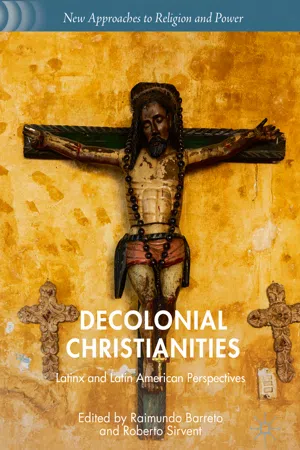
eBook - ePub
Decolonial Christianities
Latinx and Latin American Perspectives
- English
- ePUB (mobile friendly)
- Available on iOS & Android
eBook - ePub
Decolonial Christianities
Latinx and Latin American Perspectives
About this book
Information
© The Author(s) 2019
R. Barreto, R. Sirvent (eds.)Decolonial ChristianitiesNew Approaches to Religion and Powerhttps://doi.org/10.1007/978-3-030-24166-7_11. Introduction
Raimundo Barreto1 and Roberto Sirvent2
(1)
Princeton Theological Seminary, Princeton, NJ, USA
(2)
Hope International University, Fullerton, CA, USA
In her essay, “The Bible and 500 years of Conquest,” Mexican-born biblical scholar Elsa Tamez invites Christians to move beyond trying to construct “liberating hermeneutics” and instead focus on “a critical analysis of our own Christian-biblical discourse.”1 Commenting on the limits of “Western rationality” to respond to the religious practices of Indigenous, African Brazilian, and African Caribbean communities, Tamez asks what it would mean to follow Kuna theologian Aiwan Wagua’s observation that “to think things from outside indigenous thought” is quite problematic. Without naming it, and still using a terminology that did not fully acknowledge the plurality of Latin American Christianities, Tamez’s observation can be taken as a challenge for Latin American Christians to undergo a more radical cultural and epistemological turn, critically reviving their self-understanding in the region. The Christian Church might have shown itself to “be sensitive to the poor,” Tamez writes, “but not to the other.”2 Speaking at the time Indigenous peoples in Latin America were commemorating the 500 years of resistance to the European invasion of their land and world, Tamez takes the Christian Church—its practices, its theology, and its hermeneutics—to task for its complicity in the destruction of life, denouncing “that many deaths have been caused, maybe more than the actual liberation of persons and peoples.” Thus the significance of taking a further step in the critical analysis of Christian biblical-theological discourse in Latin America. As Tamez notes, it is no longer possible to “substitute the work of the Indigenous or blacks who are the subjects” of such experiences. Instead, the task of Christian theologizing in the region “is to help the non-Indigenous people to open up their mentality to receive with joy and equality those different practices of faith.”3 Ultimately, Tamez admits, elaborating “a biblical hermeneutics that includes other-non-Christian practices…is a task that we will learn from Indigenous exegetes themselves.”4
Tamez’s call for Christianity to confront its centuries-long complicity in colonialism, conquest, and domination at a time when Latin American Christianity was wrestling with the 500th anniversary of its first and tragic encounter with the peoples of Abya Yala was an early call for theologians to start thinking of “decolonial Christianities” even before the establishment of the intellectual movement we now know as the decolonial turn.5 This is to say nothing of the many Indigenous Christian communities across the globe, including Latin American, that have not only been theorizing decoloniality before and apart from recent scholarship but practicing it as well.6 Indeed, decolonial epistemologies and praxis preceded any academic theorizing of the decolonial turn. Moreover, they continue to take shape in Christian and other communities among people who may have never even heard of the term “decolonial.” So, we might ask, what benefit is there in initiating a direct conversation between lived Christianities and the important scholarship being produced by decolonial thinkers? In other words, what can be gained from making explicit (i.e. theoretical connections between decolonial thought and Christian theology) what is already implicit (i.e. decolonial praxis found in many Latinx, Latin American, and Indigenous communities)?
Decolonial Christianities: Latinx and Latin American Perspectives addresses these and other important questions inviting a select group of Latinx and Latin American scholars to a multidirectional conversation, which engages the rich theoretical contributions of the decolonial turn, while relocating Indigenous, Afro-Latin American, Latinx, and other often marginalized practices and hermeneutical perspectives to the center-stage, thus decentering colonial Christianity and theology. While the decolonial turn aims to critique and debunk the West’s “paradigm of discovery and newness,”7 it also proposes new possibilities of knowing and constructing the world which go beyond Western rationality. Decoloniality is at the same time critical and constructive. Whereas it denounces hegemonic forms of knowing, it proposes forms of knowing otherwise. It moves from ‘learning to unlearn’ to the utopian constructive proposition that another world is possible.8 In other words, decolonial theory is an option for epistemic disobedience , the delinking from the hegemonic Western foundations of knowledge.9 As Mignolo clarifies, though, such delinking does not mean “abandoning or ignoring what has been institutionalized all over the planet.” Instead, he says, it is meant
In short, going beyond the mere criticism of Eurocentric epistemologies, the decolonial turn proposes an interculturality, which while reassessing, “without denying, the hegemonic epistemology of Western reason upon other peoples and cultures,” moves “towards an intercultural dialogue in which the excluded also participate.”11to shift the geo- and body-politics of knowledge from its foundation in Western imperial history of the past five centuries, to the geo-and body-politics of people, languages, religions, political and economic conceptions, subjectivities, etc., that have been racialized (that is, denied their plain humanity).10
With its focus on coloniality12 rather than merely on colonialism , decolonial theory addresses the various configurations of power—the “gradual propagation of capitalism, racism, the modern/gender system, and the naturalization of the death ethics of war”13—that outlived the imperial conquest. In the steps of decolonial thinkers like Aimé Césaire, Frantz Fanon, Chela Sandoval, Maria Lugones, Sylvia Wynter, Nelson Maldonado-Torres, Walter Mignolo, Gloria Anzaldúa , Linda Tuhiwai Smith, and Enrique Dussel,14 this edited volume hopes to contribute to the “unfinished project” of decoloniality not only through the critique of three of colonialism’s violent legacies: (1) the coloniality of power, (2) the coloniality of knowledge, and (3) the coloniality of being—including the coloniality of faith, and Christian complicity with colonialism and its violent legacies; but also through the proposition of Latin American and Latinx decolonial options in the context of emerging Christianities, which engage “in epistemic disobedience and delinking from the colonial matrix,” promoting “a vision of life and society that requires decolonial subjects, decolonial knowledges, and decolonial institutions.”15
Throughout this volume’s dialogue between decolonial thought and Christian theology and praxis, our contributors address significant questions around the topics of epistemology, modernity, and the production of knowledge. As Nelson Maldonado-Torres writes,
The Decolonial Turn is about making visible the invisible and about analyzing the mechanisms that produce such invisibility or distorted visibility in light of a large stock of ideas that must necessarily include the critical reflections of the ‘invisible’ people themselves. Indeed, one must recognize their intellectual production as thinking – not only as culture or ideology.16
Decolonial thought exposes how the academy, the archives, and various apparatuses of state power seek to determine not just what is heard or listened to but what is considered theory to begin with. As Maldonado-Torres explains above, these very mechanisms do not just determine what is theory but who can and cannot produce it. The decolonial turn therefore examines how those in the “underside of modernity” create spaces that serve as sites for producing theory, knowledge, philosophy and, we add, theology. Central to this examination of how certain ideas are made “invisible” by the colonial matrix of power is its intersection with the racial, gender, and sexual hierarchies generated and strengthened by Western modernity. In doing so, decolonial theorists challenge dominant ideologies about reason, agency, and what it means to be human.
We situate this volume alongside other important works, hoping to both complement and go beyond the conversations initiated by their contributors. Among them, we highlight three. The first, Mark G. Brett and Jione Havea’s Colonial Contexts and Postcolonial Theologies: Storyweaving in the Asia-Pacific, examines how “colonial domination damaged native systems of expression” in the lives of Indigenous Australians and Pacific Islanders, outlining creative postcolonial practices that help readers imagine how the church and academy can “shape more constructive intercultural politics and theologies” for the future.17 Colonial Contexts and Postcolonial Theologies addresses the important question of the central role played by religious and theological language in the colonial process, making critical analysis of religion crucial to decolonizing efforts. Rooted in the Asian-Pacific context, and in conversation with postcolonial rather than decolonial theorists, this volume does not address the Latin American colonial experience. However, regardless of obvious differences of context and approach, we see some equivalence between its contributions and the ones in the present volume, particularly as for the explicit concern for creating innovative spaces for (respectively) postcolonial and decolonial conversations in the academic study of religion and theology. Both books elevate previously overlooked expressions of Christianity and theological voices, offering important contributions to the often-neglected discussion about the relationship between religion (and Christianity, more expressly), postcolonial/decolonial theories, and Indigenous experiences and perspectives in academic discourse. Furthermore, both works advance creative and innovative interdisciplinary conversations, which while fully acknowledging “the impact of colonialism on indigenous peoples, validate strategies of resistance to ongoing colonial harms, […] also seek to offer constructive thinking, which might move the conversations toward the ideal[s] of [healing and] reconciliation.”18
Another important book we are indebted to is Decolonizing Epistemologies: Latina/o Theology and Philosophy. Engaging in a more direct conversation with decolonial rather than postcolonial thought, in th...
Table of contents
- Cover
- Front Matter
- 1. Introduction
- Part I. Focal Essays
- Part II. Indigenous Dreams, Indigenous Resistance
- Part III. Decolonial Politics and Theological Possibilities
- Part IV. Decolonial Ecclesiologies
- Part V. Conclusion
- Back Matter
Trusted by 375,005 students
Access to over 1.5 million titles for a fair monthly price.
Study more efficiently using our study tools.
Frequently asked questions
Yes, you can cancel anytime from the Subscription tab in your account settings on the Perlego website. Your subscription will stay active until the end of your current billing period. Learn how to cancel your subscription
No, books cannot be downloaded as external files, such as PDFs, for use outside of Perlego. However, you can download books within the Perlego app for offline reading on mobile or tablet. Learn how to download books offline
Perlego offers two plans: Essential and Complete
- Essential is ideal for learners and professionals who enjoy exploring a wide range of subjects. Access the Essential Library with 800,000+ trusted titles and best-sellers across business, personal growth, and the humanities. Includes unlimited reading time and Standard Read Aloud voice.
- Complete: Perfect for advanced learners and researchers needing full, unrestricted access. Unlock 1.5M+ books across hundreds of subjects, including academic and specialized titles. The Complete Plan also includes advanced features like Premium Read Aloud and Research Assistant.
We are an online textbook subscription service, where you can get access to an entire online library for less than the price of a single book per month. With over 1.5 million books across 990+ topics, we’ve got you covered! Learn about our mission
Look out for the read-aloud symbol on your next book to see if you can listen to it. The read-aloud tool reads text aloud for you, highlighting the text as it is being read. You can pause it, speed it up and slow it down. Learn more about Read Aloud
Yes! You can use the Perlego app on both iOS and Android devices to read anytime, anywhere — even offline. Perfect for commutes or when you’re on the go.
Please note we cannot support devices running on iOS 13 and Android 7 or earlier. Learn more about using the app
Please note we cannot support devices running on iOS 13 and Android 7 or earlier. Learn more about using the app
Yes, you can access Decolonial Christianities by Raimundo Barreto, Roberto Sirvent, Raimundo Barreto,Roberto Sirvent in PDF and/or ePUB format, as well as other popular books in Social Sciences & World History. We have over 1.5 million books available in our catalogue for you to explore.