This book analyzes the origins and organizational structure of Islamic State (IS), examining its military triumphs and success in securing new recruits via social media. From its base in Iraq and Syria, IS has spread globally with 17 regional affiliates from Indonesia to Nigeria and sleeper cells in at least 60 countries, capable of atrocities like the Paris attack. To understand the threat of IS, this book explores its organizational structure and underlying ideology, and implications for Western efforts to attack the leadership of IS. The ways IS has grown by swiftly adapting its military strategy, developing creative forms of funding and efforts to win hearts and minds of locals are identified. The author highlights how the competing individual national interests between the Western military alliance and local partners have served to strengthen IS. With its ideology spreading ever further, this book warns of the looming violent confrontation between democratic and Islamist forces. This volume speaks to academics in international relations, security studies and strategic studies, policy-makers and interested parties.
- English
- ePUB (mobile friendly)
- Available on iOS & Android
eBook - ePub
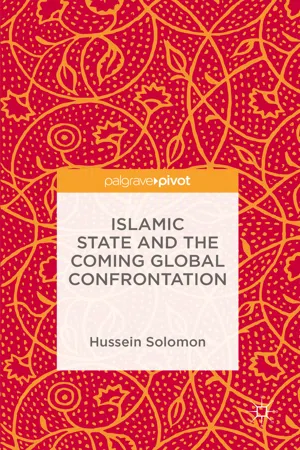
Islamic State and the Coming Global Confrontation
About this book
Information
© The Editor(s) (if applicable) and The Author(s) 2016
Hussein SolomonIslamic State and the Coming Global Confrontation10.1007/978-3-319-30719-0_11. The Rise of the Islamic State
Hussein Solomon1
(1)
University of the Free State, Bloemfontein, South Africa
Abstract
This chapter traces the origins of Islamic State (IS) to 1999, when Jordanian militant Abu Musab al-Zaraqawi established Al Qaeda in the Land of the Two Rivers. The renaming of the organization as the Islamic State of Iraq (ISI) was a turning point in that the organization saw itself not merely as a terrorist group wreaking revenge on American “occupiers,” but also as a governing entity. This chapter explores the structures of IS and its strategic significance. The role of the IS leader Caliph Al-Baghdadi is also examined. In conclusion, we examine how IS has managed to spread its influence into Africa, the Caucasus, and the Far East.
Keywords
Abu Musab al-ZaraqawiCaliph Al-BaghdadiAl QaedaIslamic State of IraqIntroduction
More than 20,000 people from 90 countries1 have already flocked to Iraq and Syria to fight under the banner of the IS and their self-styled “Caliph” Abu Bakr al-Baghdadi2 (whose real name is Ibrahim Badri al-Qurashi al-Sammarai). To put this into perspective, the pace at which this recruitment is occurring, according to the US State Department, is “greater than that at which foreign militants have gone to Afghanistan, Iraq, Yemen or Somalia at any point in the last 20 years.”3 The dangers that these pose are clearly evident in the recent terrorist atrocities in Australia, Canada, France, and Libya. Indeed, the threat sleeper cells hold for national and global security cannot be underestimated.
Despite an impressive international coalition aligned against IS, the jihadis have been getting stronger, spreading their tentacles across the Middle East—west into Africa, and east into Asia. Away from the Islamic heartland, IS is even acquiring recruits from the USA and across Europe. The tragic consequence of this recruitment was seen in the January 2015 attack on the offices of Charlie Hebdo in Paris. Clearly then, the current counter-terrorism strategies are failing. In order to understand the reasons for the failure of current strategies, we need to understand the nature of the threat posed by IS, as well as explore its organizational structure, its goals, strategies, and tactics. It will be argued that current counter-terrorism constructs—based as it is on the nation-state and national security—are woefully inadequate to effectively respond to the global threat constituted by IS.
Origins of Islamic State: What’s in a Name?
The origins of what developed into IS can be traced to 1999, when a Jordanian militant Abu Musab al-Zaraqawi established Al Qaeda in the Land of the Two Rivers (Euphrates and Tigris), which proved too cumbersome. The name was then shortened to Al Qaeda in Iraq (AQI) (Tanzim Qa’idat al-Jihad fi Bilad al Rafidayn) and, in 2004, this group formally pledged allegiance to Al Qaeda.4 By 2006, the group renamed itself as the Majlis Shura al-Mujahideen. Later that year, and following the death of Al-Zarqawi, it renamed itself as ISI (Dawlat al-Iraq al-Islamiya) under the leadership of Abu Omar al-Baghdadi.5 The constant renaming of the organization suggests a movement in search of their own unique identity and something to distinguish themselves from other militant jihadi organizations in Iraq and further afield.
The naming of the organization as an “Islamic State” was the first indication that the objectives of the militant group had become more grandiose—that it saw itself as a governing entity. This notion of being a governing authority witnessed a “cabinet” announcement by the ISI in April 2007. Accordingly, various “ministries” were created, including a Ministry for Media Affairs, a Ministry for War, an Oil Ministry, a Ministry for Agriculture and Fisheries, and a Ministry for Health. In addition to these “ministries,” and given the religious zealotry guiding the actions of ISI, various Shar’ia Committees6 were also created to apply and enforce Islamic law. It is important, too, to understand how sophisticated the nascent IS had become in their strategic thinking. These “ministries” were staffed with technocrats such as a medical doctor, Dr. Abu Abdullah al-Zaidi, heading the Health Ministry and an engineer Abu Ahmad al-Janabi leading the Oil Ministry. Many Middle Eastern societies are tribal in nature. Recognizing this, IS ensured that the cabinet was as inclusive as possible—reflecting the tribal mix of Iraqi society. The “Minister” of Media Affairs, for instance, hailed from a Sunni area just north of Baghdad and was a Mashhadani, whilst his counterpart heading the Ministry of Martyrs and Prisoners was an Issawi from Anbar Province.7 Governing in an inclusive manner (at least as far as Sunni Muslims were concerned) stood in sharp contrast to the lack of inclusive governance demonstrated on the part of the regime in Baghdad—or Damascus—for that matter.
Another very important ISI-created structure is a da’wah office. This office is often regarded as the bedrock of the organization, given the multiplicity of roles it plays. First, it has a social outreach function specifically preaching their version of “pure Islam” to Muslims. As such, it directly liaises with local mosques. The da’wah office’s social outreach function also takes the form of erecting billboards calling on women to dress modestly and the like. This office also serves to recruit members as well as to collect intelligence on rival groups in the areas they occupy. It is also the da’wah office who liaises with community members if they have problems regarding the conduct of individual IS members.8 Education, too, in a particular area, falls under the purview of the da’wah office. Under the circumstances, it is not an exaggeration to state that the da’wah office is the building block of local administration and IS power in a given area.
Given the ongoing civil war in Syria which began in 2011 and the resultant political vacuum created, the organization soon established itself there, prompting a name change once again in 2013—the Islamic State in Iraq and Greater Syria (Al Dawla al-Islamiya fil Iraq wa al-Sham or ISIS). With increasing confidence in its global reach, ISIS saw itself as a global caliphate and renamed itself in 2014 simply as the Islamic State.9 The new name suggests two things. First, that there are no geographic boundaries. Second, “the” implies that it is singular, the only Islamic State—one to which all 1.5 billion Muslims owe their loyalty. This was made emphatically clear when Al-Baghdadi announced, “Rush O Muslims to your State. Yes, it is your state. Rush, because Syria is not for the Syrians, and Iraq is not for the Iraqis.”10 Here then was a state that knew no territorial boundaries and encompassed 1.5 billion Muslims wherever they were. With the Declaration of a caliphate in June 2014,11 IS restructured itself to reflect as a state with various government departments operating at the “national”, “provincial,” and “local” levels. As of August 2015, the IS “cabinet” is as follows (Table 1.1).
Table 1.1
Diwans and their functions
Government department | Function |
|---|---|
Diwan al-Ta’lim | Education |
Diwan al-Khidamat | Public services (e.g., electricity, water, street cleaning). Manageme... |
Table of contents
- Cover
- Frontmatter
- 1. The Rise of the Islamic State
- 2. Accounting for Islamic State’s Appeal and Resilience
- 3. Responding to Islamic State and Getting It Wrong
- 4. Fighting Islamic State: A Call to Action
- 5. Gazing into the Crystal Ball
- Backmatter
Trusted by 375,005 students
Access to over 1.5 million titles for a fair monthly price.
Study more efficiently using our study tools.
Frequently asked questions
Yes, you can cancel anytime from the Subscription tab in your account settings on the Perlego website. Your subscription will stay active until the end of your current billing period. Learn how to cancel your subscription
No, books cannot be downloaded as external files, such as PDFs, for use outside of Perlego. However, you can download books within the Perlego app for offline reading on mobile or tablet. Learn how to download books offline
Perlego offers two plans: Essential and Complete
- Essential is ideal for learners and professionals who enjoy exploring a wide range of subjects. Access the Essential Library with 800,000+ trusted titles and best-sellers across business, personal growth, and the humanities. Includes unlimited reading time and Standard Read Aloud voice.
- Complete: Perfect for advanced learners and researchers needing full, unrestricted access. Unlock 1.5M+ books across hundreds of subjects, including academic and specialized titles. The Complete Plan also includes advanced features like Premium Read Aloud and Research Assistant.
We are an online textbook subscription service, where you can get access to an entire online library for less than the price of a single book per month. With over 1.5 million books across 990+ topics, we’ve got you covered! Learn about our mission
Look out for the read-aloud symbol on your next book to see if you can listen to it. The read-aloud tool reads text aloud for you, highlighting the text as it is being read. You can pause it, speed it up and slow it down. Learn more about Read Aloud
Yes! You can use the Perlego app on both iOS and Android devices to read anytime, anywhere — even offline. Perfect for commutes or when you’re on the go.
Please note we cannot support devices running on iOS 13 and Android 7 or earlier. Learn more about using the app
Please note we cannot support devices running on iOS 13 and Android 7 or earlier. Learn more about using the app
Yes, you can access Islamic State and the Coming Global Confrontation by Hussein Solomon in PDF and/or ePUB format, as well as other popular books in Politics & International Relations & Middle Eastern Politics. We have over 1.5 million books available in our catalogue for you to explore.