This book offers the first comprehensive study of Spanish foreign policy since 2000. Based on privileged access to some of Spain's most important foreign policy actors – including Prime Minister José Luis Rodríguez Zapatero and Foreign Minister Miguel Ángel Moratinos – the book offers an insider account of how Spanish foreign policy was shaped within the context of international diplomacy. It offers crucial new insights into the foreign policy of the PSOE governments (Spanish Socialist Workers' Party, 2004 to 2011). The volume considers the changes on the international stage since the fall of the Berlin Wall in 1989, showing how regional conflicts and tensions affected the policy agendas of the West. To increase security and prosperity at home, the 2004 Spanish socialist government reasoned that they could no longer rely exclusively on unilateral measures, old Cold War alliances or a 'Spain-first' approach. Against the backdrop of this changing world, the book explores the concept of 'effective multilateralism' put forward by the PSOE, in which Spain abandoned its hitherto unconditional support for the US and instead engaged in a series of multilateral collaborations with regions around the world. Above all, this study seeks to provide a new international history of contemporary Spain, demonstrating how domestic changes intersected with global transformations, and put forward the argument that diplomacy works.
eBook - ePub
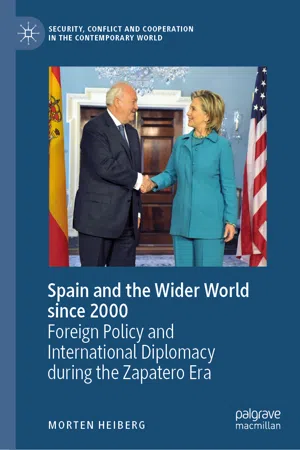
Spain and the Wider World since 2000
Foreign Policy and International Diplomacy during the Zapatero Era
- English
- ePUB (mobile friendly)
- Available on iOS & Android
eBook - ePub
Spain and the Wider World since 2000
Foreign Policy and International Diplomacy during the Zapatero Era
About this book
Information
© The Author(s) 2019
M. HeibergSpain and the Wider World since 2000Security, Conflict and Cooperation in the Contemporary Worldhttps://doi.org/10.1007/978-3-030-27343-9_11. Introduction
Morten Heiberg1
(1)
Department of English, Germanic and Romance Studies, University of Copenhagen, Copenhagen, Denmark
It was around nine in the morning, and the cell phone was ringing incessantly. Having celebrated until late into the night the end of a successful election campaign, the sound of a beeping phone was not what Miguel Ángel Moratinos particularly wanted to hear. Nevertheless, the internationally renowned Spanish diplomat got on the phone. “There has been a series of explosions, a terrorist attack against the Madrid railway system. You must come to Madrid at once.”1 The voice at the other end belonged to José Luis Rodríguez Zapatero, the leader of the Socialist party, the PSOE, who within a few weeks would also be the new prime minister of Spain. For security reasons, all public transport had been shut down following the terrorist attack, and in order to get from his constituency in Córdoba to Madrid, Moratinos had to persuade some local party members to drive him the nearly 400 kilometers to the Socialist headquarters in Calle Ferraz. General elections were only three days away.
When Moratinos arrived in the capital on the evening of Thursday 11 March 2004, he had already received abundant information through private channels indicating that the terrorist attack was Al Qaeda’s work.2 It was also clear that it was the most vicious assault against the West since 11 September 2001 and the worst in the recent history of Spain. Ten bombs had exploded simultaneously in four different local trains in Madrid between 7.37 and 7.41 a.m., and it later transpired that, all in all, 191 people had died and 1841 had been wounded.3 In spite of the fact that the perpetrators had used the well-known Al Qaeda technique of simultaneous bomb attacks, the Spanish Conservative government under José María Aznar’s leadership immediately pointed to Euskadi Ta Askatasuna (ETA), the Basque terrorist group, as being responsible for the massacre. By so doing, the Conservative Partido Popular (PP) effectively decoupled the disaster in Madrid from Islamic terrorism and thus also from the government’s commitment to the US military intervention in Iraq, which the Socialist opposition had strongly opposed during the election campaign. Moratinos was a member of Zapatero’s shadow cabinet and one of the main architects behind the Socialists’ electoral promise to pull the Spanish contingent of troops out of Iraq. The next three days witnessed what has widely been described as a massive political cover-up by the Conservative government, who to the surprise of many observers lost the general elections on Sunday 14 March.4
Many aspects remain obscure, not only of this tragic event, but of the almost Copernican turn that Spanish foreign policy took after the bomb attacks. Was it truly Al Qaeda, who won the elections for the PSOE and triggered a shift in Spanish foreign policy? This was definitely a widespread view among both Spanish and foreign observers, especially those of Conservative stamp.5 To the more objective observer, though, it looked at least as if the new Socialist government was determined to do more or less the opposite of their Conservative predecessors in almost every field. In fact, a number of important questions can be raised with regard to the immediate and longer-term objectives of the Zapatero government, which came to dominate Spanish politics for nearly eight years and in many ways transformed the country during that period.
However, before broaching such questions, it is necessary to briefly reflect on the political handling of the bomb attack, which has been subjected to contrasting interpretations. A crucial question remains as to why the Socialist opposition party was so well-informed of who the perpetrators behind the terrorist attack were, while José María Aznar’s Conservative government claimed that it was not. On the day of the bombing, the Socialist leadership had few if any doubts about the authorship of the attack, yet on the very same afternoon, Prime Minister Aznar personally called the editors-in-chief of different newspapers to reassure them that ETA was the culprit, just as the Spanish Foreign Ministry contacted the UN Security Council in order to obtain a formal condemnation of the Basque separatist group.6 To fully understand the degree to which the Conservative government was willing to defend the ETA narrative, one must take into regard all the crucial information to the contrary that was carefully collected by the Socialist party from its international sources, among others from Middle East intelligence agencies, and loyally passed on to the PP government, who however ignored it. This part of the history of the bomb attack has been left untold until this very day.
This study also hopes to provide a more nuanced understanding of the election campaign, which contrary to widely held beliefs saw the Conservative PP in grave difficulties long before Al Qaeda committed its hideous crime. While the PSOE was effectively mobilizing its potential voters, a crisis of confidence had occurred in the relationship between the PP and its electorate. The Conservative leadership was perfectly aware of the risk of failure, but never openly admitted that this was the case. In other words, this study seriously puts to the test the common claim that the Al Qaeda bomb attack won the elections for the PSOE. Thus, the first chapters are primarily concerned with the national and international legitimacy of the new Socialist government, as this played a major role in its potential to effectively apply a new foreign policy.
Seen from an international perspective, the immediate Spanish withdrawal of the Spanish forces from Iraq was probably the most controversial action of the new government, as it openly defied the foreign policy and the security doctrine of the Bush administration. In her memoirs, Condoleezza Rice claims that the new Spanish prime minister simply “reversed course, precipitously withdrawing Spanish forces from Iraq and causing tensions in our relationship that were never overcome.”7 True, the Bush administration certainly made the Zapatero government sweat in the following months, yet the fact remains that it did little more than that. Come spring 2005, this book holds, the bilateral working relations were essentially back on track. However, the fact that Madrid could turn its back on Washington almost scot-free clearly upset several US allies. The successful withdrawal of troops inspired new hopes within the anti-war movements in many countries, not least in Australia and Japan, two of America’s most important allies in the world.8 Was the world’s last remaining hegemon loosening its grip on its allies? And if so, who would then govern the world?
It is important to stress that the decision to pull its forces out of Iraq was only one in a series of new Spanish initiatives concerning European, Latin American, African as well as Asian affairs, where the Zapatero government markedly changed the foreign policy course of Spain. What is indeed noteworthy of Zapatero’s nearly eight years in power, is his government’s proactive engagement in multilateral attempts to resolve international conflicts which were of no direct material concern to Spain and also largely considered the reserved domain of the major players of international politics. Yet, what did the Socialist government think it could actually achieve by getting involved in a long series of complex multilateral processes, the outcome of which was very uncertain indeed?
To answer this question satisfactorily, it is important to pay proper attention to the broader international context in which the new Spanish foreign policy was formulated. At the beginning of the millennium, there were strong countercurrents challenging the neoconservative foreign policy doctrine of the United States. To increase security and prosperity at home, the new Spanish Socialist government reasoned in 2004, one could no longer rely exclusively on unilateral measures, Cold War alliances or a “Spain first” approach, as pronounced by Prime Minister Aznar prior to the 2000 general elections. The world was rapidly transforming—no one knew exactly into what—but surely the developments abroad, even in the most distant corners of the world, could no longer be ignored when they had the potential to bring about fundamental change at home. The terrorist attack in 2004 was just one example of this trend. The immediate aftermath of the terrorist attack saw many new trials, among others a refugee crisis with people suddenly arriving in thousands onto Spanish shores from central Africa or even from as far away as Bangladesh. Without marked changes to Spain’s traditional foreign policy, the government reasoned, it could not expect to bring such situations under control. The main question, though, was how to handle these challenges most effectively.
What was also important for the PSOE’s multilateral commitment was probably the weight of history. For most of the twentieth century, Spain had been incapable of controlling its own destiny in the international system, and the first democratic Socialist governments led by Felipe González (1982–1996) had worked overtime to reverse exactly this trend. In fact, among Zapatero’s foremost advisors in foreign affairs were former diplomats who had been actively involved in some of the most important revisions of Spanish foreign policy during the era of democratic transition after General Franco’s death in 1975. The first UCD center-right governments had managed to tackle some of the most pressing problems of Spain’s foreign relations, the most important being the question of Spain’s membership of NATO in 1982. However, the arduous task of rebalancing the uneven relationship with the United States and obtaining Spanish membership of the EC was left entirely in the hands of the PSOE, who won a landslide victory in the general elections of 1982.9
Interestingly, nearly all the notes and reports written by Spanish foreign policy advisors in this period recommended new undertakings that could secure a much higher degree of autonomy for democratic Spain in the international system. Although torn over the wisdom of joining NATO, they all agreed on the necessity of increasing Spain’s multilateral engagements, as an isolated Spain would be too vulnerable to...
Table of contents
- Cover
- Front Matter
- 1. Introduction
- 2. Terror in Madrid
- 3. Breaking the Shackles
- 4. A European House of Cards
- 5. Fidel and Raúl
- 6. The Other Comandante
- 7. Stupid Little Island
- 8. Alliance or Clash of Civilizations?
- 9. Capitalism Has Died
- 10. Conclusions
- Back Matter
Trusted by 375,005 students
Access to over 1.5 million titles for a fair monthly price.
Study more efficiently using our study tools.
Frequently asked questions
Yes, you can cancel anytime from the Subscription tab in your account settings on the Perlego website. Your subscription will stay active until the end of your current billing period. Learn how to cancel your subscription
No, books cannot be downloaded as external files, such as PDFs, for use outside of Perlego. However, you can download books within the Perlego app for offline reading on mobile or tablet. Learn how to download books offline
Perlego offers two plans: Essential and Complete
- Essential is ideal for learners and professionals who enjoy exploring a wide range of subjects. Access the Essential Library with 800,000+ trusted titles and best-sellers across business, personal growth, and the humanities. Includes unlimited reading time and Standard Read Aloud voice.
- Complete: Perfect for advanced learners and researchers needing full, unrestricted access. Unlock 1.5M+ books across hundreds of subjects, including academic and specialized titles. The Complete Plan also includes advanced features like Premium Read Aloud and Research Assistant.
We are an online textbook subscription service, where you can get access to an entire online library for less than the price of a single book per month. With over 1.5 million books across 990+ topics, we’ve got you covered! Learn about our mission
Look out for the read-aloud symbol on your next book to see if you can listen to it. The read-aloud tool reads text aloud for you, highlighting the text as it is being read. You can pause it, speed it up and slow it down. Learn more about Read Aloud
Yes! You can use the Perlego app on both iOS and Android devices to read anytime, anywhere — even offline. Perfect for commutes or when you’re on the go.
Please note we cannot support devices running on iOS 13 and Android 7 or earlier. Learn more about using the app
Please note we cannot support devices running on iOS 13 and Android 7 or earlier. Learn more about using the app
Yes, you can access Spain and the Wider World since 2000 by Morten Heiberg in PDF and/or ePUB format, as well as other popular books in History & European History. We have over 1.5 million books available in our catalogue for you to explore.