- English
- ePUB (mobile friendly)
- Available on iOS & Android
eBook - ePub
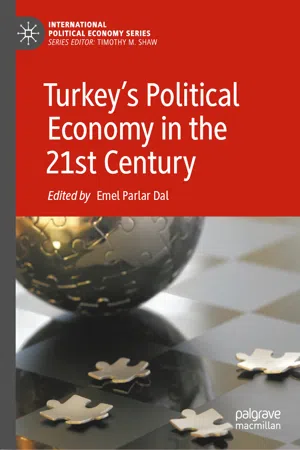
Turkey’s Political Economy in the 21st Century
About this book
This book shows the remarkable diversification in Turkey's international political economy landscape in the 2000s: its domestic political-economy framework, instrumental alternatives and geographic outreach. It assesses both how an emerging economy like Turkey copes with domestic and external challenges and the question of how substantial Turkey's recent rise in global politics really is. The volume also explains Turkey's economic growth and political transformation in line with the changes occurring in world economics, from the Washington Consensus era to the current "mix" or "hybrid" era encompassing both the characteristics of the Post-Washington and Beijing Consensus eras. The contributors portray the complexity of Turkish politics and its fragilities at the political economy level.
Information
© The Author(s) 2020
E. Parlar Dal (ed.)Turkey’s Political Economy in the 21st CenturyInternational Political Economy Serieshttps://doi.org/10.1007/978-3-030-27632-4_11. The Changing Landscape and Dynamics of Turkey’s Political Economy in the Twenty-First Century: An Introduction
Emel Parlar Dal1
(1)
Faculty of Political Science, Marmara University, Istanbul, Turkey
Emel Parlar Dal
Keywords
TurkeyTurkey’s international political economyEmerging powers and marketsTurkish foreign policyIntroduction
Turkey’s political economy in the 2000s has shown a remarkable diversification in its international political economy landscape, its domestic political economy framework, instrumental alternatives and geographic outreach, despite intensifying internal and external challenges. Regardless of the degree of success of the major economic reforms in the 2000s, it is possible to argue that change and diversification in the international, domestic, instrumental and geographic domains of Turkey’s political economy have provided it with a variety of foreign policy options and tools. In this regard, the interplay between Turkey’s domestic, instrumental and geographic political economy diversification and its changing foreign policy preferences in the 2000s constitutes the main scope of this book project.
Why is there a need for such an edited book? First, the increasing complexity of Turkey’s regional and global political economy in a rapidly expanding and challenging internal political environment makes it difficult to assess Turkey’s current political economy without a comprehensive and embedded research focus. This cluster’s integrationist approach helps the audience delve into the general contours of Turkey’s political economy direction since post-Washington Consensus (PWC) era which also witnessed the twin crises of 2000 and 2001 in the country. The new trends and tools of Turkey’s political economy create new regional networks that may also be linked to its global outreach. This collection also focuses on multiple regions such as the Middle East and North Africa (MENA), sub-Saharan Africa (SSA) and Asia-Pacific while engaging in understanding Turkey’s evolving political-economical motivations, strategies and orientations. On the other hand, the twenty-first century has witnessed the use of a grand variety of new political economy tools by Turkey’s decision-makers such as foreign aid, development aid, membership to informal groupings such as MIKTA, new free trade agreements and increasing voting weight in global financial organizations. These interconnected aspects of contemporary Turkish foreign policy are addressed in this volume with the aim of providing the international and Turkish reader with a complete picture of Turkey’s diversified political economy in terms of domestic politics, tools and varying geographies.
A bird’s eye view of the literature on emerging countries’ political economy in general and Turkey’s political economy in particular reveals an urgent need for an updated collection that focuses on Turkey’s political economy in the 2000s from a broader and comprehensive perspective. This book therefore aims to contribute to the existing literature on three levels. First, despite the various studies on the changing dynamics of emerging powers’ political economies such as China, India, Brazil and others, there is still lack of comprehensive and comparative works locating the political-economic transformations of countries having in-between characteristics between the West and East and the North and South such as Turkey. In this regard, this book attempts to fill this research gap by analyzing Turkey’s political economy in the 2000s with a specific focus on its in-between role and its new orientations in the changing global economy of the 2000s. Therefore, by incorporating Turkey into the ongoing debates on the role of emerging powers in global economy, this book attempts to contribute to the literature by providing a selected collection of works about Turkey’s motives, roles, strategies, capabilities and limits in the changing global economy in the 2000s. Second, the domestic and external challenges Turkey has faced and their repercussions, particularly after 2010, have not been analyzed together with Turkey’s changing political-economic actorness. Multiple crises including increasing domestic polarization, ongoing criticisms about its democratic credentials, the impact of the recent coup attempt, effects of the Arab Spring and the Syrian Civil War and deepening rifts with European capitals have not yet been integrated into the studies on Turkey’s political economy from a broader perspective. This book thus aims at contributing to the literature by looking at how an emerging economy like Turkey copes with domestic and external challenges with an eye to understanding the question of how substantial Turkey’s recent rise in global politics really is. In that sense, this book contributes to the literature on Turkey as a rising power by also bringing critical insights into the topic. Third, although international political economy as a discipline has started to become more institutionalized in Turkey with recently opened graduate programs on IPE in Turkish universities, there is a growing need for reference works more than ever for educational purposes to support these programs.
Based on this, this volume aims at bringing together some of the best research essays on the most debated and important topics on contemporary Turkish political economy. Necessarily selective, this collection focuses on a limited number of chapters specifically covering both the diversification-expansion and transformation in Turkish political economy since the 2000s. As mentioned above, the volume begins with the domestic diversification of Turkish political economy (Part I), including a general article dealing with the recent dynamics of Turkey’s political economy and radical political transformation and three other articles dealing with respectively income inequality in Turkey: 2003–2015, dynamics and challenges of Turkey’s labor market, the Syrian entrepreneurs in Turkey as new economic actors. Part II moves on to contributions on the instrumental diversification of Turkey’s political economy and covers topics such as Turkey’s new donor role among established and emerging donors, emerging middle powers (MIKTA) in the changing global political economy, determinants of Turkey’s foreign aid as a new political economy tool and appeal to changing global governance structure. Part III seeks to illustrate the rapid evolution of Turkey’s political economy with regard to its geographic outreach in an era of multiple and complex changes in the country’s domestic, regional and international environment with a special focus on the following topics: the Political Economy of Turkey’s Integration into the MENA Economy, the Turkish “Trading State” in the SSA and the Political Economy of Turkey’s Relations with the Asia-Pacific.
In order to draw the above-explained three interconnected rationales together, this present project addresses the following research questions:
- In which ways and through which instruments has Turkey’s contemporary political economy transformed since the 2000s?
- What are the main driving factors, motives and strategies behind the diversification of contemporary Turkey’s political economy?
- To what extent have domestic and foreign policy shifts in Turkey’s political landscape contributed to the diversification of its political economy in the 2000s?
- Which new geographies have been added to Turkey’s landscape of political-economic engagement in the 2000s?
- How has Turkey redressed the balance between its traditional political-economic engagements with its Western partners and its new political-economic relations with its emerging partners in the Global South in the 2000s?
- What are the illusions and realities about Turkey’s political-economic achievements in the 2000s? Is it really a success story or backlash?
- To what extent have domestic, regional and global crises affected Turkey’s political economy?
- Does Turkey’s current political-economic landscape resemble its Western partners more than other emerging powers in the Global South?
- What are the opportunities and challenges of contemporary Turkish political economy?
Based on these research questions, the overall framework of this book seeks to make a comprehensive analysis of Turkey’s political economy in the twenty-first century and to grasp how it has diversified in the domestic, instrumental and geographic domains. To this end, this introductory chapter will first rethink Turkey’s political economy with an eye to explaining Turkey’s economic growth and political transformation in line with the changes occurring in world economics from the Washington Consensus (WC) era to the current “mix” or “hybrid” era encompassing both the characteristics of post-Washington and Beijing Consensus (BJC) era. In sum, the overarching aim of this book project is twofold: to scrutinize the transformation experienced in Turkey’s political economy in the 2000s and to link this transformation with the changing preferences in Turkish foreign policy.
International and Structural Change of Turkey’s Political Economy from PWC to the Mix-Consensus Era
The PWC refers to the period following the WC era, particularly the early 2000s.1 Developed in the 1980s and 1990s, the WC underlined three core principles (trade liberalization, privatization and deregulation) to be implemented by the developing world to push economic growth (Serra and Stiglitz 2008). Increasing evid...
Table of contents
- Cover
- Front Matter
- 1. The Changing Landscape and Dynamics of Turkey’s Political Economy in the Twenty-First Century: An Introduction
- Part I. Domestic Diversification of Turkey’s Political Economy
- Part II. Instrumental Diversification of Turkey’s Political Economy
- Part III. Geographical Diversification of Turkey’s Political Economy
- Back Matter
Trusted by 375,005 students
Access to over 1.5 million titles for a fair monthly price.
Study more efficiently using our study tools.
Frequently asked questions
Yes, you can cancel anytime from the Subscription tab in your account settings on the Perlego website. Your subscription will stay active until the end of your current billing period. Learn how to cancel your subscription
No, books cannot be downloaded as external files, such as PDFs, for use outside of Perlego. However, you can download books within the Perlego app for offline reading on mobile or tablet. Learn how to download books offline
Perlego offers two plans: Essential and Complete
- Essential is ideal for learners and professionals who enjoy exploring a wide range of subjects. Access the Essential Library with 800,000+ trusted titles and best-sellers across business, personal growth, and the humanities. Includes unlimited reading time and Standard Read Aloud voice.
- Complete: Perfect for advanced learners and researchers needing full, unrestricted access. Unlock 1.5M+ books across hundreds of subjects, including academic and specialized titles. The Complete Plan also includes advanced features like Premium Read Aloud and Research Assistant.
We are an online textbook subscription service, where you can get access to an entire online library for less than the price of a single book per month. With over 1.5 million books across 990+ topics, we’ve got you covered! Learn about our mission
Look out for the read-aloud symbol on your next book to see if you can listen to it. The read-aloud tool reads text aloud for you, highlighting the text as it is being read. You can pause it, speed it up and slow it down. Learn more about Read Aloud
Yes! You can use the Perlego app on both iOS and Android devices to read anytime, anywhere — even offline. Perfect for commutes or when you’re on the go.
Please note we cannot support devices running on iOS 13 and Android 7 or earlier. Learn more about using the app
Please note we cannot support devices running on iOS 13 and Android 7 or earlier. Learn more about using the app
Yes, you can access Turkey’s Political Economy in the 21st Century by Emel Parlar Dal in PDF and/or ePUB format, as well as other popular books in Politics & International Relations & Comparative Politics. We have over 1.5 million books available in our catalogue for you to explore.