eBook - ePub
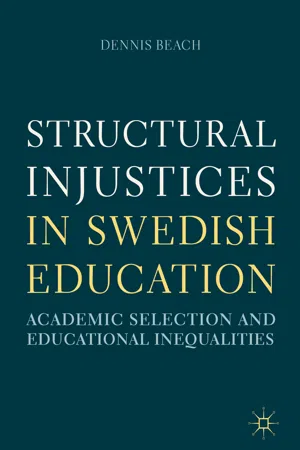
Structural Injustices in Swedish Education
Academic Selection and Educational Inequalities
- English
- ePUB (mobile friendly)
- Available on iOS & Android
eBook - ePub
Structural Injustices in Swedish Education
Academic Selection and Educational Inequalities
About this book
While Sweden is often viewed as a benchmark for equality within education, this book examines this assumption in greater depth. The author argues that Sweden's education system – even prior to the global spread of neoliberalism in education, meta-policies and privatization – was never particularly equal. Instead, what became apparent was a system that offered advantages to the upper social classes under a sheen of meritocracy and tolerable inequalities. Combining ethnographic and meta-ethnographic methodologies and analyses, the author examines the phenomenon of structural injustice in the Swedish education system both vertically and diachronically across a period of intensive transformation and reform. This revealing volume offers a mode of engagement that will be of value and interest to researchers and students of injustices within education, as well as policy makers and practitioners.
Information
Topic
EducationSubtopic
Comparative Education© The Author(s) 2018
Dennis BeachStructural Injustices in Swedish Educationhttps://doi.org/10.1007/978-3-319-95405-9_11. The Myth of Swedish Education Equity
Dennis Beach1
(1)
Department of Education and Special Education, University of Gothenburg, Göteborg, Sweden
Dennis Beach
The purpose of this book is to explore aspects of education justice and equity in relation to an educational system that is generally considered fairer and more equitable than most others: that of Sweden. There are seriously good reasons for undertaking this project. The education system in Sweden does seem to be ostensibly equitable, open and inclusive (Gudmundsson 2013) with upwards of 85% of all child cohorts between the ages of 3 and 19 being included for 6 hours or more each weekday in some form of organised institutional education or day-care, regardless of their social class, gender or racial or ethnic heritage or any possible physical or mental disabilities. And as has been suggested by the OECD in relation to its education justice barometer, this is perhaps internationally remarkable. However, perhaps equally remarkable is the lack of impact the investments have had in terms of the creation of greater levels of class consciousness (Maisuria 2016, 2017) or significantly reduced gender, racial and ethnic equality or social and material distributions of power in society at large (Alinia 2006; Swedish Ministry for Social Affairs and Health 2010). Sweden’s cities are still highly segregated in terms of the levels of wealth and higher education held by their population, as well as in terms of ethnicity. Moreover, men still more or less monopolise power positions in civic society and industry and people with mental and physical disabilities are still disproportionately outside education and employment as adults compared to others (Swedish Ministry for Social Affairs and Health 2010).
Thus, social divisions in Sweden have remained very powerful, despite decades of so-called democratic and inclusive education and other social policies , and many groups are not only still at risk of social exclusion, but also of increasing economic exclusion as well. These distinctions are also visible in the education system. Education seems to be becoming even more polarised at the same time as it also seems to be fracturing horizontally into schools that confer systematically differing amounts of cultural and social capital (Beach and Dyson, Eds 2016c; Swedish Ministry for Social Affairs and Health 2010; Swedish National Agency for Education 2009). Justice and equity are being measured only in terms of access to and retention and inclusion in educational systems, and not in terms of the effects education has on the population.
These points about continued social and educational inequities have also been made in the recent National School Commission report in Sweden (SOU 2017), where differences related to family income, parental occupation and parental education have been identified as widening at each stage of the education system. In addition the education system seems to add to existing differences by differentially rewarding young people from higher social class backgrounds compared to those from lower class backgrounds as children with a higher social class background but a low assessment of their relative cognitive ability when young, overtake those with a lower social class background in school who were initially assessed as having high ability. And there are also significant factors connected to space and place effects as poor educational outcomes are also typically concentrated in areas where other forms of disadvantage are also concentrated. Thus, rather than offering a route to social mobility and equality, the education system reproduces inequality and it is particularly learners with less access to the forms of social and cultural capital favoured by the system that seem to be troubled the most (Swedish School Commission 2017).
Given these introductory points, that (a) based on levels of access to and retention in education institutions between and across year cohorts Sweden’s education system is internationally recognised as more just and equitable than most, but that (b) this doesn’t seem to lead to greater manifestations of equity in terms of educational performances in relation to social classes, ethnicity and gender (National School Commission Report 2017) or to elevated levels of class consciousness in society (Maisuria 2016, 2017), the present book will explore two broadly related questions. They concern (a) the correctness of the assumptions about justice and democracy in Sweden’s education system and (b) the evidence related to the perpetuation of class domination (and upper- and middle class success) in that system.
These are particularly relevant questions to pose. Sweden has invested heavily in the post-World War II period; and particularly up to the mid-1990s; in the production of a massive educational infrastructure. This project was coupled through a series of reforms in the education system to a broader welfare state project called the Folk Home Project (Folkhemsprojektet). Literally translated as home for all people, it included the idea of one-school (system)-for-all children based around a common comprehensive school with identical curricula providing equal educational possibilities and experiences for all children between 6/7 and 16 years. The intention with this was to delay social class, gender and ability assessment based differentiation until the post-compulsory level. Differentiation was supposed to occur first for pupils aged 16–19 in what was still politically expressed as an integrated upper-secondary school sector that from 1994 also included university matriculation possibilities for all pupils. In addition there was also an extensive programme of adult education that comprised a fully comprehensive municipal adult education system as well as a system for early education inclusion in a uniform and centrally controlled education and day-care sector for all children from the age of three years.
The Folk Home educational reforms took place broadly speaking from the 1930s to the 1980s (Lindval and Rothstein 2010). They were politically described as a means for creating a more inclusive school with equal educational possibilities and educational equality (Börjesson 2016), and investments in education were made by the State that were internationally distinct and unsurpassed by any other western nation. Moreover, through the appointment of a series of scientific committees and commissions in what became called a process of rolling reform (Ball and Larsson, Eds 1989) Sweden also invested heavily in attempting to understand why these investments often failed and what could be done about this (Börjesson 2016).
More recently the direction of investment and the characteristics of the reform processes have been different (Lindblad et al. 2002; Lindvall and Rothstein 2010). The folk-home project was abandoned and both investments and reforms have been more aimed at transforming the education system by adopting a global policy paradigm related to market politics and neo-liberal governance (Beach 2010; Dahlstedt and Fejes 2018; Lundahl et al. 2013, 2014)....
Table of contents
- Cover
- Front Matter
- 1. The Myth of Swedish Education Equity
- 2. Education Differentiation Within Contemporary Globalization: A Meta-ethnographic Analysis of the Conferral of Power and Status in Modern Education Systems
- 3. Performativity, Creativity and Personalised Learning
- 4. Twelve Years of Upper-Secondary Education in Sweden: The Beginnings of a Neo-Liberal Policy Hegemony?
- 5. Social Class Stereotypes in Upper-Secondary School
- 6. Higher Education Expansion and Student Choices: A Critical Analysis
- 7. A Meta-ethnography of Research on Education Justice and Inclusion in Sweden with a Focus on Territorially Stigmatised Areas
- 8. Education Markets and Inequalities
- 9. Conclusions: Reconsidering Sweden’s International Contemporary Recognition and Historical Standing in Regard to Matters of Educational Justice and Equity
- Back Matter
Trusted by 375,005 students
Access to over 1.5 million titles for a fair monthly price.
Study more efficiently using our study tools.
Frequently asked questions
Yes, you can cancel anytime from the Subscription tab in your account settings on the Perlego website. Your subscription will stay active until the end of your current billing period. Learn how to cancel your subscription
No, books cannot be downloaded as external files, such as PDFs, for use outside of Perlego. However, you can download books within the Perlego app for offline reading on mobile or tablet. Learn how to download books offline
Perlego offers two plans: Essential and Complete
- Essential is ideal for learners and professionals who enjoy exploring a wide range of subjects. Access the Essential Library with 800,000+ trusted titles and best-sellers across business, personal growth, and the humanities. Includes unlimited reading time and Standard Read Aloud voice.
- Complete: Perfect for advanced learners and researchers needing full, unrestricted access. Unlock 1.5M+ books across hundreds of subjects, including academic and specialized titles. The Complete Plan also includes advanced features like Premium Read Aloud and Research Assistant.
We are an online textbook subscription service, where you can get access to an entire online library for less than the price of a single book per month. With over 1.5 million books across 990+ topics, we’ve got you covered! Learn about our mission
Look out for the read-aloud symbol on your next book to see if you can listen to it. The read-aloud tool reads text aloud for you, highlighting the text as it is being read. You can pause it, speed it up and slow it down. Learn more about Read Aloud
Yes! You can use the Perlego app on both iOS and Android devices to read anytime, anywhere — even offline. Perfect for commutes or when you’re on the go.
Please note we cannot support devices running on iOS 13 and Android 7 or earlier. Learn more about using the app
Please note we cannot support devices running on iOS 13 and Android 7 or earlier. Learn more about using the app
Yes, you can access Structural Injustices in Swedish Education by Dennis Beach in PDF and/or ePUB format, as well as other popular books in Education & Comparative Education. We have over 1.5 million books available in our catalogue for you to explore.