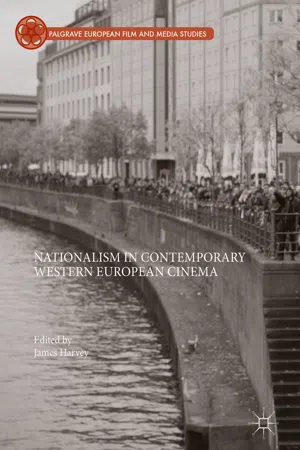
This book investigates screen representations of 21st century nationalism—arguably the most urgent and apparent phenomenon in the Western world today. The chapters explore recurrent thematic and stylistic features of 21st century western European cinema, and analyse the ways in which film responds to contemporary developments of mounting tensions and increasing hostilities to difference. The collection blends incisive sociological and historical engagement with close textual analysis of many types of screen media, including popular cinema, art-house productions, low-budget independent work, documentary and video installation. Identifying motifs of nationhood and indigeneity throughout, the contributors of this volume present important perspectives and a timely cultural response to the contemporary moment of nationalism.
- English
- ePUB (mobile friendly)
- Available on iOS & Android
eBook - ePub
Nationalism in Contemporary Western European Cinema
About this book
Information
Subtopic
Film & Video© The Author(s) 2018
James Harvey (ed.)Nationalism in Contemporary Western European CinemaPalgrave European Film and Media Studieshttps://doi.org/10.1007/978-3-319-73667-9_11. Introduction: On the Visual Cultures of the New Nationalisms
James Harvey1
(1)
Independent Scholar, London, UK
James Harvey
In June 2016, when 52% of the British electorate voted to leave the European Union, it became clear that Benedict Anderson’s notion of nations as ‘imagined communities’ (1984) was as relevant as ever. The transnational promise of fluid borders and comingling cultures was being forced out of the geopolitical landscape by a rejuvenated nostalgia for a singular, native identity. Since the millennium, signs of such nostalgia have pierced the seamlessness of an economically open and socially mobile Western Europe. This is peculiar: have not Western European governments defined themselves in terms of fluid diversity for decades? As events from recent years have shown, ideals of openness have struggled to cope with mounting right-wing populism. The European electorate’s taste for organised far-right parties has intensified in recent years, exemplified by the rise of Lega Nord in Italy, Partij voor de Vrijheid in the Netherlands and the FPO in Austria. Terror attacks in Belgium and France have been opportunistically mobilised for political leverage by Vlaams Belang in Belgium and Front National in France. Such electoral shifts have been accompanied by a surge in hate crimes across Western Europe, frequently involving attacks against places of worship and aimed at cultural and ethnic minorities. While some of the effects of these new nationalisms are clear, the cultural response to these contemporary developments is in urgent need of address.
In these times of mounting tensions and increasing hostilities to difference, understanding the ways in which cultural artefacts and artistic texts respond will provide a vital perspective on the contemporary moment. This collection brings together analyses of case studies from across Western Europe to explore the way individual nations are being figured in and through films today. Broaching a breadth of questions regarding identity and indigeneity, borders and hybridity, dissent, heritage, nation-branding and patriotism, contributors to Nationalism in Contemporary Western European Cinema are engaged in addressing the persistent cultural tendencies of the century past—but in ways that reflect the uneasy moment of the early twenty-first century. To begin, then: what has changed?
The Return of the National
The title of this book is dense by necessity. Each of the terms—contemporary , Western European, even cinema—are equally important to understanding what is at stake in the visual culture of today’s nationalist formations.
By contemporary , we recognise that one cannot remain contented by the contemporariness of post-Enlightenment modernity, nor even postmodernity. Nor is the moment in which we find ourselves containable in the contemporary described by Peter Osborne: ‘first, structurally, as idea, problem, fiction and task; and second, historically, in its most recent guise as the time of the globally transnational’ (Osborne 2013: 15). There have been some profound changes on the political scene in recent years that—while perhaps not yet causing any radical change in the order of global capitalism—have at least introduced novel challenges. These challenges cross the social, cultural and economic realms.
First, the attacks on the World Trade Centre on 11 September 2001 and the global ‘war on terror’ that ensued. The state of perpetual war that followed initiated a new era of global securitisation. Borders, previously permeated for the free and inventive mobility of labour and capital, re-hardened. Ruth Wodack has demonstrated how such ‘border politics’ have been co-opted as effective strategies by right-wing populist parties (Wodack 2018: 412). Such border politics have of course been part of the mainstream for some time, now. Their contemporariness can be measured in relation to the new wave of xenophobia, especially in the form of Islamophobia. As Liz Fekete has demonstrated, nativist scapegoating of minorities—specifically Muslims—preceded twenty-first century anti-terror legislation. Citing as exemplary the German and French governments’ institutionally racist treatment of Muslim communities, formerly populist rhetoric became mainstream in the 1990s (Fekete 2009: 10). However, it is impossible to understate quite how much the institutional racism of border politics intensified throughout the early twenty-first century. It is emblematised famously, for instance, by ever-increasing surveillance and information-sharing, Donald Trump’s ‘travel ban’ and the lack of official opposition to such discriminatory policies.
The second challenge regards the market crash of 2008, which threw Western economies into disarray, destroyed the livelihoods of millions of people and, in some cases, collapsed the economies of many formerly comfortable nation states. In his study of the revival of nationalism across Europe, Geoffrey Hosking identifies the anachronism of national economies in the globalised free-market economy as the principle reason for the rise of populist ethno-nationalism. As such, Hosking defines these new nationalisms as ‘a challenge to us to find new ways of reconciling global markets, nation-states and democracy’ (Hosking 2016: 220). Wolfgang Streeck has offered some vital thoughts towards the way these three realms interact. The economic crisis produced a sharp decline in ‘the political manageability of democratic capitalism’ (Streeck 2011: 24) with the resultant effect that ‘democracy is as much at risk as the economy’ (ibid.: 25). Widespread austerity policies and the continued accumulation of wealth by a tiny minority have cemented the fact that ‘economic power seems today to have become political power, while citizens appear to be almost entirely stripped of their democratic defences’ (ibid.: 29). This politico-economic reality seems to provide a crucial determining factor in the populist backlash against the status quo. Elsewhere, Streeck has addressed the mechanisms of how said populism has taken its nationalist form:
[N]eoliberal globalization was far from actually delivering the prosperity for all that it had promised…Instead of trickle-down there was the most vulgar sort of trickle-up: growing income inequality between individuals, families, regions and, in the Eurozone, nations…‘Global governance’ didn’t help, nor did the national democratic state that had become uncoupled from the capitalist economy for the sake of globalization. To make sure that this did not become a threat to the Brave New World of neoliberal capitalism, sophisticated methods were required to secure popular consent and disorganize would-be resisters. In fact, the techniques developed for this purpose initially proved impressively effective. (Streeck 2017: 7)
Streeck accounts both for the (temporary) re-stabilisation of precarious global neoliberal economies and the resurgence of populist nationalism through sophisticated methods: lies. The emergence of the so-called ‘post-factual’ age—emblematised by Donald Trump in the US and the Brexit campaign in the UK. An emergent distaste for experts paved the way for a new consensus led by anti-globalist personalities. Streeck is critical of the ‘moral denunciation’ (ibid.: 12) directed at those supporting this position, ironically ventriloquising the retortive battle cries of ethno-nationalism. While Streeck is correct to problematise those that dismiss the contemporary opposition to globalism as ethno-nationalistic, the stunning breadth of his argument itself neglects the important ethnocentric dimension of today’s populist nationalisms. The very post-truth strategies he associates with mainstream media and governmental rhetoric revolves above all around the non-native: the foreigner becomes the point of interest as much—perhaps even more so—for cultural and aesthetic reasons as she does for her socio-economic status.
The resurgent visibility of ethno-nationalism in the public sphere has also fed into the public response to the third challenge. As state and non-state forms of terror escalated across the Middle East, mass migrations of people seeking refuge tested the infrastructure of European states. One of the primary motivations for the slim majority that voted to ‘leave’ the European Union in the UK’s EU referendum of 2016 regarded the rehoming of refugees. Angela Merkel’s subsequent demand for all EU member states to ‘do their part’ involved the proposed introduction of quotas to ensure a fair spread of refugees across Europe. As Rainer Bauböck has explained though, most states are happy to ignore this plea ‘as long as moral blame is the only consequence of non-cooperation’ (Bauböck 2017: 6). The far-right’s recent achievement of permeating the Central European political establishment has fed into much of the West’s contemptuous official response to rehoming refugees. And since the official line has been largely apathetic and often hostile, those previously on the fringes of political discourse have penetrated the mainstream across Western Europe too. The margins have altered and hate campaigns led by the likes of Britain First, Pim Fortuyn in the Netherlands and AfD in Germany have been given unprecedented mainstream exposure as a result.
Consequently, the inability of the centrist political establishment to forge an effective way of coping with these three pivotal threats has thrown into question what Osborne called ‘the time of the globally transnational’ (Osborne 2013: 15). The contemporary today involves the re-introduction of an earlier, mainstream political binary: between a pluralistic social democracy and conservative nationalism. It is the latter that has quickly made ground in recent years and provides the core concern for contributors here. It is our intention to unpack the localised representations of— and disputes with—nationalism, at the level of cinema.
By Western European, we recognise the distinct geopolitical character of these changes. For nearly seventy years, this geographic area has been commonly viewed as the most socially stable and coherent democratic arena in the world. That moral codes established at the end of the Second World War could be deemed dispensable by the very culture that lived and breathed such horror, is surely no less than a shocking, tragic failure of humanity. It is a failure to learn the lessons of history. It is a failure to adapt to the inevitable comingling of vastly different social and cultural realities. It is a failure to understand cultural identity as, in Stuart Hall’s words, ‘a matter of “becoming” as well as of “being”’ (Hall 1990: 225). And, insofar as social change involves cultural hybridity, it is a failure to care for and about our world and its people. As right-wing populism reaches sophisticated levels of organisation across Western Europe, purposeful resistance to well-documented historical experience begins to mimic other past tragedies, whereby a people consent to what is bad for them. One might be reminded of some words by Walter Benjamin:
Mankind, which in Homer’s time was an object of contemplation for the Olympian gods, now is one for itself. Its self-alienation has reached such a degree that it can experience its own destruction as an aesthetic pleasure of the first order. This is the situation of politics which Fascism is rendering aesthetic. (Benjamin 1968: 242)
As Benjamin expressed so effectively, when this failure unfolds in the social arena, it also registers as an aesthetic phenomenon. It is this intersection between aesthetics and politics that preoccupies the contributors herein. While Benjamin’s essay, ‘The Work of Art in the Age of Mechanical Reproduction’, explored the democratic potential of cinema against Fascism over seventy years ago, it is still no clearer to what extent cinema provides an effective tool of res...
Table of contents
- Cover
- Front Matter
- 1. Introduction: On the Visual Cultures of the New Nationalisms
- 2. The ‘Liberal Left’ Response to Twenty-First Century Nationalism: Le Week-end (2013) and I, Daniel Blake (2016)
- 3. From Down Terrace to High-Rise: The ‘Unreal Estate’ Cinema of Ben Wheatley
- 4. Approaches to Othered Identities and Spaces in French Cinema
- 5. Documenting the Charlie Hebdo Tragedy
- 6. Diasporic Belgian Cinema: Transnational and Transcultural Approaches to Molenbeek and Matonge in Black
- 7. The Freedom to Make Racial Jokes: Satires on Nationalism and Multicultural Comedies in Dutch Cinema
- 8. Building Bridges: Fatih Akin and the Cinema of Intercultural Dialogue
- 9. “Kapitalismus tötet”: Liquid National Identities in the Cinema of the Berlin School
- 10. Resistance Against Itself: Austrian Cinema’s Responses to the Far-Right
- 11. Frivolity and Place Branding in Martínez Lázaro’s ‘Nationalist Comedies’
- 12. After the Crisis: Europe and Nationhood in Twenty-First-Century Portuguese Cinema
- Back Matter
Trusted by 375,005 students
Access to over 1.5 million titles for a fair monthly price.
Study more efficiently using our study tools.
Frequently asked questions
Yes, you can cancel anytime from the Subscription tab in your account settings on the Perlego website. Your subscription will stay active until the end of your current billing period. Learn how to cancel your subscription
No, books cannot be downloaded as external files, such as PDFs, for use outside of Perlego. However, you can download books within the Perlego app for offline reading on mobile or tablet. Learn how to download books offline
Perlego offers two plans: Essential and Complete
- Essential is ideal for learners and professionals who enjoy exploring a wide range of subjects. Access the Essential Library with 800,000+ trusted titles and best-sellers across business, personal growth, and the humanities. Includes unlimited reading time and Standard Read Aloud voice.
- Complete: Perfect for advanced learners and researchers needing full, unrestricted access. Unlock 1.5M+ books across hundreds of subjects, including academic and specialized titles. The Complete Plan also includes advanced features like Premium Read Aloud and Research Assistant.
We are an online textbook subscription service, where you can get access to an entire online library for less than the price of a single book per month. With over 1.5 million books across 990+ topics, we’ve got you covered! Learn about our mission
Look out for the read-aloud symbol on your next book to see if you can listen to it. The read-aloud tool reads text aloud for you, highlighting the text as it is being read. You can pause it, speed it up and slow it down. Learn more about Read Aloud
Yes! You can use the Perlego app on both iOS and Android devices to read anytime, anywhere — even offline. Perfect for commutes or when you’re on the go.
Please note we cannot support devices running on iOS 13 and Android 7 or earlier. Learn more about using the app
Please note we cannot support devices running on iOS 13 and Android 7 or earlier. Learn more about using the app
Yes, you can access Nationalism in Contemporary Western European Cinema by James Harvey in PDF and/or ePUB format, as well as other popular books in Media & Performing Arts & Film & Video. We have over 1.5 million books available in our catalogue for you to explore.