- English
- ePUB (mobile friendly)
- Available on iOS & Android
eBook - ePub
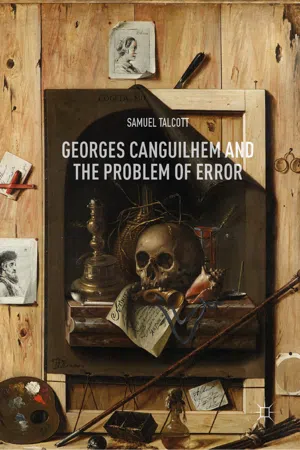
Georges Canguilhem and the Problem of Error
About this book
Examining Georges Canguilhem's enduring attention to the problem of error, from his early writings to Michel Foucault's first major responses to his work, this pathbreaking book shows that the historian of science was also a centrally important philosopher in postwar France. Samuel Talcott elucidates Canguilhem's contributions by drawing on previously neglected publications and archival sources to trace the continuity of commitment that led him to alter his early anti-vitalist, pacifist positions in the face of political catastrophe and concrete human problems. Talcott shows how Canguilhem critically appropriated the philosophical work of Alain, Bergson, Bachelard, and many others while developing his own distinct writings on medicine, experimentation, and scientific concepts in an ethical and political endeavor to resist alienation and injustice. And, while suggesting Canguilhem's sometimes surprising philosophical importance for a range of younger thinkers, the book demonstrates Foucault's own critical allegiance to Canguilhem's spirit, techniques, and investigations.
Information
Topic
PhilosophySubtopic
Ethics in Medicine© The Author(s) 2019
Samuel TalcottGeorges Canguilhem and the Problem of Errorhttps://doi.org/10.1007/978-3-030-00779-9_11. Power, Ruse, and Resistance in Societies of Control: Canguilhem on Algeria, the Republic, and Education
Samuel Talcott1
(1)
Department of Humanities, University of the Sciences, Philadelphia, PA, USA
And Ulysses, wrapped up and sleeping under the leaves, like a shepherd’s fire, is Ulysses nonetheless. We must extend a credit of honor and hospitality to every shape of man; and the idea that any stranger may be a god in disguise, is among those that the future will not diminish.—Alain, The Gods1
Who was Georges Canguilhem? In 1955, he was appointed to the position that has largely determined his reputation ever since, replacing Gaston Bachelard as Professor of History and Philosophy of the Sciences at the Sorbonne and director of the Institute for the History of Sciences and Techniques.2 Yet this is also when he began to publicly engage the war France was waging against Algerian independence, leading to a series of essays about the war and the collapse of the Fourth French Republic under threat of a military coup. In these, we find a philosopher concerned with concrete political problems drawing brilliantly on his earlier studies in the history of science and medical practice. The problems concerned not only the question of Algerian independence, but also the military uses and significance of purportedly scientific knowledge in the struggle to protect French Algeria and France itself. Indeed, they would eventually open onto the nuclear arms race and its implications for human existence and ethics. These essays, therefore, written and published between 1958 and 1960, serve as an excellent introduction to Canguilhem and his work, for in them coalesce the themes and issues that might seem to animate two different persons, the social-political philosopher and militant pacifist of the 1930s and the patient historian of the life sciences who taught at the Sorbonne after 1955. As these writings show, Canguilhem’s life found room for both.
Canguilhem first publicly commented on the war by contributing his signature to a clear, concise, and public call for peace in Algeria.3 Rather than call for rebellion, as another declaration had done, he supported a document highlighting the untenable moral choices with which the state was confronting the youth, whether to desert their military duties or participate in actions that they judged immoral, whether to abandon their nation or declare their faith in the use of military violence to solve human problems. Many signed it, though only the names of a few appear in print. Canguilhem’s is found alongside other professors from the Sorbonne and the Collège de France, a few specializing in Islam and North Africa, two Church leaders, and writers, including Guéhenno, Leiris, Bataille, Breton, and Sartre, Canguilhem’s former classmate. Why was Canguilhem’s name included here? He was a highly regarded intellectual in his own right, after all he had just been appointed to replace Gaston Bachelard at the Sorbonne. But his reputation as a resistant under the German Occupation and his continued service to France after the war—first as the state’s Inspector General of philosophy teaching, then as contributor to UNESCO’s international inquiry into the significance of philosophy teaching and editor of the publication to which this led—made him a national figure.4
Published in the November 7, 1955 issue of L’Express, a weekly magazine that would oppose the Algerian war, the declaration demanded: “an end to repression; immediate negotiations; ending the state of emergency in Algeria; liberation of the conscripts; no racial discrimination, whether overseas or in the metropole.” Its signatories, moreover, promised to “solemnly engage to act in all ways that they judge to be good by conscience, and in all domains they can reach, in order to put an end to a war in North Africa which is a menace to the Republic and simultaneously a crime against humankind” (Canguilhem et al. 1955, 679). While this might seem an initiative fit for Sartre, exemplar of the engaged intellectual, it also points directly to Émile Chartier (1868–1951). An ardent pacifist and famous essayist after the Great War, Chartier taught philosophy to the young Canguilhem and many others at the Lycée Henri IV in Paris, including Sartre, Merleau-Ponty, and Weil, all of whose published ideas respond in one way or another to his classes and the short discussions [propos], each only a few pages long, he had published using the pseudonym Alain. Canguilhem, however, became one of Chartier’s closest associates in the 1930s, eventually serving as chief editor of Alain’s journal, Libres Propos, before breaking with him over the question of pacifism in the face of fascism’s ascendance.5 But even after this, and after the Occupation, Canguilhem remained close to Chartier and, I will show, certain aspects of his philosophy of individual reflection, judgment, pacifism, and resistance.6 The declaration points to Alain and Canguilhem in another way too. As it makes clear, this was the first time since the formation of the Vigilance Committee of Anti-fascist Intellectuals (CVIA), which had combatted its spread in France during the 1930s, that such a large number of French intellectuals gathered on behalf of a political cause (Canguilhem et al. 1955, 679). As I discuss in Chapter Two, Alain was one of its founding leaders and Canguilhem himself had contributed importantly, albeit anonymously, to its work. Their eventual rupture in the 1930s notwithstanding, Alain’s continuing importance for Canguilhem in the late 1950s needs considering because Canguilhem himself publicly returns to Alain’s political philosophy at this time.
A Political Education During the Downfall of the Republic
After signing the Express declaration, Canguilhem seems to have remained more or less silent, in print anyway, about the conflict in Algeria until 1958.7 Then, over the course of two years, he published a number of articles directly related to the Algerian war and its profound consequences in La Dépêche du Midi. In June of 1958, months before the first of these appeared, however, he edited and republished a number of Alain’s political writings, selected from Propos published between 1909 and 1930, under the title “Alain, The Education of Citizen and Voter,” abbreviated hereafter as Alain (Canguilhem 1958a). Chartier had sought throughout his writing to theorize and promote the means to support Republican France through its troubles, no small task given the history. Little wonder, then, that Canguilhem might urge a renewal of Alain’s thought as Republican France seemed on the verge of definitive collapse. As we will see, Canguilhem’s writings about France and the Algerian war follow directly from his condensed reedition of Alain’s political writings.
Canguilhem’s edition opens with an epigraph to the effect that a person is not a republican because the Republic exists, that the Republic is never a state of fact.8 Instead, quoting Alain:
[t]he true Republic is a parti pris and a rule posited to which one will bend experience. And if the Republic is weak, unjust, and corrupted in fact, this is the moment to hold tight for the Idea; otherwise one is not a thinking man, but a collection of tatters exposed to every breeze. (Canguilhem 1958a, 823)
By including this comment’s date, April 1, 1914, Canguilhem draws attention to the most critical period in Chartier’s life, both for himself and his later followers, since his participation in the Great War, despite his pacifism, would be centrally important to his thought, writing, and future impact on students. Moreover, this epigraph also keys the reader into the importance of questioning what it means to be a proponent of a Republic, about the meaning of the Republic itself in highly unsettled and uncertain times. With this subtle reference to the historical moment in which Alain urged the French to remain true to the Idea of the Republic, Canguilhem nudges his reader to wonder about how ideas and history relate to each other in their own moment. And he declares that, “we must take in this lesson from Alain. Because it is time, today, to hold good for the Idea of the Republic.” The “conditions of fact” stipulated by Alain’s text are at present fulfilled, that is, the current Republic is weak, unjust, and corrupt (Canguilhem 1958a, 824). By its publication, the putsch of May 13, instigated by the French Army of Africa in order to continue the war against Algerian independence, had happened. And June, the month of its publication, began with de Gaulle’s empowerment as President with the authority to design a new constitution favoring stronger executive power, effectively ending the 4th Republic. This, combined with the brevity of the selections, a mere twenty-seven pages in Canguilhem’s Oeuvres complètes, suggests that the edition was prepared quickly and in response to the events of the putsch. It was a précis meant to excite resistance to a new threat to republican government. If the military had installed a general as President of the Republic by threatening force, what would prevent force from becoming the rule?
Given this situation and the continuing atrocities of the Algerian war, we can understand why he decides, “to present…some principles of his political thought, understood as a general analytic of civic obligations in democracy” (Canguilhem 1958a, 824). It is not a matter of applying Alain’s principles to the present moment, rather it is up to readers to “discern” the extent to which these principles, forged in relation to the War of 1914, are “capable of ‘functional variation’ in the historical context of a Fourth Republic that the war of 1939 separates from the Third” (Canguilhem 1958a, 824). Stated thus, Canguilhem highlights the repetition of war and its disastrous impact on the Republic: one had recently been overthrown by the German occupation, now another was collapsing because of its own war against Algerian independence. And he lets it be known that he is resisting, holding tight for the Republic. As a philosopher, Canguilhem trusts this analytic presentation of civic obligations will provide opportunities for citizens to reflect on ways to do the same, while insisting that neither can Alain’s principles simply be applied to solve present problems, nor can these problems serve to provoke their simple “critical revision” (Canguilhem 1958a, 824). They have enduring value, even if they require functional variation in the moment. The exercise of rereading Alain’s political thought will thus benefit “any reader, citizen or voter, who cares to oppose the resistance of a few clear ideas to fluctuating opinions in the disarray of minds” (Canguilhem 1958a, 824).
But before turning to Canguilhem’s edition, consider some other reasons why it would have been necessary to republish Alain’s political thought only seven years after his death. First, Alain’s propos, written over many years and in response to current events, had not systematically presented the principles of his thought. Canguilhem’s edition, which presents ten theses and deploys select comments to elucidate them, addresses and corrects this concern. But the other reason concerns Alain’s pacifism regarding the Nazi threat and the German invasion and occupation of France. While Chartier himself never accepted the occupying forces, some of Alain’s followers deployed the integral pacifism that they had learned from his writings as a reason to accept the German occupation of France.9 Indeed, he had even signed, unwittingly, a document advocating unconditional peace with the German invaders (Sartre 1984, 22). In short, Alain’s name and writings were tainted by the support collaborators had found in them. Highly regarded as an intellectual and popular for his philosophical journalism before the war, Alain’s name became associated with people who now provoked visceral disgust and hatred in France. And despite the efforts of advocates like Canguilhem or Jean Hyppolite, his writings have been largely forgotten by the history of philosophy.10 Criticism by former students, like Sartre, who preferred phenomenology to Alain’s school of reflexive judgment, helped make this possible, especially with his suggestion that Alain stands for the abdication of thought (Granel 1962).11 That Sartre’s existentialism owes much to his teach...
Table of contents
- Cover
- Front Matter
- 1. Power, Ruse, and Resistance in Societies of Control: Canguilhem on Algeria, the Republic, and Education
- 2. The Births of Political Resistance and Biological Philosophy Out of the Spirit of Medicine: Error in the Early Years
- 3. Technical Alterations in the Problem of Error: From the True and the False to the Normal and the Pathological
- 4. Error and the Problem of Creation
- 5. Knowledge of Life True to Life: Medicine, Experimentation, and Milieu
- 6. Becoming Rationalist: Biological Philosophy, History of the Reflex Concept, and the Uses of Water
- 7. Experimentation and the Crisis of Medicine
- 8. Put to the Test: Canguilhem’s Biological Philosophy and a New Concept of Error
- Back Matter
Trusted by 375,005 students
Access to over 1.5 million titles for a fair monthly price.
Study more efficiently using our study tools.
Frequently asked questions
Yes, you can cancel anytime from the Subscription tab in your account settings on the Perlego website. Your subscription will stay active until the end of your current billing period. Learn how to cancel your subscription
No, books cannot be downloaded as external files, such as PDFs, for use outside of Perlego. However, you can download books within the Perlego app for offline reading on mobile or tablet. Learn how to download books offline
We are an online textbook subscription service, where you can get access to an entire online library for less than the price of a single book per month. With over 1.5 million books across 990+ topics, we’ve got you covered! Learn about our mission
Look out for the read-aloud symbol on your next book to see if you can listen to it. The read-aloud tool reads text aloud for you, highlighting the text as it is being read. You can pause it, speed it up and slow it down. Learn more about Read Aloud
Yes! You can use the Perlego app on both iOS and Android devices to read anytime, anywhere — even offline. Perfect for commutes or when you’re on the go.
Please note we cannot support devices running on iOS 13 and Android 7 or earlier. Learn more about using the app
Please note we cannot support devices running on iOS 13 and Android 7 or earlier. Learn more about using the app
Yes, you can access Georges Canguilhem and the Problem of Error by Samuel Talcott in PDF and/or ePUB format, as well as other popular books in Philosophy & Ethics in Medicine. We have over 1.5 million books available in our catalogue for you to explore.