- English
- ePUB (mobile friendly)
- Available on iOS & Android
eBook - ePub
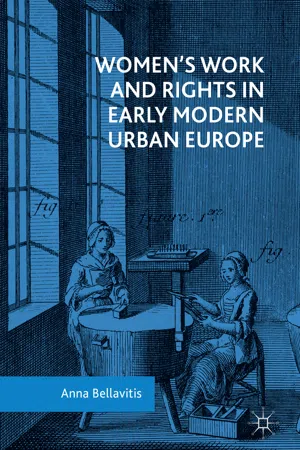
Women’s Work and Rights in Early Modern Urban Europe
About this book
In the last decades, women's role in the workforce has dramatically changed, though gender inequality persists and for women, gender identity still prevails over work identity. It is important not to forget or diminish the historical role of women in the labour market though and this book proposes a critical overview of the most recent historical research on women's roles in economic urban activities. Covering a wide area of early modern Europe, from Portugal to Poland and from Scandinavia to the Mediterranean, Bellavitis presents an overview of the economic rights of women – property, inheritance, management of their wealth, access to the guilds, access to education – and assesses the evolution of female work in different urban contexts.
Information
© The Author(s) 2018
Anna BellavitisWomen’s Work and Rights in Early Modern Urban Europehttps://doi.org/10.1007/978-3-319-96541-3_11. Women Have Always Worked
Anna Bellavitis1
(1)
University of Rouen, Rouen, France
Anna Bellavitis
In the next chapters, we shall examine in detail the development of women’s work in relation to the great evolutions that characterised the early modern age, but first it will be useful to propose a brief historiographical overview.
Since the early decades of the twentieth century, some pioneering research, to which we shall return, has been carried out, especially in England and in particular at the London School of Economics. In an article from 1992, Maxine Berg drew attention to the important contribution made by some women historians to economic history, from the Middle Ages to the Industrial Revolution, including Eileen Power, Alice Clark and Ivy Pinchbeck, concluding that: “the decline of women in the economic history profession has, it seems, coincided with their exclusion from our historical memory” (Berg 1992). These three historians carried out fundamental research on women’s work, Eileen Power in relation to the middle ages, Alice Clark for the early modern age and Ivy Pinchbeck for the industrialisation era, suggesting readings and interpretations that have influenced historiography to this day. The tradition of research on these issues has remained alive and, in Britain, the historiographical production on women’s work in early modern times is vast and constantly evolving. During the course of the book, reference will often be made to this abundant bibliography, but the English case is not the main focus of the book, one of the aims of which is precisely to broaden the framework and adopt as European a perspective as possible.
Louise Tilly’s and Joan Scott’s book: Women, Work and Family, published in 1978, which focuses on the evolution of women’s work in England and France from 1700 to 1950 (Tilly and Scott 1978) represents an important milestone in the debate on the role of women’s work in history and has become a model for other historical periods as well. Tilly and Scott showed the continuity between the types of work that women did before, during and after the development of industrial capitalism. Later research confirmed that, for much of the nineteenth century, both men and women were employed mainly in the traditional sectors of the urban economy and that, even in England, it was in those sectors (crafts , commerce, services ), and not in manufacturing, that the greatest increase in female employment was recorded (Hill 1989). Above all, Tilly and Scott analysed women’s work in relation to family roles and family models, drawing attention to the market work activities carried out by women in their homes. In their introduction to the new 1987 edition, they insisted that productive and reproductive roles within the family should not be seen as “natural”, but as political and ideological constructs: “reproduction is a culturally defined, socially organized activity; it has no inherent or inevitable social consequence for women” (Tilly and Scott 1987: 8).
Any history of women’s work must therefore consider the pivotal role attributed by Tilly and Scott to the family and in particular assess any:
bargaining, negotiation and domination as well as consensus about what family interest was. Conflict erupted because of unequal power relationships […] family members invoked competing ideologies to justify their actions […]. These negotiations at once accepted and questioned existing concepts of households and family roles. Future research needs to focus on such family bargaining and decision making as a way of understanding behavior for this will shed new light on the ways in which existing division of labor by age and sex were transformed or reproduced. (Tilly Scott 1987: 9)
The authors used the words “negotiation”, “bargaining” and “conflict”, but not the concept of “agency”, which was brought to gender history by Edward P. Thompson’s “history from below”, as well as by the rethinking of Foucault and Derrida, through Judith Butler’s feminist criticism and has become central to women’s economic history in more recent years (Montenach 2012; Fazio 2013). In 2013, in their introduction to the volume Female Agency in the Urban Economy, Anne Montenach and Deborah Simonton pointed out that “the concept of agency seldom has been explicitly used and discussed by early modern historians” and declared the need to:
illustrate the circumstances under which women could rise above their restrictive situations, and illuminate the factors – age, marital and social status, political or economic climate – that determined their ability to manage their own lives […] Agency here is not conceptualized strictly in terms of resistance to male authority or patriarchal patterns, but arose from the variety of everyday interactions in which women accommodated, negotiated or manipulated social rules and gender roles. (Montenach and Simonton 2013: 4–5)
In addition to the concept of ‘agency’, recent research developments in women’s history deal with the concept of ‘capabilities’, that is, according to Amartya Sen, “what a person can do and can be”. “Capability involves an understanding of the individual’s freedom to operate and an ability to participate in economic, social and political actions” (Fontaine 2013: 56). Agency and capabilities must be related to the ‘resources’ to which women, or men, can have access, as well as to the ability to search for, and create such resources.
In their introduction to the 1987 edition, Tilly and Scott also specified that their analysis included the work for the market carried out by women at home, but not unpaid ‘reproductive’ work and ‘care’ work, performed by wives and mothers primarily, but also daughters, unmarried aunts and other family members. This is a very long-standing issue, but its characteristics change throughout history (Davidson 1982; Hill 1989). The distinction between “productive” and “reproductive” work is rejected by feminist economy research (Duffy 2011) even if it is almost impossible to assess this work economically, unless we can establish an equivalence with the wages of people who carried out the same type of activity as paid work, namely servants , nurses, cooks and so on (Folbre and Wagman 1993).
Research on women’s work contributes then to the redefinition of the concept of work that, in the Swedish research project Gender & Work directed by Maria Ågren, is defined as any activity that allowed people to “make a living” (Ågren 2017). Nevertheless, family members have always performed “productive” unpaid work in their family shops: the sale, accounting, organisation work carried out by the wives of the craftsmen or shopkeepers, as well as the craft work that the wives and children of masters carried out in workshops, were not assessed in terms of wages (Martini and Bellavitis 2014; Bellavitis et al. 2016; Bellavitis 2018). In actual fact, the work of master craftsmen, traders or shopkeepers was never assessed in terms of wages either, but the difference lies in their social status and also, as we shall see in more detail below, in the assessment of these roles made by quantitative sources. Master craftsmen and shopkeepers appeared in censuses and tax roles as ‘active’, whereas their wives, who also worked, were rarely considered as such. The question of sources is one of the central problems in women’s history, and we shall look into it in more detail in the following pages.
In 1990, the History of Women in the West, edited by Georges Duby and Michelle Perrot, was published in Italy and the French edition came out in 1991. Immediately translated into many other languages, the series represented an important international and collective attempt to provide a summary of women’s history in Western Europe and America. It was followed by many others, and replaced more recently by “global” assessments (Meade and Weisner-Hanks 2004). The third volume, Renaissance and Enlightenment Paradoxes, opened with the essay “Women, work and family” by Olwen Hufton (Hufton 1990 and 1993 for the English edition), who highlighted how the work of women in early modern times was part of a “makeshift economy”, characterised by precarious work and the need to find solutions to poverty on a daily basis. In the wake of these studies, an important line of research has developed on the role of women in illegal activities such as theft or smuggling (Rublack 1999; Montenach 2013, 2015), which has also highlighted, as we shall see, cases of leniency by the authorities, within a moral economy aimed at protecting the weakest members of society.
In 1990, the Proceedings of the Annual Conference of the Institute of Economic History Francesco Datini of Prato, La donna nell’economia, secc. XIII–XVIII (Woman in economy, thirteenth–eighteenth centuries), held in 1989, were also published. The conference helped to recognise the topic of women’s work as a central one for economic history, but the most interesting methodological proposals came from the debate and round tables that, as was the tradition of the conferences of the Istituto Datini, were included in the volume of the proceedings. During the round table on urban work, Angela Groppi called for avoiding a too rigid distinction between male and female work, not to remain bogged down in the model of the family economy, which ignores economically active women alone, and introduced the concept of the economic “value” of women (Groppi 1990), that she developed in the volume The Work of Women, the third of a series on the history of women in Italy, which is considered as the “Italian response” to the History of Women in the West, and was published in 1996. This book is still a fundamental point of reference, but unfortunately it was never translated into English and therefore is little known outside Italy (Groppi 1996a). A very important aspect of the interpretative approach proposed by Angela Groppi, and developed in particular with regard to the early modern age, is precisely the interweaving of work and rights: in particular, the distinction between women’s work and women’s value, or rather between women’s ability to produce wealth through their work and their characteristic of “being” wealth, as bearers of dowries , in the specific context of the Roman legal tradition:
The fact that laws and statutes pr...
Table of contents
- Cover
- Front Matter
- Part I. Women, Work, Rights and the City
- Part II. Women’s Jobs
- Part III. Workshops and Markets
- Part IV. Conclusions
- Back Matter
Trusted by 375,005 students
Access to over 1.5 million titles for a fair monthly price.
Study more efficiently using our study tools.
Frequently asked questions
Yes, you can cancel anytime from the Subscription tab in your account settings on the Perlego website. Your subscription will stay active until the end of your current billing period. Learn how to cancel your subscription
No, books cannot be downloaded as external files, such as PDFs, for use outside of Perlego. However, you can download books within the Perlego app for offline reading on mobile or tablet. Learn how to download books offline
Perlego offers two plans: Essential and Complete
- Essential is ideal for learners and professionals who enjoy exploring a wide range of subjects. Access the Essential Library with 800,000+ trusted titles and best-sellers across business, personal growth, and the humanities. Includes unlimited reading time and Standard Read Aloud voice.
- Complete: Perfect for advanced learners and researchers needing full, unrestricted access. Unlock 1.5M+ books across hundreds of subjects, including academic and specialized titles. The Complete Plan also includes advanced features like Premium Read Aloud and Research Assistant.
We are an online textbook subscription service, where you can get access to an entire online library for less than the price of a single book per month. With over 1.5 million books across 990+ topics, we’ve got you covered! Learn about our mission
Look out for the read-aloud symbol on your next book to see if you can listen to it. The read-aloud tool reads text aloud for you, highlighting the text as it is being read. You can pause it, speed it up and slow it down. Learn more about Read Aloud
Yes! You can use the Perlego app on both iOS and Android devices to read anytime, anywhere — even offline. Perfect for commutes or when you’re on the go.
Please note we cannot support devices running on iOS 13 and Android 7 or earlier. Learn more about using the app
Please note we cannot support devices running on iOS 13 and Android 7 or earlier. Learn more about using the app
Yes, you can access Women’s Work and Rights in Early Modern Urban Europe by Anna Bellavitis in PDF and/or ePUB format, as well as other popular books in Economics & Business General. We have over 1.5 million books available in our catalogue for you to explore.