This volume brings together leading gender and politics scholars to assess how women's political empowerment can best be conceptualized and measured on a global scale. It argues that women's political empowerment is a fundamental process of transformation for benchmarking and understanding all political empowerment gains across the globe. Chapters improve our global understanding of women's political empowerment through cross-national comparisons, a synthesis of methodological approaches across varied levels of politics, and attention to the ways gender intersects with myriad factors in shaping women's political empowerment. This book is an indispensable resource for scholars of politics and gender, as well as being relevant to a global scholarly and policy community.
eBook - ePub
Measuring Women’s Political Empowerment across the Globe
Strategies, Challenges and Future Research
- English
- ePUB (mobile friendly)
- Available on iOS & Android
eBook - ePub
Measuring Women’s Political Empowerment across the Globe
Strategies, Challenges and Future Research
About this book
Information
© The Author(s) 2018
Amy C. Alexander, Catherine Bolzendahl and Farida Jalalzai (eds.)Measuring Women’s Political Empowerment across the GlobeGender and Politicshttps://doi.org/10.1007/978-3-319-64006-8_11. Introduction to Measuring Women’s Political Empowerment Across the Globe: Strategies, Challenges, and Future Research
Amy C. Alexander1, 2, 3 , Catherine Bolzendahl1, 2, 3 and Farida Jalalzai1, 2, 3
(1)
Department of Political Science, Gothenburg, Sweden
(2)
Department of Sociology University of California, Irvine, CA, USA
(3)
Oklahoma State University, Stillwater, OK, USA
Amy C. Alexander
is an associate professor in the Department of Political Science at the University of Gothenburg and a Research Fellow with Performance of Democracies Project at the Quality of Government Institute. Her research focuses on the sources of women’s political empowerment and its effects on political representation, social values, democratization and governance across the globe. She has published on these and related topics in several peer-reviewed journals including Comparative Politics, the European Sociological Review, Politics and Gender, the International Sociological Review, and Social Indicators Research.
Catherine Bolzendahl
is Associate Professor of Sociology at the University of California, Irvine. Her research intersects with comparative political sociology and the sociology of gender. She co-authored an award-winning book on American definitions of family, and several of her articles have appeared in peer-reviewed sociology and political science journals, including Social Forces, British Journal of Sociology, Gender & Society, Political Studies, and Social Politics.
Farida Jalalzai
is Hannah Atkins Endowed Chair and Professor of Political Science at Oklahoma State University. Her research analyzes women and minorities in politics and the role of gender in the political arena. She has authored two books examining women national leaders, as well as several peer-reviewed articles in journals such as Politics & Gender, International Political Science Review, and Politics and Religion.
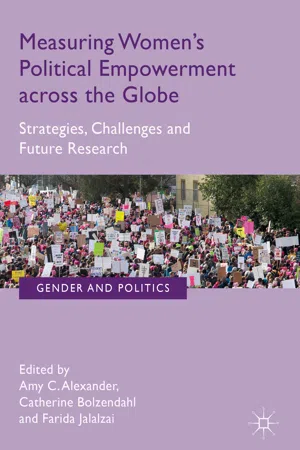
On January 21, 2017, hundreds of thousands of people gathered in Washington, DC, in what is known as the “Women’s March.” Viewed as a call to action in response to Donald Trump’s official inauguration to the US presidency (which occurred the day before), marches were held in 673 cities across the country. Not only did these occur1 in major urban centers like Los Angeles, Chicago, and New York but marches spread to smaller (and more conservative) settings such as Erie, Pennsylvania, Oklahoma City, and Decorah, Iowa. Even more striking is that parallel women’s marches were held on every single continent worldwide. All told, nearly five million people, mainly women, marched on that day. Representing diverse groups, women and their allies mobilized around various issues spanning reproductive rights, environmental justice, and equal pay, among others. As such, women’s marches proved to be much more than a Trump counter-inauguration; they were a demand that women’s political empowerment take center stage globally. This presents a critical moment, one that calls for the assessment of women’s political empowerment worldwide, and builds off many factors leading to this point. By bringing together leading gender scholars in sociology and political science as well as practitioners, this edited volume provides a framework for understanding women’s political empowerment on such a global scale.
Few social changes have been as dramatic and rapid as women’s increased political represen tation worldwide (Paxton et al. 2006). Scholars and public figures rightfully tout these gains as remarkable evidence of greater gender equality, yet current academic and policy research faces a large lacuna in theoretical and empirical understandings of women’s political empowerment. Nowhere do women hold equal power to men in influencing and exercising political authority worldwide and efforts to increase women’s political agency are often actively and violently repressed. This combination of opportunity and limitations heightens the need for a comprehensive, global treatment of women’s political empowerment. In this volume, we therefore unite leading scholars to develop theoretical frameworks, methodological strategies, and research agendas for addressing these issues at every level of political authority.
Across these different approaches, this volume emphasizes three major axioms. First, gains in women’s political empowerment directly decrease the role of gender inequality as an obstacle to political incorporation. Women’s political empowerment is not a zero-sum game, and gender equality opens, rather than closes, the political domain to all members of society. Second, gender is a major organizing force in social relations across the globe, such that sex and gender are used simultaneously to create status inequalities that disadvantage women (Ridgeway 2011). Thus, women’s political empowerment requires special attention given that women are the largest categorical group today experiencing long-term, ongoing barriers to political incorporation worldwide. Third, inequalities in political empowerment cut across multiple statuses and other sources of inequality. Understanding how gender intersects with other barriers to empowerment is a central question, and women’s political empowerment should be viewed as a fundamental process of transformation for benchmarking and understanding more general political empowerment gains across the globe (e.g., UN Millennium Development Goals, http://www.un.org/millenniumgoals/; Hudson et al. 2012).
Responding to these issues means developing a broader research agenda related to women’s political empowerment. We must understand how social constructions of gender influence such outcomes and how these can be made relevant to a global scholarly and policy community.
Our efforts to build a comprehensive approach to women’s global political empowerment stand on the shoulders of many scholarly giants. Researchers across the social sciences have contributed a great deal of knowledge regarding women’s enhanced access to political power. Increasingly, scholars and policy-makers question the factors that induce women to become politically active and the impact politically empowered women have on social and political outcomes. From these questions, answers are beginning to emerge, especially in our understanding of women’s elite office holding (e.g., parliament and presidencies). Theoretically and empirically, however, our scholarship on the topic is uneven and incomplete. Before we undertook the research presented in this volume, a theoretically driven definition of women’s global political empowerment did not exist. Moreover, while much has been done empirically to understand the causes and consequences of women’s economic autonomy, global scholarship on women’s political empowerment remains narrow, mainly analyzing women legislators and/or quotas advancing women to the legislature (Krook 2010).
The goal of this volume thus is to bring together scholars to develop a broader vision of women’s political empowerment, to understand how social constructions of gender influence such outcomes, and to offer original research relevant to a global scholarly and policy community. Together, we work to improve our global understanding of women’s empowerment through cross-national comparisons, a variety of data types and a synthesis of methodological approaches. In particular the volume focuses on developing frameworks that address women’s political empowerment among elites, civil society, and in social processes. In doing so, we highlight the complexities and insufficiencies in the definition and measurement of women’s global political empowerment in a review of existing cross-national comparisons, data types, and methodological approaches.
In this introductory chapter we identify the complexities in defining women’s global political empowerment; critically review prior research on elites and masses to develop definitional and measurement goals; and, tie women’s global political empowerment to broader social concerns and processes. We then provide an overview of the chapter contributions from authors recognized as the leading scholars investigating questions related to gender ...
Table of contents
- Cover
- Frontmatter
- 1. Introduction to Measuring Women’s Political Empowerment Across the Globe: Strategies, Challenges, and Future Research
- 2. Women’s Political Empowerment Through Public Opinion Research: The Citizen Perspective
- 3. The Status of Women’s Political Empowerment Worldwide
- 4. Intersectionality and Women’s Political Empowerment Worldwide
- 5. Social Movements as Women’s Political Empowerment: The Case for Measurement
- 6. Women’s Empowerment at the Local Level
- 7. Electing Women to National Legislatures
- 8. Legislatures as Gendered Organizations: Challenges and Opportunities for Women’s Empowerment as Political Elites
- 9. The Empowerment of Women in Diplomacy
- 10. Measuring Women’s Judicial Empowerment as Part of Political Empowerment
- 11. Women Cabinet Ministers in Highly Visible Posts and Empowerment of Women: Are the Two Related?
- 12. Women Heads of State and Government
- 13. Conclusions and Further Directions
- Backmatter
Trusted by 375,005 students
Access to over 1.5 million titles for a fair monthly price.
Study more efficiently using our study tools.
Frequently asked questions
Yes, you can cancel anytime from the Subscription tab in your account settings on the Perlego website. Your subscription will stay active until the end of your current billing period. Learn how to cancel your subscription
No, books cannot be downloaded as external files, such as PDFs, for use outside of Perlego. However, you can download books within the Perlego app for offline reading on mobile or tablet. Learn how to download books offline
Perlego offers two plans: Essential and Complete
- Essential is ideal for learners and professionals who enjoy exploring a wide range of subjects. Access the Essential Library with 800,000+ trusted titles and best-sellers across business, personal growth, and the humanities. Includes unlimited reading time and Standard Read Aloud voice.
- Complete: Perfect for advanced learners and researchers needing full, unrestricted access. Unlock 1.5M+ books across hundreds of subjects, including academic and specialized titles. The Complete Plan also includes advanced features like Premium Read Aloud and Research Assistant.
We are an online textbook subscription service, where you can get access to an entire online library for less than the price of a single book per month. With over 1.5 million books across 990+ topics, we’ve got you covered! Learn about our mission
Look out for the read-aloud symbol on your next book to see if you can listen to it. The read-aloud tool reads text aloud for you, highlighting the text as it is being read. You can pause it, speed it up and slow it down. Learn more about Read Aloud
Yes! You can use the Perlego app on both iOS and Android devices to read anytime, anywhere — even offline. Perfect for commutes or when you’re on the go.
Please note we cannot support devices running on iOS 13 and Android 7 or earlier. Learn more about using the app
Please note we cannot support devices running on iOS 13 and Android 7 or earlier. Learn more about using the app
Yes, you can access Measuring Women’s Political Empowerment across the Globe by Amy C. Alexander, Catherine Bolzendahl, Farida Jalalzai, Amy C. Alexander,Catherine Bolzendahl,Farida Jalalzai in PDF and/or ePUB format, as well as other popular books in Politics & International Relations & Politics. We have over 1.5 million books available in our catalogue for you to explore.