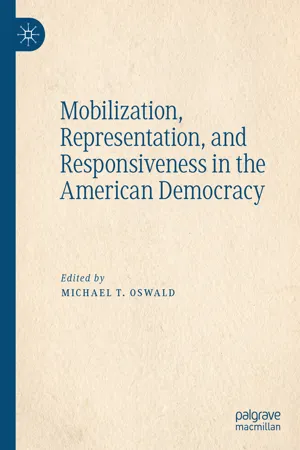
This edited volume investigates America's transforming democracy as it faces the challenges and developments of the 21st century—challenges and developments that have brought deep dissatisfaction, cultural fragmentation, and economic indignation. Although political power remains in the hands of the people, a fundamental incapability to compromise has locked policymakers in a permanent stalemate. In this legislative paralysis, grassroots movements build more and more momentum amidst regular protests and civil disobedience. This new political vigor and dynamism is dualistic, portending either a future of falsehoods and authoritarianism or a more empowering and direct form of democracy. This book ultimately seeks to understand how the US government is frantically adjusting to these sharp cultural, technological, and economic changes.
eBook - ePub
Mobilization, Representation, and Responsiveness in the American Democracy
- English
- ePUB (mobile friendly)
- Available on iOS & Android
eBook - ePub
Mobilization, Representation, and Responsiveness in the American Democracy
About this book
Information
© The Author(s) 2020
M. T. Oswald (ed.)Mobilization, Representation, and Responsiveness in the American Democracyhttps://doi.org/10.1007/978-3-030-24792-8_11. Constitutional Crisis, Norm Derogation, and the Broader Impact of Partisan Polarization in Contemporary American Politics
Michael T. Oswald1 and John D. Robertson2
(1)
University of Passau, Passau, Germany
(2)
Texas A&M University, College Station, TX, USA
“Democracy is the theory that the common people know what they want, and deserve to get it good and hard.”
—H. L. Mencken
“I could stand in the middle of Fifth Avenue and shoot somebody, and I wouldn’t lose any voters.”
—Donald J. Trump
“When the President does it that means that it is not illegal.”
—Richard Nixon
Keywords
PolarizationPopulismNorm derogationPartisanshipPresidencyIntroduction
It was obvious even to a casual observer watching American politics play out during the period between May 2017 and March 2019 that something approximating a genuine emergency, if not crisis of authority was gripping the community. Whether this is a constitutional crisis or merely one more emergency growing out of the complexity of America’s separation of powers and constitutional checks and balances is a hotly debated argument as of spring 2019 in the American political arena. However, hovering over the entire milieu of confusion and contempt is the reality of a polarized, divided, and partisan American political culture. This chapter will offer some contextual perspective on the important interactive effect of affective partisan polarization and the impact polarization has on constructing pathways to opening conflict between opposing partisan interests. The literature and empirical evidence reviewed in this chapter compel the conclusion that it is these pathways that fuel and propel not a constitutional crisis but rather the persistent and common strategy of norm derogation in the American political system. We begin with a consideration of the current context of the American political scene. The chapter then draws on literature from constitutional law to consider the difference between a constitutional crisis and that of the more common but important strategy of norm derogation. Following this, we offer some evidence drawn from the American National Election Surveys to help put into perspective the importance of partisan polarization as a force fueling norm derogation. We compare the period of the late 1970s–1980s with that of 2016 to offer some temporal perspective to the issue. In the end, we conclude that the evidence suggests it would be more productive to understand the current reality in the American political system as being merely the ongoing struggle over norm definition, derogation, and the struggle of partisan interests within a period of close, contentious elections. This may well be, in many subtle but significant ways, a more daunting challenge to American democracy moving forward in time than a genuine constitutional crisis.
The Context of Crisis
As of early May 2019, the executive branch of the US federal system had refused to release the president’s tax records, or comply with requests for executive branch officials (including cabinet secretaries) to testify before Congress; it dared Congress to subpoena executive branch officials asserting executive privilege and claiming Congress—especially the House of Representatives—was merely seeking to dig up dirt on Trump . The Attorney General William Barr faced possible contempt charges from Congress for refusing to testify before the House Judiciary committee. This is a seemingly basic requirement of legislative branch oversight and accountability responsibilities supported by courts and a specific constitutional authority within the context of separate powers in the federal constitution. The public watched as the president had ordered federal troops to the border to stop illegal immigration to the country, an act considered by many as a direct violation of the Reconstruction Era’s Posse Comitias Act of 1878 disallowing the use of federal troops to enforce domestic laws. This was accompanied by the president’s order to divert federal funds from military projects authorized by Congress for other purposes in order to construct a wall along the American southern border with Mexico. The governors and their attorneys general in 20 states filed suit against the Trump administration for violating separation of powers by disregarding the constitutional authority of Congress to control federal spending (Stevenson 2019).
For many, the impending struggle between the House of Representatives grows from the incumbent president’s anxiety over a divided government. Following the 2018 mid-term elections to Congress, President Trump lost his unified Republican legislative branch partner. The American electorate returned the House to Democratic control, engineering a net gain of 40 seats over Republicans to win 235 House seats in total, amassing nearly nine million more votes for Democratic House candidates than their Republican opponents (a threefold increase in the margin of popular vote total over the 2016 House elections). This was matched by a net gain of over 400 seats across state legislatures, increasing Democrat-controlled state legislative chambers from 32 to 37 across the 50 states and adding 13 Democrat governorships. The Senate, with its advantage to the more rural base of the American electorate, saw Republicans extend their majority from four to six seats (from 51 Republicans senators to 53, with Vice-President Mike Pence as the tie-breaker, if needed by the administration for legislative matters). More telling in many ways, when one looks more closely at the patterns of country election results from the 2018 midterms, one sees a clear shift away from Republicans in 2016 in some key counties. In 2008 and 2012, 204 counties delivered a plurality vote victory to Barack Obama, before abandoning the Democrats in 2016 and delivering a plurality or majority margin of victory for Donald Trump . In 2016, the margin of Trump ’s victory over Clinton across these 204 counties averaged 11.7 percentag...
Table of contents
- Cover
- Front Matter
- Part I. Introduction
- Part II. Institutions of Democracy and the Democratic Rule
- Part III. Socio-cultural and Technological Challenges of Democracy
- Part IV. Populism–Polarization–Protest
- Part V. America and Global Democracy
- Part VI. Conclusion
- Back Matter
Trusted by 375,005 students
Access to over 1.5 million titles for a fair monthly price.
Study more efficiently using our study tools.
Frequently asked questions
Yes, you can cancel anytime from the Subscription tab in your account settings on the Perlego website. Your subscription will stay active until the end of your current billing period. Learn how to cancel your subscription
No, books cannot be downloaded as external files, such as PDFs, for use outside of Perlego. However, you can download books within the Perlego app for offline reading on mobile or tablet. Learn how to download books offline
Perlego offers two plans: Essential and Complete
- Essential is ideal for learners and professionals who enjoy exploring a wide range of subjects. Access the Essential Library with 800,000+ trusted titles and best-sellers across business, personal growth, and the humanities. Includes unlimited reading time and Standard Read Aloud voice.
- Complete: Perfect for advanced learners and researchers needing full, unrestricted access. Unlock 1.5M+ books across hundreds of subjects, including academic and specialized titles. The Complete Plan also includes advanced features like Premium Read Aloud and Research Assistant.
We are an online textbook subscription service, where you can get access to an entire online library for less than the price of a single book per month. With over 1.5 million books across 990+ topics, we’ve got you covered! Learn about our mission
Look out for the read-aloud symbol on your next book to see if you can listen to it. The read-aloud tool reads text aloud for you, highlighting the text as it is being read. You can pause it, speed it up and slow it down. Learn more about Read Aloud
Yes! You can use the Perlego app on both iOS and Android devices to read anytime, anywhere — even offline. Perfect for commutes or when you’re on the go.
Please note we cannot support devices running on iOS 13 and Android 7 or earlier. Learn more about using the app
Please note we cannot support devices running on iOS 13 and Android 7 or earlier. Learn more about using the app
Yes, you can access Mobilization, Representation, and Responsiveness in the American Democracy by Michael T. Oswald in PDF and/or ePUB format, as well as other popular books in Politics & International Relations & American Government. We have over 1.5 million books available in our catalogue for you to explore.