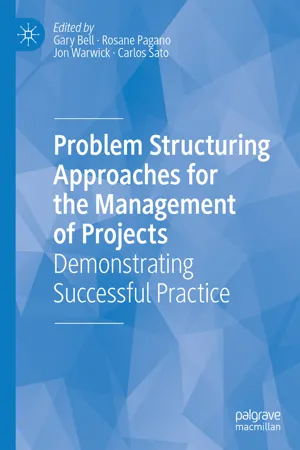
Exploring the three levels of project management, this edited collection analyses the practice of problem structuring approaches (PSAs) with an aim to improve organisational adaptability and value creation. By studying these approaches, the authors present techniques for enhancing project management knowledge, informing decision-making and guiding management actions. This book is an insightful and timely read, as it addresses the need for organisations to adapt in order to tackle new challenges within today's changing business landscape. Undoubtedly useful to those studying project management and operational research, this book is also an important read for managers and decision-makers within organisations as it identifies and examines the effective outcomes of PSAs.
eBook - ePub
Problem Structuring Approaches for the Management of Projects
Demonstrating Successful Practice
- English
- ePUB (mobile friendly)
- Available on iOS & Android
eBook - ePub
Problem Structuring Approaches for the Management of Projects
Demonstrating Successful Practice
About this book
Information
Topic
BetriebswirtschaftSubtopic
Unternehmensstrategie© The Author(s) 2019
Gary Bell, Rosane Pagano, Jon Warwick and Carlos Sato (eds.)Problem Structuring Approaches for the Management of Projectshttps://doi.org/10.1007/978-3-319-93263-7_11. A Systemic ‘Theories of Change’ Approach for Projects and Change Initiatives in the Context of Quality Enhancement Activity in Higher Education
Diane Hart1
(1)
Faculty of Business and Law, Manchester Metropolitan University, Manchester, UK
Keywords
Theory of changeFacilitated modellingProgramme evaluationSystems thinkingOrganisational learningIntroduction
Theories of Change (ToC) is an evaluation approach emerging in the context of community change initiatives in the USA (Connell and Kubisch 1998). It has since been used more widely in other countries and sectors, for example health (Sullivan et al. 2002; Barnes et al. 2003; Mackenzie and Blamey 2005; Sullivan and Stewart 2006; Breuer et al. 2016), education and higher education (Hart et al. 2009a, b; Levy 2012; Richards et al. 2016), community development (Archibald et al. 2016), crime (Hopkins and Wickson 2013), and agriculture (Mayne and Johnson 2015; Thornton et al. 2017). Although ToC has evolved in the discipline of evaluation theory and practice, it is not restricted to this purpose. The approach involves facilitated development of models that can form the basis for planning implementation and evaluation activity, and reflecting on the results of evaluation , to inform decisions about further improvement. Those familiar with soft operational research (OR) and problem structuring methods will recognise elements of the approach. However, it is anticipated that it will be new to practitioners more familiar with project management methodologies.
The examples used in this chapter to illustrate the application of ToC are from educational development activity in the context of a large UK university . The term educational development is used to mean “ systematic and scholarly support for improving both educational process and practices and capabilities of educators” (Stefani 2003, p. 10). UK universities are expected to undertake a process of systematic continuous improvement of their educational provision (Higher Education and Research Act 2017) guided by a quality code (Quality Assurance Agency 2017). However , there continues to be debate about methods and measures to inform improvement efforts (Gibbs 2010). There has been much criticism of these efforts focusing on a narrow range of sector-wide quality assurance measures (Harvey and Williams 2010a, b).
The approach illustrated here is intended to help practitioners understand how their change strategies are working in the specific contexts of application. However, it is adapted with some systems thinking to improve connection with the wider environment and higher-level strategies. Systems thinking involves exploring a situation of interest ‘as if it were’ a complex adaptive system . The theoretical basis for this is explored in the next section. This is followed by a description of ToC applications in educational development projects, and finally a personal critical reflection on the learning from these applications.
Theoretical Background
The theoretical model of organisational learning typically relied on to underpin quality enhancement processes in higher education is that of the reflective practitioner (Schön 1983; Kolb 1984). From this perspective, improvement action is assumed to be informed by practitioners actively engaged in attempting to understand how and why their implemented teaching strategies work (or not) in specific contexts of implementation. It is argued that through their everyday activity practitioners develop mental models about the complex dynamics of the situations in which they practise. These models have been termed ‘theories of change’ (or variations on this), and in reflective practice these theories are consciously and continuously tested and revised through learning cycles of planning, action, evaluation , and reflection. More recently it has been argued that there is a need to develop improved and explicit ToC (Trowler et al. 2014) with joined up thinking about the connection between change at different levels of organisation (Trowler et al. 2005, 2014). This organisation-wide learning and change requires this process to be undertaken collectively (Biggs 2001, Vince 2002) and through rigorous action research (Argyris and Schön 1996; Kember 2002; Marks-Maran 2015). However, a more formal and collective approach to educational action research has been acknowledged to present significant challenges in terms of the complexity of the social and political processes (Trowler et al. 2005). For example in motivating and engaging participants (Greenbank 2007), establishing shared goals and vocabulary for collaborative work (Jacobs 2016), and producing outputs that are more widely transferable and usable (Saunders 2012).
Programme evaluation aims to improve ToC about how intervention programmes work in practice in specific contexts and is used to inform decisions and actions to improve these situations (Funnell and Rogers 2011; Patton 2012). Typically this type of approach involves some sort of ‘modelling’ or ‘problem structuring’ of the situation of interest, which helps in framing the planning of data generation, analysis, and interpretation. The approach is not prescribed, and there is much debate about how decisions about the evaluation design affect what is learnt and how evaluation is used to influence improvement. In addition to decisions about, for example methods, data, and participants, there are core decisions about whose theories are tested, and whose questions are answered. These choices can reflect fundamentally different assumptions about the complexity of improving organised activity and learning about how this can be achieved. For example the reflective practitioner or action research mode of inquiry described earlier is often considered to lack rigour because the investigator is too closely involved in the situation, and has a vested interest in the findings and outcomes , which may bias their interpretation of them. The use of external ‘experts’ is often used to introduce this rigour. In the OR literature, Franco and Montibeller (2010) identify this expert mode as the most common and traditional approach to OR intervention. In this mode, the assumption is that an (external) ‘expert’ can straightforwardly define ‘success’ and use objective and scientific methods of inquiry to measure success, discover how activity and other factors are influencing success, and therefore recommend solutions. However, the risk associated with this mode is that the prioritisation of the expert’s definition and criteria of success will lead to findings not thought to be relevant or useful by other stakeholders, and will not be used (Patton 1986). This approach therefore does not appear compatible with enhancement processes, where improvement needs to be understood from the perspective of a wide range of stakeholders and is dependent on the actions of many actors. From a utilisation-focused perspective (Patton 1986), the inquiry should help decision makers and others that have the ability to influence change in a situation to arrive at their own judgements about, and commitment to, the improvement needed. This suggests a more facilitated and developmental approach is needed. In the facilitated mode of OR intervention (Franco and Montibeller 2010), consultants facilitate a participative process of problem structuring with stakeholders to guide their intervention and inquiry. It is accepted that different stakeholders and actors involved will have different notions of success and how to achieve it, based on their previous experiences, learning, values, motivations, and the information to which they have access. Cause-effect relationships in these situations are therefore understood more as producer-product relationships that are socially constructed, that is through people’s actions based on their own mental models of their effects in the complex contexts in which they act. Models are probabilistic rather than predictive, and the more complex the situation, the more uncertain the outcomes . In developmental approaches (Fetterman 1994; Patton 1994), the facilitator also helps in capacity building for o...
Table of contents
- Cover
- Front Matter
- 1. A Systemic ‘Theories of Change’ Approach for Projects and Change Initiatives in the Context of Quality Enhancement Activity in Higher Education
- 2. Explore, Experiment, Experience: A Synthesis of Vickers’ Appreciative Learning System and Ackoff’s Problem Approach Applied in Practice
- 3. Multicriteria Mapping as a Problem Structuring Method for Project Front-Ending
- 4. Evaluating Understanding: Endogenous Project Evaluation Using Practice-Based Interaction Analysis (PIA)
- 5. Delivering Better Outcomes Through Customer-Led Project Management: The Case of the Major Project BT 21st Century Network in the UK
- 6. Exploring the Use of Soft Systems Methodology (SSM) in Front-Ending Public-Funded Rural Bridge Construction Projects in Bangladesh
- 7. Managing Context: Lessons from a Large-Scale Science Project
- 8. Systemic Approach and Problem Structuring Methods in Teaching Sustainability in Project Management Courses at Manchester Metropolitan University: Some Reflections on Good Practice
- 9. Using SSM in Project Management: Aligning Objectives and Outcomes in Organizational Change Projects
- Back Matter
Trusted by 375,005 students
Access to over 1.5 million titles for a fair monthly price.
Study more efficiently using our study tools.
Frequently asked questions
Yes, you can cancel anytime from the Subscription tab in your account settings on the Perlego website. Your subscription will stay active until the end of your current billing period. Learn how to cancel your subscription
No, books cannot be downloaded as external files, such as PDFs, for use outside of Perlego. However, you can download books within the Perlego app for offline reading on mobile or tablet. Learn how to download books offline
Perlego offers two plans: Essential and Complete
- Essential is ideal for learners and professionals who enjoy exploring a wide range of subjects. Access the Essential Library with 800,000+ trusted titles and best-sellers across business, personal growth, and the humanities. Includes unlimited reading time and Standard Read Aloud voice.
- Complete: Perfect for advanced learners and researchers needing full, unrestricted access. Unlock 1.5M+ books across hundreds of subjects, including academic and specialized titles. The Complete Plan also includes advanced features like Premium Read Aloud and Research Assistant.
We are an online textbook subscription service, where you can get access to an entire online library for less than the price of a single book per month. With over 1.5 million books across 990+ topics, we’ve got you covered! Learn about our mission
Look out for the read-aloud symbol on your next book to see if you can listen to it. The read-aloud tool reads text aloud for you, highlighting the text as it is being read. You can pause it, speed it up and slow it down. Learn more about Read Aloud
Yes! You can use the Perlego app on both iOS and Android devices to read anytime, anywhere — even offline. Perfect for commutes or when you’re on the go.
Please note we cannot support devices running on iOS 13 and Android 7 or earlier. Learn more about using the app
Please note we cannot support devices running on iOS 13 and Android 7 or earlier. Learn more about using the app
Yes, you can access Problem Structuring Approaches for the Management of Projects by Gary Bell, Rosane Pagano, Jon Warwick, Carlos Sato, Gary Bell,Rosane Pagano,Jon Warwick,Carlos Sato in PDF and/or ePUB format, as well as other popular books in Betriebswirtschaft & Unternehmensstrategie. We have over 1.5 million books available in our catalogue for you to explore.