This book describes the history in late 19th-century Russia and immigration to Canada of an ethnic and religious group known as Doukhobors, or Spirit Wrestlers. The book is a translation into English of the Russian original authored by Grigori? Verigin, published in 1935. The book's narrative starts with the consolidation of Doukhobor beliefs inspired by the most famous Doukhobor leader, Pëtr Verigin. It describes the arrival of Doukhobors in Canada, their agricultural and industrial accomplishments in Saskatchewan and British Columbia, and the clashes and misunderstandings between Doukhobors and the Canadian government. The narrative closes in 1924, with the scenes of Pëtr Verigin's death in a yet unresolved railway car bombing, and of his funeral. The author emphasizes the most crucial component of Doukhobor beliefs: their pacifism and unequivocal rejection of wars and military conflicts. The book highlights other aspects of Doukhobor beliefs as well, including global community, brotherhood and equality of all the people on earth, kind treatment of animals, vegetarianism, as well as abstinence from alcohol and tobacco. It also calls for social justice, tolerance, and diversity.
eBook - ePub
The Chronicles of Spirit Wrestlers' Immigration to Canada
God is not in Might, but in Truth
- English
- ePUB (mobile friendly)
- Available on iOS & Android
eBook - ePub
The Chronicles of Spirit Wrestlers' Immigration to Canada
God is not in Might, but in Truth
About this book
Information
Topic
Theology & ReligionSubtopic
Christian Denominations© The Author(s) 2019
V. Makarova, L. A. Ewashen (eds.)The Chronicles of Spirit Wrestlers' Immigration to Canadahttps://doi.org/10.1007/978-3-030-18525-1_11. Resettlement from Taurida Guberniia to the Caucasus
Grigoriǐ Vasil’evich Verigin1
(1)
Shouldice, Canada
Deceased
Taurida guberniia (governorate) was one of the administrative units of the Russian Empire that comprised the Crimean peninsula, the basin of the lower Dnieper river and the coasts of the Black Sea and Azov Sea.
End Abstract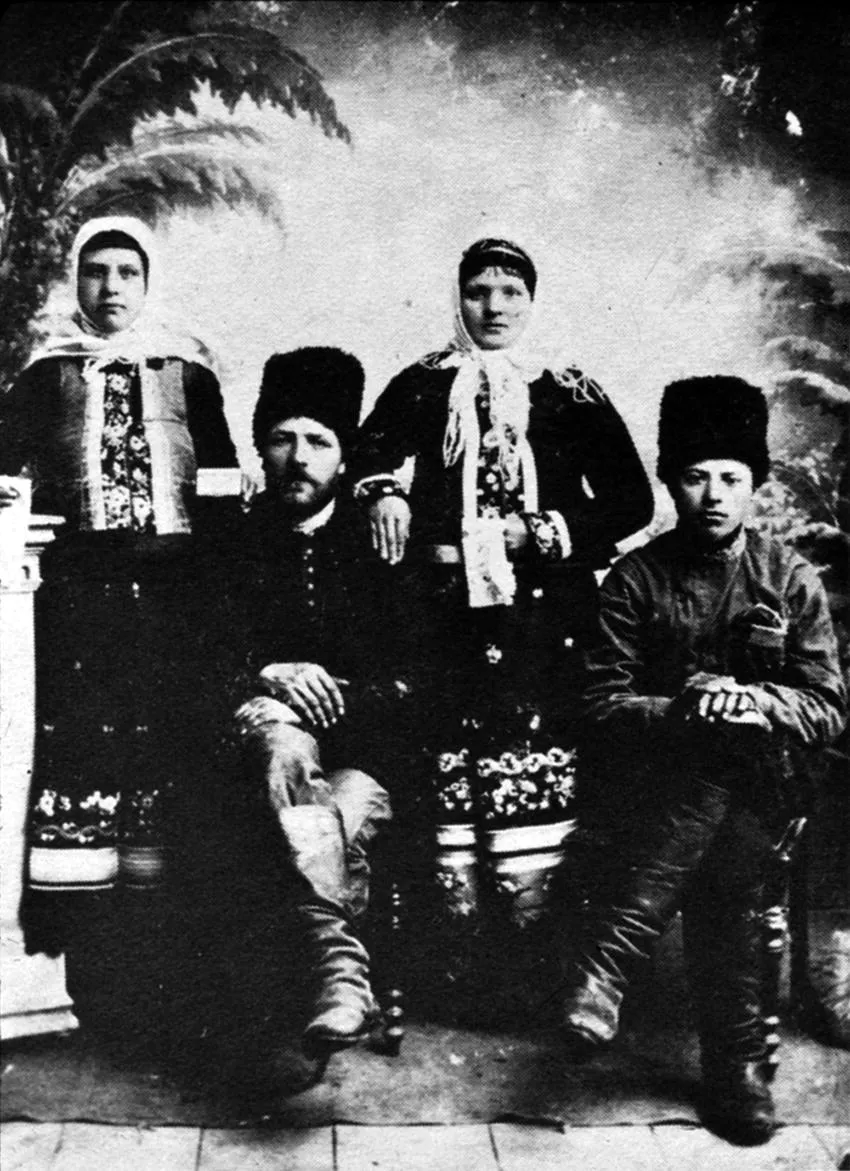
A group of Doukhobors in the Caucasus
When the Doukhobors were expelled from the Taurida guberniia by the government in 1840, they were resettled to the Tiflis guberniia, Akhalkalak District1 to the so-called Wet Mountains, 10 miles2 from the Turkish border. The government expelled them from the Taurida guberniia because of their religious convictions. They were settled on the Turkish border with the aim of weakening their religious spirit. The climate there was very severe, winters were long and cold. Because of the spring and autumn frost, wheat did not ripen at all, but barley did. For the most part, people ate barley. After two or three years, a small part of the Doukhobors resettled to the Elizavetpol’3 guberniia, three hundred miles to the east. Our parents were among those who resettled there; they lived in the village of Slavianka. The climate here was tolerable: winters were not as severe and grains would ripen in a satisfactory way.
Most of the Doukhobors stayed in the Wet Mountains. They formed up to ten villages there, and in spite of the severe climate, began to make themselves at home and to cultivate the land in earnest. The land was free and virgin. They began to breed cattle and horses, and soon life improved.
In the village of Goreloe, a so-called public Orphans’ Home was built. Orphans’ Homes had existed from ancestral times, and the Doukhobors considered this a necessity. An Orphans’ Home had been built through communal effort, the material wealth was donated. The Doukhobor leader lived in this house; besides him the old people and orphans who had no other housing lived there as well. That is why the house was called the Orphans’ Home. As I recall, in my lifetime, Luker’ia Vasil’evna Kalmykova, the ruler and leader of the Doukhobors, lived there. The house was co-owned with the resettled Doukhobors of Elizavetpol’ guberniia where there were four Doukhobor villages. Donations were given by them as well. Donations consisted mostly of money, but wheat was also brought in moderate amounts, because in the Wet Mountains it was not available.
After 40 years of living there the Doukhobors completely felt at home and became well-to-do people. The Orphans’ Home was also increasing its resources, and during this time, a capital of 100,000 roubles had accumulated there. There were 150 head of cattle, about 100 horses and about 2000 select sheep. Such an enterprise must be ruled by a reliable person who was elected from the society and was like an ataman,4 one who kept all in order. He made all the decisions he was able to, but whenever he could not cope, he asked for advice from Luker’ia Vasil’evna and she advised him. For the most part, the Doukhobors who lived there looked after the household, but other Doukhobors often worked there as volunteers. They were paid 25 roubles a year. In addition to this, all of their regular needs including clothing were taken care of. At that time, the government did not bother the Doukhobors very much. Not only the Doukhobors but all of the population of the Caucasus were not required to perform military service because, aside from the Doukhobors and Molokans,5 all of the population was Asian. Since the population consisted of Moslems, Armenians and Georgians, they were granted the privilege of not performing military service until a specific time. Now I will stop and begin writing about Pëtr Vasil’evich Verigin.
Footnotes
1
Akhalkalak (modern Akhalkalaki) is an administrative district in the country of Georgia. Now an independent state, in Imperial Russia, Georgia constituted Tiflis guberniia.
2
Here and elsewhere, the Russian word “versta” is translated as a “mile.” Verst (versta) is an old Russian measure of distance, one verst equals 1066.8 m.
3
Elizavetpol’ (later Kirovabad, since 1989, Ganja) was the capital of Elizavetpol’ guberniia in the Russian Empire. Since the separation of Azerbaijan from the Soviet Union, it is one of the largest cities in Azerbaijan.
4
Ataman (particularly among the Cossacks) is a leader of a closely connected group of people such as a village or a family clan.
5
Molokans are a sectarian religious group that split off from the Russian Orthodox Church. At present, Doukhobors of Canada and Molokans of the United States retain amicable relationships and send representatives to each other’s major events.
© The Author(s) 2019
V. Makarova, L. A. Ewashen (eds.)The Chronicles of Spirit Wrestlers' Immigration to Canadahttps://doi.org/10.1007/978-3-030-18525-1_22. Pëtr Vasil’evich Verigin
Grigoriǐ Vasil’evich Verigin1
(1)
Shouldice, Canada
Deceased
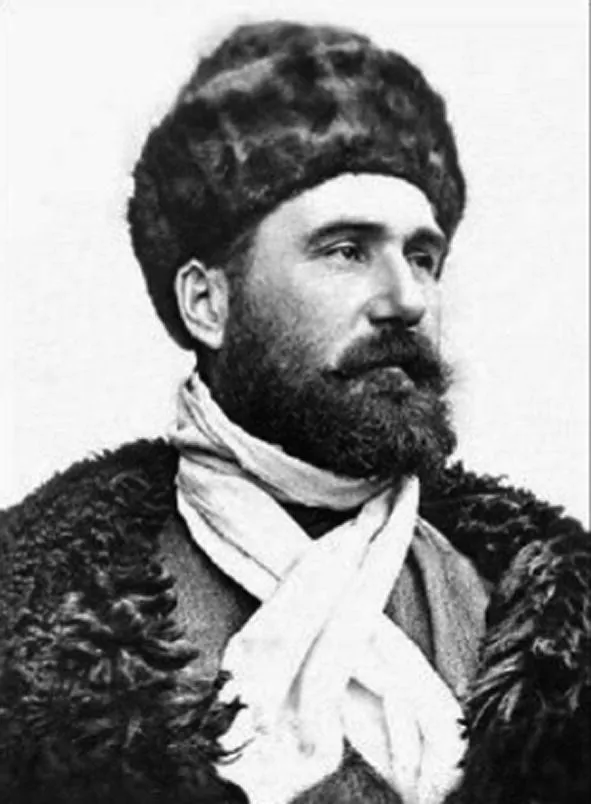
Pëtr Vasil’evich Verigin
Pëtr Vasil’evich was born in the Caucasus, in the Elizavetpol’ guberniia,1 in the village of Slavianka in 1858 on the 29th of June, on the saints’ day of Peter and Paul, into the peaceful and devout family of Verigins.
This name originates from the word verigi [chains]. Our ancestor, Fëdorushka, from the Old Believers, was the bearer of chains. As far as we remember, our heritage begins with him. Upon accepting Christ, he had his second birth in the Holy Spirit baptized in the name of the Father, the Son, and the Holy Spirit. Fëdorushka’s son was Prokof’iushka. Prokof’iushka’s son was Luk’ianushka. Luk’ianushka’s son—Vasil’iushka—this is our immediate parent.
Our mother, Anastasiia Vasil’evna, originated from the family of Kapustin. Father Verigin was of stern and just character, neither coveting nor envious of other people’s possessions. He always used to tell us: “Look children, if you desire wealth, then attain it through a just way through your own labour. Don’t covet others’ possessions. And especially, do not steal. If a lost object lies on the road, drive around it at a distance of a few feet in order not to be tempted. If that object was discarded by someone as unnecessary, you do not need it either. But if however, someone has dropped it by mistake, he will look for it and find it.” He always used to say: “Look children, the man may be naked but righteous. Avoid drunkenness as you would avoid hell.”
In the religious sense he was a true Doukhobor. The resettlement of the Doukhobors from Taurida guberniia2 to the Caucasus was done by the government with the purpose of weakening the Doukhobor spirit in the realization of their true path. The government announced: if someone does not want to resettle, they may stay, but they must become Orthodox. Such an offer was more for the rich people; and this related to Vasiliǐ Luk’ianovich as well. His father, Luk’ian Prokof’evich, was still alive. They had their own land, several tens of thousands of high bred sheep named shlyonka. It would be a great carnal temptation for a secular person, but Vasiliǐ Luk’ianovich did not waiver in spirit, he neither held onto anything nor regretted anything, he was only concerned with the preservation of Doukhoborism.
Our mother had a meek and peaceful character and she approached every being with love. In her family, she maintained Christian order, always mentioned God and His power. She hardly ever scolded us and never beat us. If we didn’t listen to her at times, and she was trying to influence us, it was with her meek request and prayer. Sometimes we didn’t listen to that either. In that case, she would tell us: “Or else I will tell your father of your disobedience.” The word “father” influenced us more strongly and we would always settle down. It happened like that only when we were small and didn’t know what it meant not to listen to your own mother. However, when we began to understand these things, then we always tried to fulfil her personal request, without waiting for the word “father” from her. But to tell the truth, our father never beat us either, although he was stern. Both of them, mother and father, were solidly built; there was no lack in physical beauty, they were, as they say, blood with milk.3 Pëtr Vasil’evich originated from those parents.
Our parents had seven sons and two daughters. The eldest was Ivan, the second one was Fëdor, the third was daughter Anna, the fourth was Lukeian, the fifth was Prokofiǐ, the sixth was Varvara, the seventh was Vasiliǐ, the eighth was Pëtr and the ninth was Grigoriǐ. All of them were built well, but Pëtr Vasil’evich stood out with the slenderness of his body...
Table of contents
- Cover
- Front Matter
- 1. Resettlement from Taurida Guberniia to the Caucasus
- 2. Pëtr Vasil’evich Verigin
- 3. Life and Death of Luker’ia Vasil’evna Kalmykova
- 4. The Arrest of Pëtr Vasil’evich and His Exile from the Orphans’ Home
- 5. His Exile According to the Administrative Order to Arkhangel’sk Guberniia for Five Years
- 6. The Transfer of Pëtr Vasil’evich from Shenkursk to the Island of Kola. The Extension of His Exile for Five More Years. The Return to Shenkursk
- 7. What Happened to the Orphans’ Home. Division of the Doukhobors
- 8. My Trip to Shenkursk and My Communal Life There
- 9. Pëtr Vasil’evich’s Message to the Doukhobors Through Ivan Evseevich Konkin
- 10. The Relaying of the Message and Its Fulfilment by the Doukhobors. The Exile of Ivan Evseevich Konkin
- 11. The New Exile of Pëtr Vasil’evich to Obdorsk of the Tobol’sk Guberniia for Five Years. The Trip by Vasiliǐ Gavrilovich Vereshchagin and Brother Vasiliǐ Vasil’evich to Shenkursk to Visit Pëtr Vasil’evich and Their Receipt of a Message for the Doukhobors
- 12. Prisoner Transport of Pëtr Vasil’evich to Obdorsk, Tobol’sk Guberniia
- 13. Accomplishment of the Mission. Letter of Pëtr Vasil’evich to the Doukhobors. Doukhobors’ Refusal of Military Service. Imprisonment of Vasiliǐ Verigin and Vereshchagin
- 14. The Burning of Weapons in Three Guberniias and the Return of the Reserve Conscription Cards
- 15. The Burning of Weapons in the Akhalkalak Area and the Brutal Massacre by the Government
- 16. The Destruction of Livelihood and Possessions; Resettlement Among the Indigenous Peoples
- 17. My Arrest and Life in Prisons
- 18. Torments in the Ekaterinograd Disciplinary Battalion
- 19. Exile to Iakutsk Area. The Description of the Prisoner Transport to Nizhneudinsk
- 20. The Continuation of Prisoner Transport. The Last Words and Death of Vasiliǐ G. Vereshchagin
- 21. Life in Nel’kan
- 22. Life in Notor, Iakutsk and Other Areas
- 23. A Trip to Russia
- 24. A Trip Abroad
- 25. Arrival in England. Meeting the Chertkovs
- 26. A Request for Relocation. A Letter by Pëtr Vasil’evich to the Empress Aleksandra Fëdorovna Romanova
- 27. The Relocation
- 28. A Letter of Anastasiia Vasil’evna Verigina to Empress Aleksandra Fëdorovna Romanova
- 29. The March of Brothers and Sisters for God’s Cause
- 30. The Release of Pëtr Vasil’evich Verigin by the Russian Government and His Journey to Canada to the Doukhobors
- 31. Pëtr Vasil’evich Travels Around All the Villages. His Speeches and His Advice to the People
- 32. The Congress for the Discussion of the Land Issue. Acceptance of Land
- 33. Starting the Communal Household. The Life of Pëtr Vasil’evich in Otradnoe
- 34. Cancellation of Land Entries by the Government for Non-acceptance of Allegiance to the British King Edward
- 35. A Letter to the Government and the People of Canada Regarding Cancellation of Land Entries
- 36. A Move to British Columbia. An Explanation to the Government
- 37. Detailed Inquiry and Investigation by Royal Commissioner William Blakemore
- 38. The Explanatory Letters of Doukhobors to Blakemore
- 39. The Inquiry Report and the Recommendation of the Royal Commissioner William Blakemore
- 40. A Conversation Between Military Minister Bowser and the Doukhobors About Registries and Schools
- 41. The Resolution by Soldiers Who Returned from the War Reached at a Big Meeting in Nelson on February 13, 1919
- 42. Canada and Doukhobors
- 43. Death and Funeral of Pëtr the Lordly
- Back Matter
Trusted by 375,005 students
Access to over 1.5 million titles for a fair monthly price.
Study more efficiently using our study tools.
Frequently asked questions
Yes, you can cancel anytime from the Subscription tab in your account settings on the Perlego website. Your subscription will stay active until the end of your current billing period. Learn how to cancel your subscription
No, books cannot be downloaded as external files, such as PDFs, for use outside of Perlego. However, you can download books within the Perlego app for offline reading on mobile or tablet. Learn how to download books offline
Perlego offers two plans: Essential and Complete
- Essential is ideal for learners and professionals who enjoy exploring a wide range of subjects. Access the Essential Library with 800,000+ trusted titles and best-sellers across business, personal growth, and the humanities. Includes unlimited reading time and Standard Read Aloud voice.
- Complete: Perfect for advanced learners and researchers needing full, unrestricted access. Unlock 1.5M+ books across hundreds of subjects, including academic and specialized titles. The Complete Plan also includes advanced features like Premium Read Aloud and Research Assistant.
We are an online textbook subscription service, where you can get access to an entire online library for less than the price of a single book per month. With over 1.5 million books across 990+ topics, we’ve got you covered! Learn about our mission
Look out for the read-aloud symbol on your next book to see if you can listen to it. The read-aloud tool reads text aloud for you, highlighting the text as it is being read. You can pause it, speed it up and slow it down. Learn more about Read Aloud
Yes! You can use the Perlego app on both iOS and Android devices to read anytime, anywhere — even offline. Perfect for commutes or when you’re on the go.
Please note we cannot support devices running on iOS 13 and Android 7 or earlier. Learn more about using the app
Please note we cannot support devices running on iOS 13 and Android 7 or earlier. Learn more about using the app
Yes, you can access The Chronicles of Spirit Wrestlers' Immigration to Canada by Grigoriǐ Vasil'evich Verigin,Grigoriǐ Vasil’evich Verigin, Veronika Makarova,Larry A. Ewashen, Veronika Makarova in PDF and/or ePUB format, as well as other popular books in Theology & Religion & Christian Denominations. We have over 1.5 million books available in our catalogue for you to explore.