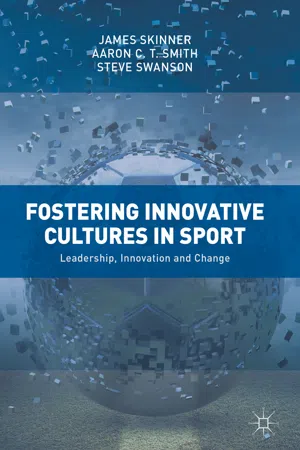
Analysing the trends that are emerging in sport enterprises such as advancements in technology and social media, the authors of this illuminating book tackle the issue of how to create new opportunities in such a changing industry. Providing valuable reading for sports business scholars, this book draws on examples from inventive companies as well as inspirational sports leaders and illustrates the various drivers behind innovation. Addressing the need for a culture of innovation within sports enterprises, the authors reveal sustainable ways for companies to stay ahead of the game in an increasingly competitive global sport market.
eBook - ePub
Fostering Innovative Cultures in Sport
Leadership, Innovation and Change
- English
- ePUB (mobile friendly)
- Available on iOS & Android
eBook - ePub
Fostering Innovative Cultures in Sport
Leadership, Innovation and Change
About this book
Information
© The Author(s) 2018
James Skinner, Aaron C. T. Smith and Steve SwansonFostering Innovative Cultures in Sporthttps://doi.org/10.1007/978-3-319-78622-3_11. Introduction: A Different Animal
James Skinner1 , Aaron C. T. Smith1 and Steve Swanson1
(1)
Institute for Sport Business, Loughborough University London, London, UK
James Skinner (Corresponding author)
Aaron C. T. Smith
Steve Swanson
Keywords
IndustryCommercialInnovationCultureFrameworkIntroduction: It Captures the Hearts and Minds of a Society
It is worth considering how business and sport arrived at the current situation. How did the business of sport get to today’s heights from the dark days of the eighties? Cave (2015) suggests many factors came together, but without the contribution of a select band of innovative entrepreneurs—three, to be precise—the revolution may never have happened in the first place. Rupert Murdoch and his Sky satellite television colleagues had the foresight and courage to plough ever-increasing sums into English football, based on their conviction that the sport is so popular with domestic audiences. More recently, Team Sky has also played a key role in the rejuvenation of British cycling. In motor racing, Bernie Ecclestone had the prescience to understand how globalisation, the enduring appeal of fast cars, and the distributive power of broadcasting could create enormous value for Formula One . In golf and tennis, Mark McCormack, the late founder of sports marketing agency International Management Group (IMG), was the first to recognise that athletes and sports stars had value well beyond their performances. By identifying athletes as sporting brands in their own right, he unlocked unexploited intellectual property, which has gone on to help create some of the most powerful brands in the world (Cave 2015).
The above individuals were all innovative entrepreneurial visionaries. They all took risks and had a visionary view on the potential for their sports, events or talent over the long term. First, Rupert Murdoch gambled on the power of football to drive a particular business proposition and proved spectacularly successful. Second, Bernie Ecclestone transformed what was a cottage industry into a global powerhouse in terms of financial performance and cutting-edge technology. Ecclestone’s achievements paved the way for all major sports to succeed as businesses and had a radical impact on the evolution as sport as a business. He had a great vision of what motor racing was capable of achieving, and understood the great public interest in it, as well as the enormous broadcasting potential. Many would argue that Ecclestone had a massive impact on so much sport, not just motor sport, because he opened everybody’s eyes to what could be done (Cave 2015). Finally, in golf and tennis, Mark McCormack, of IMG , was the first to develop the personal branding potential of athletes as popular media stars. McCormack was one of the first to understand the individual potential of sports people to earn much more money than they had done before and to take control of their own intellectual property rights (Mason 2015).
The far-sighted ideas of Murdoch, Ecclestone and McCormack have been realised. In 2016, the global sports market, comprising of infrastructure, events, training and manufacturing and retail of sports goods, was estimated to be worth $US600–700 billion (KPMG Business of Sports 2016). This accounted for approximately 1% of the global GDP. Besides exercising a significant impact on the global economy due to its close association with other sectors, including education, real estate and tourism, the sector also contributed to improvements in general health and the well-being of a country. In the United States , Burrow (2013) notes that the sports industry generates approximately $US14.3 billion in earnings a year. The industry also contributes 456,000 jobs with an average salary of $US39,000 per job. Moreover, Nightengale (2013) reported that the Chicago Cubs generate $US600 million annually for the state of Illinois and a large part of the economic impact involves jobs. In the UK from 2010 to 2015 the business of sport became a £20bn-a-year industry supporting some 450,000 jobs. According to Oxford Economics, the London Olympics had contributed £16.5bn to Britain’s 2017 gross domestic product, and cycling now brings in £3 billion annually to the UK economy.
The market for sporting events is worth US$80 billion in 2014 (Kearney 2014), with impressive growth projected for the foreseeable future. By the time the 2014 FIFA World Cup ended, 3 million people had gone through the turnstiles at 12 Brazilian stadiums, paying in some cases thousands of dollars per seat to see the world’s greatest footballers. On televisions around the world, more than 3 billion people watched at least a minute of the Cup, thanks to media rights worth as much as US$1.7 billion in total. The TV networks were rewarded handsomely with record ratings: from the 30 million Chinese who watched the Germany–Argentina final despite a 3 a.m. local start time, to the 90% of Dutch households that watched the Netherlands semi-final game against Argentina. Moreover, the US match against Portugal was one of the most watched soccer games in US history, with approximately 24.7 million viewers. This clearly demonstrates the commercial returns possible from a global sporting event (Maese 2014).
In the US , sport media rights are projected to go from US$14.6 billion in 2014 to $US20.6 billion by 2019, accounting for a compound annual rate increase of 7.2%. Over 35% of current local television rights deals with the National Basketball Association (NBA) , National Hockey League (NHL) and Major League Baseball (MLB) are set to expire by 2019, which will contribute to the overall growth in the sector, based on the assumption of progressively more lucrative new deals. Meanwhile, it is anticipated that the amounts paid to televise English Premier League (EPL) football will continue to rise across a range of new digital providers (Heitner 2015).
Another change over the past 30 years has been a recognition by business that sports can play a key role in winning hearts and minds, and transform how companies are perceived (Mason 2015). Mason believes that sports sponsorships and partnerships are conferring benefits such as deeper engagement with customers and motivation of staff, beyond the traditional avenues of brand awareness and hospitality. Sports also have the power to lift people up in times of turmoil. The ‘Miracle on Ice’ came at a time when tensions were high in the Cold War, and South Africa’s 1995 Rugby World Cup victory helped a nation heal from decades of Apartheid. Nelson Mandela said: ‘Sport has the power to change the world’.
As an example, the Laureus Academy embraces the principle of using sport to help bring positive change to disempowered communities. Sporting celebrities offer their time to support the work of the Laureus Foundation. Former sporting stars who have aligned themselves with the Laureus include Boris Becker, Jack Nicklaus, Hugo Porta, Kapil Dev, Sebastian Coe, Monica Seles, Tony Hawk and Dan Marino (Schteiber 2017). The Laureus story is a mix of corporate sponsorship, celebrity sport, and the will to succeed in some of the most devastated and impoverished parts of the planet. Significant global brands are sponsors and this ensures the work continues, while in return, the brands travel the world and associate with top sports personalities and events.
Sports provide a platform for people to come together and support their country. International events like the Olympics and the World Cup serve as a point around which to rally and show national pride and unity. More recently, the London Organising Committee of the Olympic Games yielded employee and customer engagement benefits brought by corporate associations with people-centred Games. The bodies set up to manage the event’s legacy also put in place a structure capable of delivering long-lasting benefits. Sport can inspire passion and people; it involves merchandise and money, supports ideology and identity, fosters community, enhances profile and professionalism, and generates sponsorship and symbolism. The actions that sports have taken to professionalise themselves in business strategy and administration has greatly reduced any reputational risk previously associated with sports endorsements. Sports businesses are today more transparent and professional, and more and more focused on the customer—the fan (Mason 2015)—and as such, are trusted by business partners. With the right leadership, culture and innovative practices, sport can create the foundation for social, cultural, and commercial progress. These represent the themes presented in this book.
The Global Sport Ecosystem
The ‘business ecosystem’ as a concept was introduced by James F. Moore (1993) in an article published in the Harvard Business Review called ‘Predators and Prey: A New Ecology of Competition’. It raised attention to a change in the way organisations relate to each other within the same environment. This change was triggered by the challenges of technological innovation, mainly related to the development of the World Wide Web in 1990. A new highly dynamic and interconnected world arose after the popularisation of the Internet in the early 1990s, which created a whole new world of commerce (Kelly 2015). Since then, the concept has been largely used to describe the network of organisations that evolve by competing and collaborating within the same environment.
Organisations realised that in the globalised and highly interconnected world that rose with the Internet, it was no longer possible to view their businesses as isolated members of a single industry. Businesses were seen as players of complex ecosystems that cross a variety of industries. The rise of the ‘ecosystem’ as a concept has increased the interest and concern around the interdependence of organisations and activities within a given context (Adner 2016). The relationships between organisations gained new significance, as no business is capable of...
Table of contents
- Cover
- Front Matter
- 1. Introduction: A Different Animal
- 2. Entrepreneurship: Think, Create and Act
- 3. Leaders as the Drivers of Innovation: The Sport Leadership Ecosystem and Innovative Leadership
- 4. Mapping Innovation in Sport: Revealing the Innovation Opportunity
- 5. Creating Innovative Sporting Cultures: Enabling an Innovation Enterprise
- 6. Championing Innovation: Leadership Approaches for Fostering Innovative Environments
- 7. Growing an Innovation Culture: Nurturing Ideas, Inspiring Minds and Creating Futures
- 8. Conclusion: Leadership, Culture and Invention
- Back Matter
Trusted by 375,005 students
Access to over 1.5 million titles for a fair monthly price.
Study more efficiently using our study tools.
Frequently asked questions
Yes, you can cancel anytime from the Subscription tab in your account settings on the Perlego website. Your subscription will stay active until the end of your current billing period. Learn how to cancel your subscription
No, books cannot be downloaded as external files, such as PDFs, for use outside of Perlego. However, you can download books within the Perlego app for offline reading on mobile or tablet. Learn how to download books offline
Perlego offers two plans: Essential and Complete
- Essential is ideal for learners and professionals who enjoy exploring a wide range of subjects. Access the Essential Library with 800,000+ trusted titles and best-sellers across business, personal growth, and the humanities. Includes unlimited reading time and Standard Read Aloud voice.
- Complete: Perfect for advanced learners and researchers needing full, unrestricted access. Unlock 1.5M+ books across hundreds of subjects, including academic and specialized titles. The Complete Plan also includes advanced features like Premium Read Aloud and Research Assistant.
We are an online textbook subscription service, where you can get access to an entire online library for less than the price of a single book per month. With over 1.5 million books across 990+ topics, we’ve got you covered! Learn about our mission
Look out for the read-aloud symbol on your next book to see if you can listen to it. The read-aloud tool reads text aloud for you, highlighting the text as it is being read. You can pause it, speed it up and slow it down. Learn more about Read Aloud
Yes! You can use the Perlego app on both iOS and Android devices to read anytime, anywhere — even offline. Perfect for commutes or when you’re on the go.
Please note we cannot support devices running on iOS 13 and Android 7 or earlier. Learn more about using the app
Please note we cannot support devices running on iOS 13 and Android 7 or earlier. Learn more about using the app
Yes, you can access Fostering Innovative Cultures in Sport by James Skinner,Aaron C. T. Smith,Steve Swanson in PDF and/or ePUB format, as well as other popular books in Business & Business Strategy. We have over 1.5 million books available in our catalogue for you to explore.