eBook - ePub
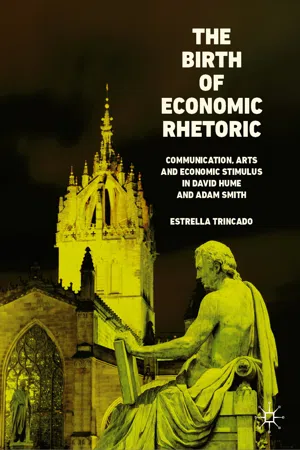
The Birth of Economic Rhetoric
Communication, Arts and Economic Stimulus in David Hume and Adam Smith
- English
- ePUB (mobile friendly)
- Available on iOS & Android
eBook - ePub
The Birth of Economic Rhetoric
Communication, Arts and Economic Stimulus in David Hume and Adam Smith
About this book
This book explores and compares the works of two great economists and philosophers, David Hume and Adam Smith, considering their contributions to language, perception, sympathy, reason, art and theatre to find a general theory of rationality and economics. The author considers and analyses both figures through a range of approaches, and moves on to demonstrate how different concepts of language affect Hume's and Smith's idea of value and economic growth. This book contributes to a wider literature on communication and language to demonstrate that economics is linked to rhetoric and is an essential part of human nature.
Information
Topic
EconomiaSubtopic
Econometria© The Author(s) 2019
Estrella TrincadoThe Birth of Economic Rhetorichttps://doi.org/10.1007/978-3-030-14306-0_11. The Setting of the Play
Estrella Trincado1
(1)
Facultad CC. Economicas y Empresariales, Complutense University of Madrid, Campus de Somosaguas, Pozuelo de Alarcón, Madrid, Spain
1.1 Introduction
This book deals with the Scottish Enlightenment in an innovative way, relating Rhetoric , rationality and economics . It contributes to the comparison between the theory of David Hume and Adam Smith and shows, against some recent scholarship, that interest lies more in the differences between Hume and Smith than in their similarities. The birth of economic rationality determines the roots of different rhetorical usages of economic science. Therefore, this chapter sets the scene in the Scottish Enlightenment and shows that authors from this period had different concepts of time , which meant that the newborn baby of Rhetoric had different growth paths. In Chapter 2, we analyse the friendship of Hume and Smith, pointing out the similarities between them, but also the differences, which implied long-term bonds and commitments. In particular, in their objective to revolutionize knowledge and faith, Hume and Smith displayed different literary strategies. These different strategies also led to dissimilar appraisals of religion and the exhibition of piety. In Chapter 3, we provide an interpretation of Hume’s thought, supplying an explanation for the more important elements that have traditionally defined his philosophy: his scepticism , his conservatism and his doctrine of utility . In Chapter 4, we prove that Adam Smith criticizes all of those theses presented by Hume: he was a realist and he gives a different definition of perception and pleasure, sympathy and rationality . Actually, Hume was describing “the mortal self ” of Smith, but for Smith the active, ever present self , is the principal actor of morality . In Chapter 5, we discuss Rhetoric and acknowledge differences also in the early formation of language , the basis for rationality . Then, literature , imitative arts and the theatre have different objectives in the theory of Hume and Adam Smith. Chapter 6 shows the consequences in economic theory of the different philosophies: the concept of time and language affect the objective of economic growth and also affect the instrument of money , blood and channel of production and growth . The book concludes with some important conclusions to be drawn on current philosophy. The comparison between these two great and fundamental philosophers, David Hume and Adam Smith , is a good setting for reconsidering the path the world will take in the future.
1.2 The Scottish Enlightenment
Recently, the dominant tendency has sought to connect Scottish thought of the eighteenth century with the general Enlightenment, particularly the French. A first group of pioneering historians such as G. Bryson, D. Forbes and H. Trevor-Roper introduced the expression the European Enlightenment movement.1 However, more recent studies have questioned the validity of such a reading. The existence of a Scottish Enlightenment with its own characteristics clearly distinguished from the French or British Enlightenment is now evident.2 As against the French Enlightenment, the Scottish Enlightenment broke with the a priori reason of the Middle Ages to go into the study of common sense and the common world, to individual perception instead of the perception of an Almighty and inapprehensible Creator of human existence.
In the opinion of Berry, Scotland was affected by the loss of the Scottish Parliament, as well as the loss of the capital in 1707 with the Act of the Union.3 Although the Scottish Parliament had decamped for London early in the century, Scotland remained the legal and ecclesiastical capital . Edinburgh was at the time one of the most cosmopolitan cities in all of Britain, boasting a rich cultural life and a group of prominent literati. This prompted the novelist Tobias Smollett to call it “a hot-bed of genius”. The Union brought times of peace, but the enlightened Scottish feared their disadvantageous position with respect to England. The concern of creating in Scotland a national character related and different from the dominant English culture led to the insistence on the need to stimulate everything that contributes to refinement in interpersonal and social relationships such as the creation of clubs and universities. The authentic heart of Scottish painting is shaped by the theoretical background developed by a heterogeneous group of authors known as Scottish literati (philosophers or moralists ): Francis Hutcheson , David Hume , Adam Smith and Adam Ferguson are some of the best-known characters, but no less significant are Hugh Blair , John Miller , William Robertson , Lord Kames (Henry Home) and poets and artists such as Robert Burns and Henry Raeburn .4
Robertson reinforces the sense of intellectual unity that, in his opinion, the Scottish Enlightenment movement has, which made “scientific” efforts in the fields of moral philosophy, historical narrative and “political economy”.5 One of the issues that most worried all those authors was the complex relationship between historical progress, economic or material, and the no less desirable moral improvement of the human being.6 From this relationship arise, in turn, certain paradoxical situations that must be accepted as they are the result of one’s own historical circumstances.
The field of moral philosophy was always one of the favourites of the Scottish philosophers of the eighteenth century. The key international figure is undoubtedly Francis Hutcheson , considered by Campbell to be the authentic “father” of the Scottish Enlightenment .7 One of the main problems addressed in common from the moral sphere—but also from different angles and with confrontations by authors such as Hutcheson , Hume and Smith—was the challenge of Mandeville’s provocative “cynicism” to the belief in innately benev...
Table of contents
- Cover
- Front Matter
- 1. The Setting of the Play
- 2. Hume and Smith, Truth and Experience
- 3. David Hume
- 4. Adam Smith
- 5. Rhetoric in Hume and Smith
- 6. Consequences on Economic Theory
- Back Matter
Trusted by 375,005 students
Access to over 1.5 million titles for a fair monthly price.
Study more efficiently using our study tools.
Frequently asked questions
Yes, you can cancel anytime from the Subscription tab in your account settings on the Perlego website. Your subscription will stay active until the end of your current billing period. Learn how to cancel your subscription
No, books cannot be downloaded as external files, such as PDFs, for use outside of Perlego. However, you can download books within the Perlego app for offline reading on mobile or tablet. Learn how to download books offline
Perlego offers two plans: Essential and Complete
- Essential is ideal for learners and professionals who enjoy exploring a wide range of subjects. Access the Essential Library with 800,000+ trusted titles and best-sellers across business, personal growth, and the humanities. Includes unlimited reading time and Standard Read Aloud voice.
- Complete: Perfect for advanced learners and researchers needing full, unrestricted access. Unlock 1.5M+ books across hundreds of subjects, including academic and specialized titles. The Complete Plan also includes advanced features like Premium Read Aloud and Research Assistant.
We are an online textbook subscription service, where you can get access to an entire online library for less than the price of a single book per month. With over 1.5 million books across 990+ topics, we’ve got you covered! Learn about our mission
Look out for the read-aloud symbol on your next book to see if you can listen to it. The read-aloud tool reads text aloud for you, highlighting the text as it is being read. You can pause it, speed it up and slow it down. Learn more about Read Aloud
Yes! You can use the Perlego app on both iOS and Android devices to read anytime, anywhere — even offline. Perfect for commutes or when you’re on the go.
Please note we cannot support devices running on iOS 13 and Android 7 or earlier. Learn more about using the app
Please note we cannot support devices running on iOS 13 and Android 7 or earlier. Learn more about using the app
Yes, you can access The Birth of Economic Rhetoric by Estrella Trincado in PDF and/or ePUB format, as well as other popular books in Economia & Econometria. We have over 1.5 million books available in our catalogue for you to explore.