Performing Intimacies with Hawthorne, Austen, Wharton, and George Eliot analyzes literary reproductions of everyday intimacies through a microsociological lens to demonstrate the value of reading microsocially. The text investigates the interplay between author, character, and reader and considers such concepts as face and moments of embarrassment to emphasize how art and life are inseparable. Drawing on narrative theory, the phenomenological approach, and macro approaches, Maya Higashi Wakana examines Hawthorne's "The Minister's Black Veil," Austen's Pride and Prejudice, Wharton's Ethan Frome and The Age of Innocence, and George Eliot's The Mill on the Floss. Through a multidisciplinary approach, this book provides new ways of reading the everyday in literature.
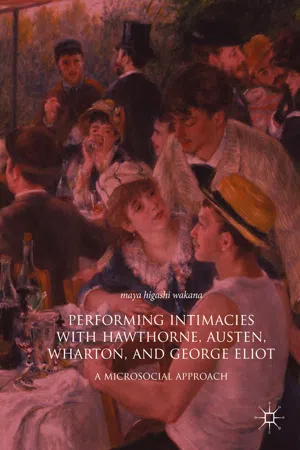
eBook - ePub
Performing Intimacies with Hawthorne, Austen, Wharton, and George Eliot
A Microsocial Approach
- English
- ePUB (mobile friendly)
- Available on iOS & Android
eBook - ePub
Performing Intimacies with Hawthorne, Austen, Wharton, and George Eliot
A Microsocial Approach
About this book
Information
© The Author(s) 2018
Maya Higashi WakanaPerforming Intimacies with Hawthorne, Austen, Wharton, and George Eliothttps://doi.org/10.1007/978-3-319-93991-9_11. Introduction: The Reader and Varieties of Intimacies
Maya Higashi Wakana1
(1)
Ritsumeikan University, Kyoto, Japan
I argue in this book for the value of reading microsocially. I demonstrate how adopting this approach in analyzing certain types of novels—namely those that fall under the umbrella of psychological realism—opens them up to intriguing, illuminating readings. By employing a perspective that microsociologist Erving Goffman (1922–1982) elaborates on in works such as The Presentation of Self in Everyday Life and Stigma: Notes on the Management of Spoiled Identity , I examine Nathaniel Hawthorne’s “The Minister’s Black Veil: A Parable,” Jane Austen’s Pride and Prejudice , Edith Wharton’s Ethan Frome and The Age of Innocence , and George Eliot’s The Mill on the Floss and show that despite scholars’ references to Goffman, theatricality, performance, and moments of embarrassment, and their ample focus on the “small” world of social interaction in these and other literary works, the articulation of the microsocial in reading literary texts has barely begun .
I focus in this book on the microsocial to elaborate on a heretofore-overlooked aspect of fictional meaning making, simultaneously offering new vocabulary with which to discuss what we often know only intuitively or miss altogether because of the obscuring familiarity. Being able to recognize the norm that requires individuals to respond in a backstage manner when they are accosted in a backstage tone, for example, contributes significantly to what can be perceived in literary reproductions of such norms exerting their inexorable influence on individuals—including on readers. In other words, my microsocial critical methodology and the thematic content of this book, the topics of this introductory chapter, are intertwined.
I am mostly interested in structures of interaction. As this book will illustrate, one particularly rich sphere of investigation in looking at them is that of personal intimacies, including romantic ones. However, I must assert from the outset that not all personal intimacies are cordial. Although knowledge of, and an accompanying sense of familiarity, closeness, and identification with, an object of intimacy invariably accompanies intimate relations, intimacy itself need not be warm or friendly.1 For one, identification with others tends to be an automatic response rather than an outcome of liking or similarity. For another, intimate understanding can be motivated by envy, suspicion, or dislike. As social thinker George Herbert Mead (1934) asserts, whenever individuals are face to face with one another, they instinctively “take the attitude of the other” (134) toward themselves to gauge how they appear to this other and fashion their responses accordingly. Such gestures, when repeated frequently, can generate a sense of intimately knowing an individual, which can be pleasing—or unpleasant, occasioning emotions such as jealousy, suspicion, or disgust. This phenomenon relates to the first reason I use the term “intimacies” in the plural. Using the term “intimacies” allows me to discuss people’s various close relationships—with friends, rivals, colleagues, lovers, nemeses, spouses, siblings—as “exhibit[ing] fuzzy, overlapping boundaries” (Cupach and Spitzberg 2004, 22), so that they might be aligned in a kind of existential continuum, irrespective of their formal classifications.
In viewing intimacies this way, I adopt philosopher Martha Craven Nussbaum’s (2001) understanding that “love, while an emotion, is also a relationship” (473; emphasis in original)—that is, social. In my microsocial view, however, emotion is also social and not merely a personal affect that flows outward from within. It is regulated by the requirements of one’s macro/microsocial position, the context of the interaction, one’s personal history, and the availability of a valid reason for feeling and then expressing the emotion. For example, in Eliot’s The Mill on the Floss , miller Luke Mogg’s dispassionate resignation to his lot, Prissy Jakin’s cheerful but shy submissiveness, and the small allowance stigmatized individuals such as hunchbacked Philip Wakem have to express their resentment or unhappiness tend to be considered unexceptional, even typical. Readers must empirically know, even if they are unable or unwilling to articulate the understanding, that emotions are not democratically distributed, as rhetorician Daniel M. Gross (2006) asserts: emotions are “markers of social distinction rather than … expressions of a human nature essentially shared by all” (178). The way in which passions, such as impatience, annoyance, and indignation, are methodically “hoarded and monopolized” by those who feel qualified to feel and then express them ultimately generates “selves of a certain sort” (126). This is likely true of those on the receiving end of such passions as well. And if an individual’s emotional response seems spontaneous, this is in all likelihood because it has become part of the individual’s stock of ready-made responses—like habit, which uses “previously formed sensory paths,” to borrow Kristie M. Allen’s (2010, 835) expression.
In short, while the requirements of one’s macro and microsocial position tend to prescribe one’s emotional responses, the expressive responses—or performances—reify one’s social identity. At this juncture, I need to clarify the use of the term “performance” in this book. Microsociologically, performances are not limited to dramatic, intended, or deceptive forms of display. Ostensibly natural or unconsciously displayed behavior is no less performative in “giv[ing]” or “giv[ing] off” impressions (Goffman 1959, 2; emphasis in original) that, regardless of intent, convey an individual’s claim to an identity, or what Goffman (1967) calls “face,” the “positive social values a person effectively claims for himself by the line others assume he has taken during a particular contact” (5). To modify philosopher Judith Butler’s (1990) definition of gender—“ gender is not a noun” but is instead “performatively produced and compelled by the regulatory practices of gender coherence” and is “always a doing, though not a doing by a subject who might be said to preexist the deed” (34; emphasis in original)— identity is similarly expressively produced and regulated by the requirements of identity coherence. As Goffman (1959) earlier asserted, “A status, a position, a social place is not a material thing, to be possessed and then displayed; it is a pattern of appropriate conduct, coherent, embellished, and well articulated” (75). With this, sociologist Candace West (1996) would agree, when she writes that men and women “‘[do]’ gender” and “power” (359).
A commitment to microsocial reading complements the pursuit of an understanding of literary works within a larger historical context, and vice versa. The microsocial face-to-face realm, however, has yet to be fully acknowledged and understood. As I explained elsewhere (Wakana 2009, 3; 8), the face-to-face sphere is regulated by tacitly shared rules that exist alongside those that govern hierarchical relations in the larger sphere. The microsocial sphere and the more “macro” sphere are not just extensions of one another. While power relations defined by such macrosocial factors as money, gender, and class influence face-to-face interaction processes,2 a separate set of microsocial norms that govern an interaction order “sui generis”—a term sociologist Ann Rawfield Rawls (1987) uses to describe Goffman’s microsociological model of society—can challenge or undermine those relations (136). And yet, as Goffman (1983) asserts, “To speak of the relatively autonomous forms of life in the interaction order … is not to put forward these forms as somehow prior, fundamental, or constitutive of the shape of macroscopic phenomena” (9). When individuals are viewed as existing in such a complex world, in real life and in imaginatively reproduced versions of it, they become the loci of frequently competing moral claims. Morality, explains sociologist Gregory W. H. Smith (2006), is “built right into the detail of interaction” (100) that is regulated by microsocial rules of civility, including everyday etiquette.
One such microsocial rule is individuals’ need to observe what Goffman (1967) calls the “rule of self-respect and the rule of considerateness” (11), which etiquette writers have discussed in modified form. In Letters of Advice to His Son, Philip Dormer Stanhope, better known as Lord Chesterfield ([1774] 1792), writes that speaking with a monarch should be as uncomplicated as speaking with a servant: “Were you to converse with a King, you ought to be as easy and unembarrassed as with your own valet de chamber: but yet every look, word, and action, should imply the utmost respect” (3:186); Arthur Martine ([1866] 1996) asserts that “even courtesy has limits where dignity should govern it, for when carried to excess, particularly in manner, it borders on sycophancy, which is almost as de...
Table of contents
- Cover
- Front Matter
- 1. Introduction: The Reader and Varieties of Intimacies
- 2. “Fitting in” and Hawthorne’s “The Minister’s Black Veil: A Parable”
- 3. Host–Guest Relationships in Austen’s Pride and Prejudice
- 4. “Working” Intimacies in Wharton’s Ethan Frome
- 5. The Gentleman in Wharton’s The Age of Innocence
- 6. Unconditional Love in George Eliot’s The Mill on the Floss
- 7. Conclusion: Art Makes Life, Which Makes Art, Which Makes Life
- Back Matter
Trusted by 375,005 students
Access to over 1.5 million titles for a fair monthly price.
Study more efficiently using our study tools.
Frequently asked questions
Yes, you can cancel anytime from the Subscription tab in your account settings on the Perlego website. Your subscription will stay active until the end of your current billing period. Learn how to cancel your subscription
No, books cannot be downloaded as external files, such as PDFs, for use outside of Perlego. However, you can download books within the Perlego app for offline reading on mobile or tablet. Learn how to download books offline
Perlego offers two plans: Essential and Complete
- Essential is ideal for learners and professionals who enjoy exploring a wide range of subjects. Access the Essential Library with 800,000+ trusted titles and best-sellers across business, personal growth, and the humanities. Includes unlimited reading time and Standard Read Aloud voice.
- Complete: Perfect for advanced learners and researchers needing full, unrestricted access. Unlock 1.5M+ books across hundreds of subjects, including academic and specialized titles. The Complete Plan also includes advanced features like Premium Read Aloud and Research Assistant.
We are an online textbook subscription service, where you can get access to an entire online library for less than the price of a single book per month. With over 1.5 million books across 990+ topics, we’ve got you covered! Learn about our mission
Look out for the read-aloud symbol on your next book to see if you can listen to it. The read-aloud tool reads text aloud for you, highlighting the text as it is being read. You can pause it, speed it up and slow it down. Learn more about Read Aloud
Yes! You can use the Perlego app on both iOS and Android devices to read anytime, anywhere — even offline. Perfect for commutes or when you’re on the go.
Please note we cannot support devices running on iOS 13 and Android 7 or earlier. Learn more about using the app
Please note we cannot support devices running on iOS 13 and Android 7 or earlier. Learn more about using the app
Yes, you can access Performing Intimacies with Hawthorne, Austen, Wharton, and George Eliot by Maya Higashi Wakana in PDF and/or ePUB format, as well as other popular books in Literature & Literary Criticism Theory. We have over 1.5 million books available in our catalogue for you to explore.