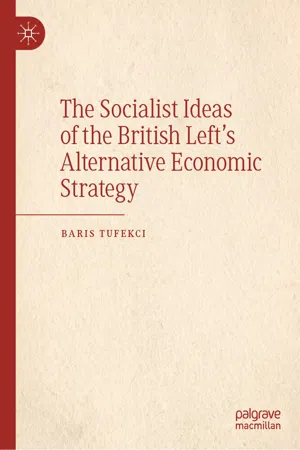
This book provides the first book-length study of the political and economic ideas of the British left's Alternative Economic Strategy in the 1970s and early 1980s. Discussing the AES's approaches to capitalism, the nation state and the working class, it argues that existing academic accounts have significantly overstated the radicalism of the strategy. Perhaps more notable, especially in the light of its stated 'revolutionary' aims, was the extent of its moderation – its continuities with post-war Labour revisionism, its marked reluctance to look beyond the market economy, the degree of its preoccupation with Britain's global-economic status, and its inability to break with Labourist politics of class co-operation in the national interest. While the book argues that the AES was the last 'class politics' socialist initiative in mainstream British politics, it also explores the ways in which its ideas perhaps prepared the way for New Labour in the 1990s, and its relationship with 'Corbynism' since 2015.
- English
- ePUB (mobile friendly)
- Available on iOS & Android
eBook - ePub
The Socialist Ideas of the British Left’s Alternative Economic Strategy
About this book
Information
© The Author(s) 2020
B. TufekciThe Socialist Ideas of the British Left’s Alternative Economic Strategyhttps://doi.org/10.1007/978-3-030-34998-1_11. Introduction: A New ‘Marketplace for Ideas’
Baris Tufekci1
(1)
Queen Mary University of London, London, UK
Keywords
Alternative Economic Strategy1970s britain‘Marketplace for ideas’, crisis of keynesianismFew periods in the Labour Party’s history intrigue the British political imagination more than the years leading up to the 1983 general election. Routinely characterised as a time when ownership of Labour fell into the hands of its hard left, the lasting impression has been one of a party signing its suicide note before an electorate increasingly bewildered by its ‘loony left’ excesses. As subsequent Labour leaders have come to appreciate, almost nothing is seen as more politically damaging than their association with the dismal memory of June 1983, when electoral disaster apparently succeeded a progressive, decade-long over-indulgence in left-wing nostrums. For many on the Conservative right, meanwhile, Labour policies which deviate from the ‘pro-market’ New Labour approach established since the 1990s—particularly with regard to public ownership—are to be condemned as threats to take Britain ‘back to the 1970s’, to a time of crisis and uncertainty seen as a direct consequence of a socialist mismanagement in government.1
Among some sections of the left, however, an alternative narrative has also emerged, defending aspects of the Labour left’s agenda in those years as viable responses to economic crisis. One account endorses the Labour left’s economic strategy, points to Tony Benn’s ‘crucial and at times heroic role’ in challenging the ‘British establishment’, upholds Labour’s ‘social contract’ and the union leaders’ role in maintaining it, while commending the self-restraint shown by British workers in the face of capitalist crisis.2 Other commentators have also sought to ‘revisit’ Labour’s 1970s strategy in favourable terms3; and, with the rise of Labour’s Jeremy Corbyn in 2015, ‘Old Labour, not New Labour’ appears to have become a slogan among those on the British left seeking to recapture some of the radicalism in Labour’s politics in the 1970s and early 1980s.4 Indeed, with ‘Corbynism’, the politics of that period have been presented as something of a benchmark, a standard of Labour-left radicalism against which to measure the radicalism of Corbyn’s agenda.
While the Labour left’s politics of the 1970s and early 1980s expressed support for a variety of causes—feminism, anti-racism, anti-militarism, unilateral nuclear disarmament—at the heart of its agenda was the Alternative Economic Strategy (AES), its programme of economic reforms that informed the Labour Party’s official economic platform between 1973 and 1983. With support and input from the Communist Party of Great Britain, left-wing trade-union leaders, left-wing economists and sections of the New Left, the AES was the rallying point for the bulk of British socialism. Demanding economic reflation, import controls, price controls, public ownership in profitable firms and sectors, compulsory planning agreements, industrial democracy and a withdrawal from the European Economic Community (EEC), the AES presented itself as a radical and, at times, even a revolutionary response to the deep crisis of British capitalism. This self-justification by the AES, at the level of its policy and rhetoric, has played an important role in the Labour left’s subsequent representation as a radical force in this period of Britain’s post-war history—by political lore, the contemporary left and, as discussed below, the academic literature.
The aim of this book, therefore, is to determine the extent to which the AES has been mischaracterised. Focusing on the political and theoretical ideas of the strategy, it questions the predominant view in the academic literature that the AES represented a radical left-wing break with the moderate, revisionist politics that dominated Labour’s approach in the two decades after the Second World War. Locating the rise of the AES in its historical context, it examines the political ideas with which the prominent proponents of the AES responded to Britain’s economic crisis and the concurrent breakdown of the post-war ‘Keynesian consensus’. It aims to show that the AES was characterised by a high degree of involvement with radical left-wing ideas, and that several of its key advocates sought to justify their strategy through the language and theoretical frameworks of Marxist theory. However, through an examination of AES approaches to socialist strategy, the capitalist economy, Britain’s economic decline and the rise of class conflict, the book also argues that existing academic accounts have significantly overstated the radicalism of the strategy. What was perhaps more notable about the AES, especially in the light of its stated ‘revolutionary’ aims, was the extent of its moderation—its continuities with post-war Labour revisionism, its marked reluctance to look beyond the market economy, the degree of its preoccupation with Britain’s global-economic status, and its inability to break with Labourist politics of class co-operation in the national interest. While the book will argue that the AES was the last mainstream political strategy in Britain identifiable as a ‘class politics’ socialist initiative, it will also point to some of the ways in which its ideas perhaps prepared the way for New Labour in the 1990s.
Prominent Academic Views on the AES
The academic literature has tended to emphasise the left-wing radicalism of the AES. According to Tomlinson, the AES ‘represented a violent break with the whole of post-war British approaches to economic policy’.5 Seyd argues along similar lines: the 1970s saw a ‘radical rethinking of the Party’s previous commitments’.6 Thompson argues that the AES ‘represented, au fond, a fundamental challenge to the ethos, principles and practice of capitalism’,7 and that ‘the overarching macroeconomic rationale of Keynesian social democracy came in for a severe pounding from the [AES] Left’.8 According to Shaw, Labour’s 1983, AES-derived general-election manifesto was ‘highly ambitious’ and ‘stuffed with left-wing ideas’.9 For Panitch and Leys, the AES marked an attempt to break with Labourist tradition: it wanted to ‘pull the party out of the failed patterns of its past behaviour’, and its development belonged to ‘a broader attempt on the part of a remarkably creative British Marxist left…to transcend the limits of both Labourist parliamentarism and Trotskyist and Leninist vanguardism’.10 According to Cronin, Labour’s 1973 party programme ‘made clear the new, or recently clarified, polarisation of British politics and called for a dramatic shift of power and wealth to working people and a major expansion of public ownership’.11 Although the arguments regarding the radicalism of the AES are often qualified, an underlying message has been that it represented a highly significant shift leftward in the Labour Party during the 1970s and early 1980s. As Jones argues, it ‘amounted to a clear repudiation of a revisionist social-democratic approach to economic strategy’.12
An important work on the AES, its book-length study by Wickham-Jones, calls it an ‘extremely radical’ strategy.13 While the AES policy of reflation was ‘conventional’, Wickham-Jones argues, its policies of public ownership, economic planning, price controls, industrial democracy and import controls were original, radical and innovative.14 For Wickham-Jones, the radical nature of the AES is evidenced by what he sees as its Marxist foundations:
The main theoretical influence for the argument about monopolisation was not Keynesian economics but Marxist in orientation. Elements of the theory such as the focus on the concentrated structure of the economy, the pressure on firms to maximise profits, and the role of classes and class conflict drew on Marxist economic analysis. It was not an orthodox Marxism but one which stressed the monopolistic nature of capitalism.15
The party’s understanding of ‘economic developments owed more to Marx than Keynes’.16 Labour ‘jettisoned the Keynesian social democracy’ which had previously characterised its economic strategy, for an economic theory based on a ‘modified Marxism’.17 Together with his association of the AES with Marxism, Wickham-Jones places it outside the reformist tradition. The AES was ‘far removed’ in its content and objectives from Labour’s previous policy pronouncements, going beyond the ‘moderation of reform...
Table of contents
- Cover
- Front Matter
- 1. Introduction: A New ‘Marketplace for Ideas’
- 2. Class and Party: The Historical Context of the Rise of the AES
- 3. Reform or Revolution: The AES as Socialist Strategy
- 4. Planning the Market: The AES and Capitalism
- 5. A Britain Oppressed: The AES and the Nation
- 6. Class Conflict and Class Collaboration: The AES and the Working Class
- 7. Conclusion: The AES, New Times and the Death of British Socialism
- Correction to: The Socialist Ideas of the British Left’s Alternative Economic Strategy
- Back Matter
Trusted by 375,005 students
Access to over 1.5 million titles for a fair monthly price.
Study more efficiently using our study tools.
Frequently asked questions
Yes, you can cancel anytime from the Subscription tab in your account settings on the Perlego website. Your subscription will stay active until the end of your current billing period. Learn how to cancel your subscription
No, books cannot be downloaded as external files, such as PDFs, for use outside of Perlego. However, you can download books within the Perlego app for offline reading on mobile or tablet. Learn how to download books offline
We are an online textbook subscription service, where you can get access to an entire online library for less than the price of a single book per month. With over 1.5 million books across 990+ topics, we’ve got you covered! Learn about our mission
Look out for the read-aloud symbol on your next book to see if you can listen to it. The read-aloud tool reads text aloud for you, highlighting the text as it is being read. You can pause it, speed it up and slow it down. Learn more about Read Aloud
Yes! You can use the Perlego app on both iOS and Android devices to read anytime, anywhere — even offline. Perfect for commutes or when you’re on the go.
Please note we cannot support devices running on iOS 13 and Android 7 or earlier. Learn more about using the app
Please note we cannot support devices running on iOS 13 and Android 7 or earlier. Learn more about using the app
Yes, you can access The Socialist Ideas of the British Left’s Alternative Economic Strategy by Baris Tufekci in PDF and/or ePUB format, as well as other popular books in Politics & International Relations & Modern History. We have over 1.5 million books available in our catalogue for you to explore.