- addresses a large gap in the marketplace by engaging with European iterations of science fiction
- links the EU–a body born of utopian ideals in response to the dystopian realities of WWII–with science fiction–a genre that thrives upon depicting such extremes
- places particular emphasis on the genre's propensity to reflect, exploit and comment upon popular political and cultural anxieties
- English
- ePUB (mobile friendly)
- Available on iOS & Android
eBook - ePub
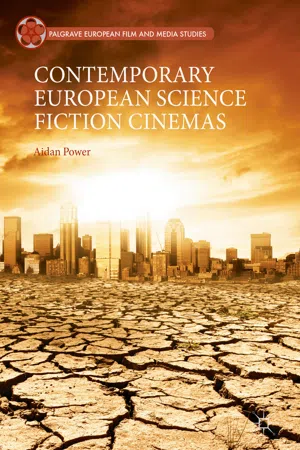
Contemporary European Science Fiction Cinemas
About this book
Information
Subtopic
Film & Video© The Author(s) 2018
Aidan PowerContemporary European Science Fiction CinemasPalgrave European Film and Media Studieshttps://doi.org/10.1007/978-3-319-89827-8_11. Introduction: A Dream Called Rome
Aidan Power1
(1)
University College Cork, Cork, Ireland
Aidan Power
On the face of it, beginning with a prominent British Conservative leader’s thoughts about European integration and the uncertain future that lies in store for Europeans may appear incongruous. After all, since David Cameron bowed to internal pressures and called a referendum on continued British European Union membership in May 2015, we have been assailed by the views of a host of Tory politicians, the most voluble of whom seem to have concluded that Europe, as we know it, is over: a view that a democratic majority of Britons ultimately endorsed. Yet, it wasn’t always so. Speaking at the University of Zurich in 1946 during the immediate aftermath of the Second World War, Winston Churchill pondered the plight of Europe, noting that while ‘some of the smaller states have indeed made a good recovery […] over wide areas are a vast, quivering mass of tormented, hungry, careworn and bewildered human beings, who wait in the ruins of their cities and homes and scan the dark horizons for the approach of some new form of tyranny or terror,’ adding apocalyptically that the ‘Dark Ages could have returned in all their cruelty and squalor,’ before allowing that they ‘they may still return’ (Greenwood, Britain and European Integration Since the Second World War 25). Having just concluded the 60th anniversary year of the signing of the Treaty of Rome, the dream of European integration is becoming ever more precarious , with the UK’s future withdrawal from the European Union (EU) and manifold spikes in nationalist sentiment across the continent threatening to shatter an institution that, for all its lofty aims, has in recent years been successfully painted as remote and technocratic by its detractors, often with not inconsiderable justification. Further afield, 2017’s candidature for annus horribilis status was well under way by mid-January when Donald Trump was sworn in as the 45th US president. His subsequent dealings with minorities, women, and international affairs, his repudiation of climate change, not to mention his deliberate blurring of fact and fiction under the rubric of ‘fake news’, have flattened distinctions between politics and science fiction (sf), with more than one commentator drawing parallels with Charles Lindbergh’s unlikely rise to the presidency in Philip Roth’s 2004 novel The Plot Against America.1
Sf will take centre stage in this book and will be a lens through which I will seek to engage some of the most pressing issues to assail Europe since the turn of the millennium. A genre that in Claudia Springer’s words has ‘been instrumental in visualizing and narrativizing the qualities associated with postmodernism: disorientation, powerlessness, fragmentation, disintegration, loss of boundaries, and hybridization’ (‘Psycho-Cybernetics in Films of the 1990s’ 205), sf film is uniquely positioned to shed light on, critique, and offer alternatives to the paths followed by modern-day Europe; ergo, we should not be surprised that the genre has undergone a major resurgence across the EU since the year 2000. It is this phenomenon that I wish to track, for, although sf has existed on European screens since before Georges Méliès’ A Trip to the Moon/Le voyage dans la lune in 1902,2 it has all too frequently been overlooked, particularly as a Europe-wide entity. This study’s novelty stems firstly from such an absence and, secondly, from a desire to analyse not just sf films but also the industries that sustain them, more of which anon. To begin with, some perspective is called for, and we would do well to remember that, bleak as things may seem in twenty-first-century Europe, the continent has endured worse, as the spectre of Winston Churchill reminds us. By the time of his Zurich address, Churchill was no longer Prime Minister, having seen the Conservatives roundly defeated by the Clement Attlee-led Labour Party in the 1945 General Election. Free from the day-to-day responsibilities of power, he felt suitably liberated to push for greater European integration and, in particular, the need for a rapprochement between Germany and France. In a notable departure from the rhetoric of his modern contemporaries in the Tory Party, Churchill stressed the need to ‘re-create the European family’ and to build ‘a kind of United States of Europe’, a term he had first used in an article for the American Saturday Evening Post in 1930 (Morrissey, Churchill and de Gaulle: The Geopolitics of Liberty 96). The need to do something was urgent. As the sheer scale of the barbarism of National Socialism began to fully sink in, and with Europe’s major cities in ruins, new ideas were clearly required, especially with the Soviet Union intent on drawing the Iron Curtain down across the continent’s Eastern flank. Within five years, the first major steps towards post-war European integration were taken, with the Schuman Declaration calling for closer ties between the French and German coal and steel industries in 1950, followed by the signing of the Treaty of Paris in 1951 by Belgium, France, Italy, Luxembourg, the Netherlands, and West Germany, which created the European Coal and Steel Community (ECSC). In 1957, the same six nations signed the Treaty of Rome (or the treaty establishing the European Economic Community (EEC), to give it its full name) and in so doing brought the EU’s forebear, the EEC, into being. In broad terms, the treaty sought to foster economic integration, paving the way for a single European market for capital and labour. This, in turn, it was hoped, would further sustain the economic revival of post-war Europe, a concerted process fuelled in part by the calculated largesse of the Marshall Plan. From political and security standpoints, instead, the establishment of the EEC was both vital and indelibly linked to the fallout from the Second World War. The clue here is in the Treaty of Rome’s initial signatories: former Axis Partners West Germany and Italy; France, which was first occupied by the Nazis and was later the staging post for the D-Day Landings; and the geographically prone Benelux nations, all three of which were occupied by the Nazis following a simultaneous Wehrmacht invasion on 10 May 1940.3 In providing a supranational body, the edicts of which would be tempered by consensus, the EEC was a huge fillip to beleaguered nation states; yet at the same time, it was carefully calibrated to curb nationalistic excess. In his speech, Churchill had pushed for a ‘third way’ that would allow for the plotting of a course between the Soviets and the United States and, while time-worn colonialist hubris coloured his vision of the role he saw Britain playing in this new Europe,4 at a minimum closer integration offered the possibility of safety in numbers for individually vulnerable nations. Concerns over internal balances remain to this day, playing a large part in the narratives surrounding Brexit, for example; yet in broad terms, the EU has generally succeeded in providing a united security front that, for all the fudges and compromises required, provides assurance to its member states. Sixty years of relative peace bears this out and has been perhaps the crowning achievement of the European project, a core legacy worthy of celebration in and of itself, if we pause to consider the geopolitical landscape of Europe only four years prior to Churchill’s Zurich address.5 By September 1942, at the apex of the Nazi advancement, the Third Reich’s sphere of influence stretched from French Morocco to the south-west of Europe to the continent’s outermost northern edges where the tip of Norway meets the Barents Sea. Westward, the Nazi empire extended to the French island of Ouessant off the Brittany coast, while to the East it encompassed the puppet states of Bulgaria and Romania, as well as Belarus and large tracts of Ukraine. Although precise figures are contested, the eminent British historian Ian Kershaw estimates that at least 50 million people died during the war6: while the Nazis’ ‘treatment of the people of the newly conquered territory was unprecedented, its modern forms of barbarism evoking, though in even more terrible fashion, the worst barbaric subjugations of bygone centuries’ (Hitler 1,070). When contemplating the post-war drive for European integration, then, we do so in the knowledge that the EEC and latterly the EU’s aims were shaped indelibly by the dystopian horrors of the Second World War.
A Pragmatic Utopia
When first sketching the contours of this project in Bremen in 2013, I was struck not just by the science fictional nature of the financial crisis in the EU but also by the seemingly utopian ideals at the heart of European integration, ideals that were geared towards fostering cross-border collaboration in place of animus. To be cynical, one could posit that, at a minimum, the pursuance of closer ties recalibrated the contours of national self-interest sufficiently, so that finding mutually beneficial solutions to adversity would in time appear more efficacious to nation states. This in turn necessitated a rethinking of the outright primacy of the nation state, a requirement that a weary post-war Europe was suitably malleable to. In a development that was not without irony, extreme nationalism ultimately begat the conditions necessary for a flowering of transnational constellations to occur in opposition. As Richard Collins writes:
Allowing that ‘utopian proposals for European union may be found as far back as the seventeenth century (and perhaps earlier)’,7 Collins emphasises that ‘it was the disaster of the Second World War which stimulated many Europeans to take practical steps to realise what had hitherto been only a fantasy’ (Satellite 174). The lingering nightmare of totalitarianism expedited this process, with the Allies’ victory serving, in Jürgen Habermas’ words, to undermine ‘the foundations of all forms of political legitimation that did not—at least verbally, at least in words—subscribe to the universalist spirit of political enlightenment’ (Postnational Constellation 46). These practical steps included the establishment of a unique su...Just as the mass slaughter of the First World War stimulated a reconstruction of Europe on the nationalist lines prescribed by the Sèvres and Versailles Treaties, so the mass slaughter of the Second World War, perceived to have grown from the poisoned soil of the nationalist vision of Versailles stimulated European reconstruction: this time on transnational, pan-European lines. (Satellite to Single Market 174)
Table of contents
- Cover
- Front Matter
- Part I. Where Is Europe? National and European Science Fiction
- Part II. Contagion! Responding to the Financial Crisis
- Part III. Shut the Gates! Scorched Earth, Fortress Continent
- Part IV. Another Planet: Hollywood SF Production in Europe
- Part V. Beyond Europe?
- Back Matter
Trusted by 375,005 students
Access to over 1.5 million titles for a fair monthly price.
Study more efficiently using our study tools.
Frequently asked questions
Yes, you can cancel anytime from the Subscription tab in your account settings on the Perlego website. Your subscription will stay active until the end of your current billing period. Learn how to cancel your subscription
No, books cannot be downloaded as external files, such as PDFs, for use outside of Perlego. However, you can download books within the Perlego app for offline reading on mobile or tablet. Learn how to download books offline
Perlego offers two plans: Essential and Complete
- Essential is ideal for learners and professionals who enjoy exploring a wide range of subjects. Access the Essential Library with 800,000+ trusted titles and best-sellers across business, personal growth, and the humanities. Includes unlimited reading time and Standard Read Aloud voice.
- Complete: Perfect for advanced learners and researchers needing full, unrestricted access. Unlock 1.5M+ books across hundreds of subjects, including academic and specialized titles. The Complete Plan also includes advanced features like Premium Read Aloud and Research Assistant.
We are an online textbook subscription service, where you can get access to an entire online library for less than the price of a single book per month. With over 1.5 million books across 990+ topics, we’ve got you covered! Learn about our mission
Look out for the read-aloud symbol on your next book to see if you can listen to it. The read-aloud tool reads text aloud for you, highlighting the text as it is being read. You can pause it, speed it up and slow it down. Learn more about Read Aloud
Yes! You can use the Perlego app on both iOS and Android devices to read anytime, anywhere — even offline. Perfect for commutes or when you’re on the go.
Please note we cannot support devices running on iOS 13 and Android 7 or earlier. Learn more about using the app
Please note we cannot support devices running on iOS 13 and Android 7 or earlier. Learn more about using the app
Yes, you can access Contemporary European Science Fiction Cinemas by Aidan Power in PDF and/or ePUB format, as well as other popular books in Media & Performing Arts & Film & Video. We have over 1.5 million books available in our catalogue for you to explore.